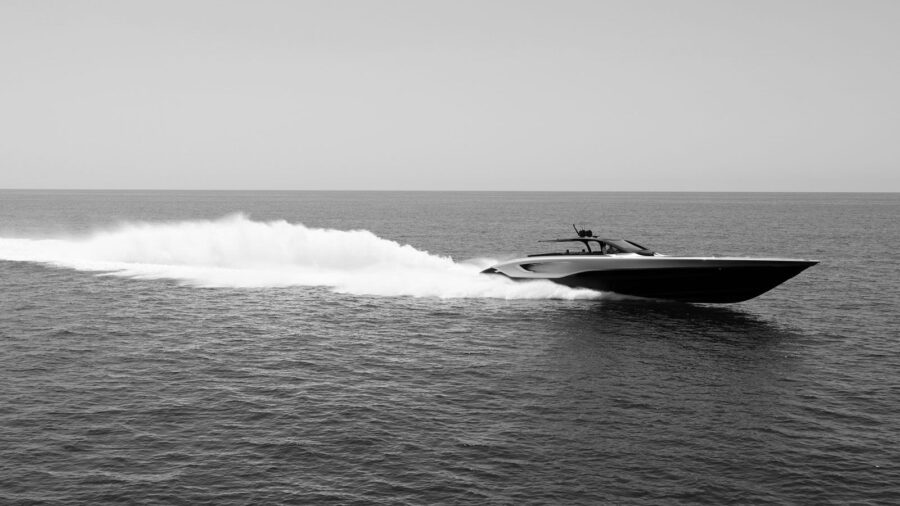
Thanks to the development of projects such as E1 RaceBird hydrofoils and experimental platforms like Kormoran, foils are experiencing a strong revival. Carbon fiber structures, FEM analysis, and CFD tools have enabled a new generation of high-performance vessels, redefining efficiency and stability in both recreational and competitive boating.
A key topic in the discussion is the distinction between fully submerged, semi-submerged, and secant foil configurations, with particular attention to secant hydrofoil design. According to Acampora, these solutions offer greater stability without the need for electronic control systems, opening the door to simpler and potentially more robust architectures.
One of the main challenges in modern foil development remains cavitation control and the transition between hydrodynamic regimes. Traditional subcavitating profiles, widely used today, are increasingly questioned due to their limitations in real-world conditions. Factors such as ventilation, surface contamination, and flow separation play a critical role in performance degradation.
This leads to a broader reflection on advanced hydrofoil design and CFD limitations, where simulation tools still struggle to fully replicate complex, dynamic marine environments. As a result, design often remains conservative, relying on well-established NACA-based profiles rather than exploring more radical solutions.
Historical references, from Russian Meteor hydrofoils to early Italian experiments, highlight how past engineering approaches may offer valuable insights for future development. Concepts such as controlled ventilation, transitional lift regimes, and multi-speed performance envelopes are returning to the center of research.
The conversation also extends to materials, where there is a growing debate between carbon fiber and metallic solutions. While carbon remains dominant, alternative approaches using aluminum, steel, and titanium alloys are being reconsidered for next-generation hydrofoil materials due to durability, cost, and manufacturability.
Finally, the integration of AI and CFD is expected to play a decisive role in accelerating innovation. Iterative design processes supported by artificial intelligence could redefine how high-performance marine foils are conceived, tested, and optimized.