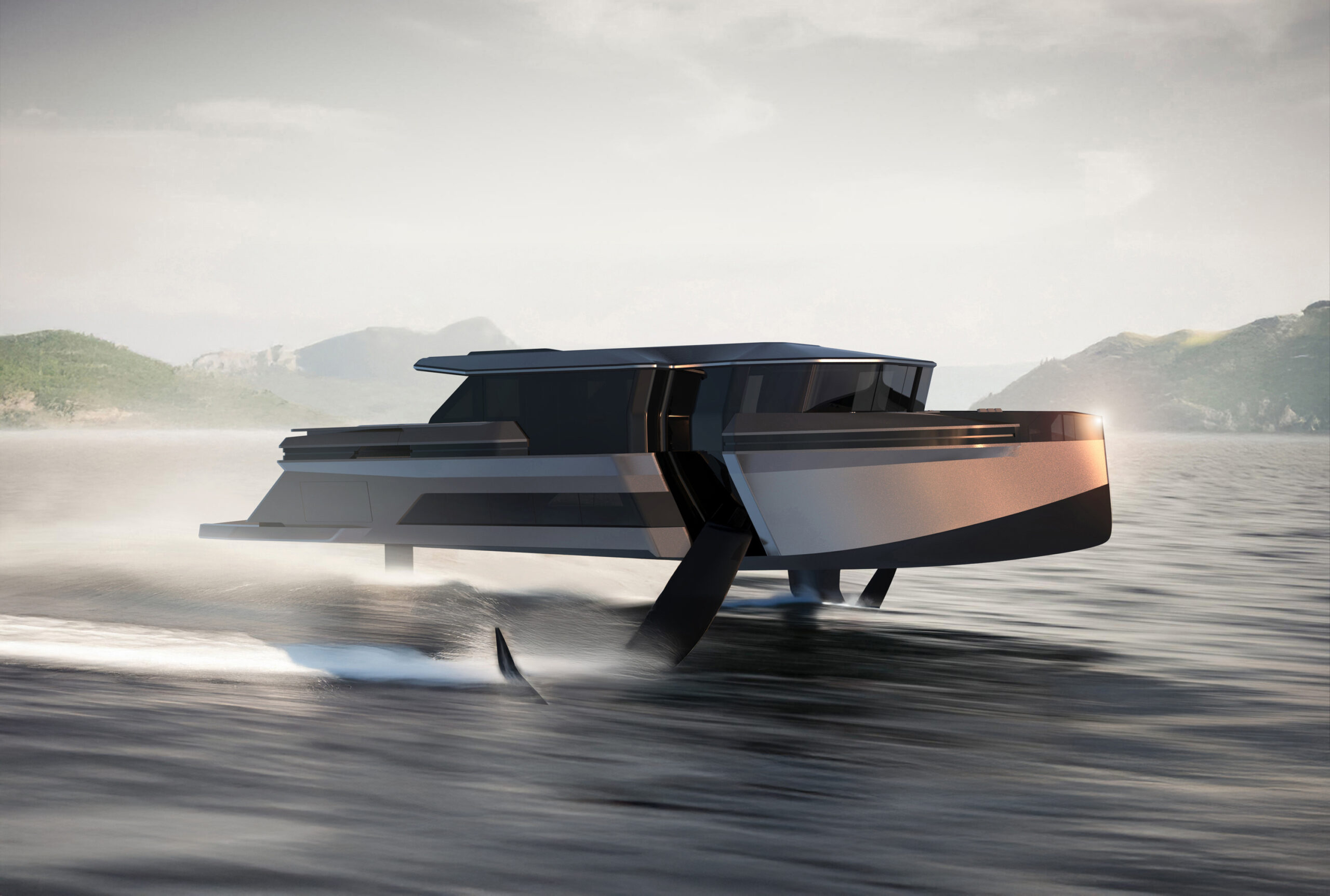
ENATA Group is a Dubai-headquartered composite engineering and manufacturing company with interests spanning advanced materials and marine platforms. Its yacht brand, Foiler, entered the market with Spirit – a 10-m hydrofoiling vessel that established proof of concept for privately-owned foiling yachts at a production level. Ghost, the latest model in the Foiler range, scales that proposition to 28 m: a step change in technical complexity that required a substantially more demanding engineering programme. The result is a Foiling Yacht conceived not simply as a one-off project, but as the basis for a new production proposition.
The build timeline
The announcement was made at the Abu Dhabi International Boat Show in November 2025, with the design developed in collaboration with Istanbul-based Bozca Design. ENATA has indicated that a new production facility near Abu Dhabi is planned to support the Foiler range, and that the first Ghost would be built there. The stated target date for the first launch is 2029, though this projection was made before the current deterioration in regional and global trade conditions. Supply chain disruptions, material cost volatility, and geopolitical instability in the Gulf region are all factors that could bear on the build timeline. At this stage, 2029 should be read as a working target rather than a contractual commitment.
Foil engineering
The technical core of Ghost is ENATA’s proprietary Foiling System, developed as a scaled evolution of the architecture already in service on Spirit. The hull is built entirely from carbon fibre and titanium, a pairing selected to control displacement while maintaining the structural integrity required under foiling loads. The foil package was developed with input from engineers who have worked on state-of-the-art appendage design, covering lift curve management, cavitation behaviour, and the active control systems that stabilise the yacht in flight.
Performance data
Performance figures published by ENATA put cruising speed in foiling mode at 30-35 knots, with a declared maximum above 40 knots. When deployed, the foils extend the beam from 8 m to approximately 20 m, providing lateral stability in operating sea states. Hull clearance in flight is approximately 2 m. Fuel consumption is projected at 40–50% below a conventional planing hull of equivalent length.
“At 40 knots, passengers can move freely, speak in hushed tones, and enjoy a completely smooth, stable ride – something unimaginable on a conventional yacht. Ghost takes this comfort and serenity to a whole new scale” says Alois Vieujot, CEO, ENATA Group.
Solar array and propulsion architecture
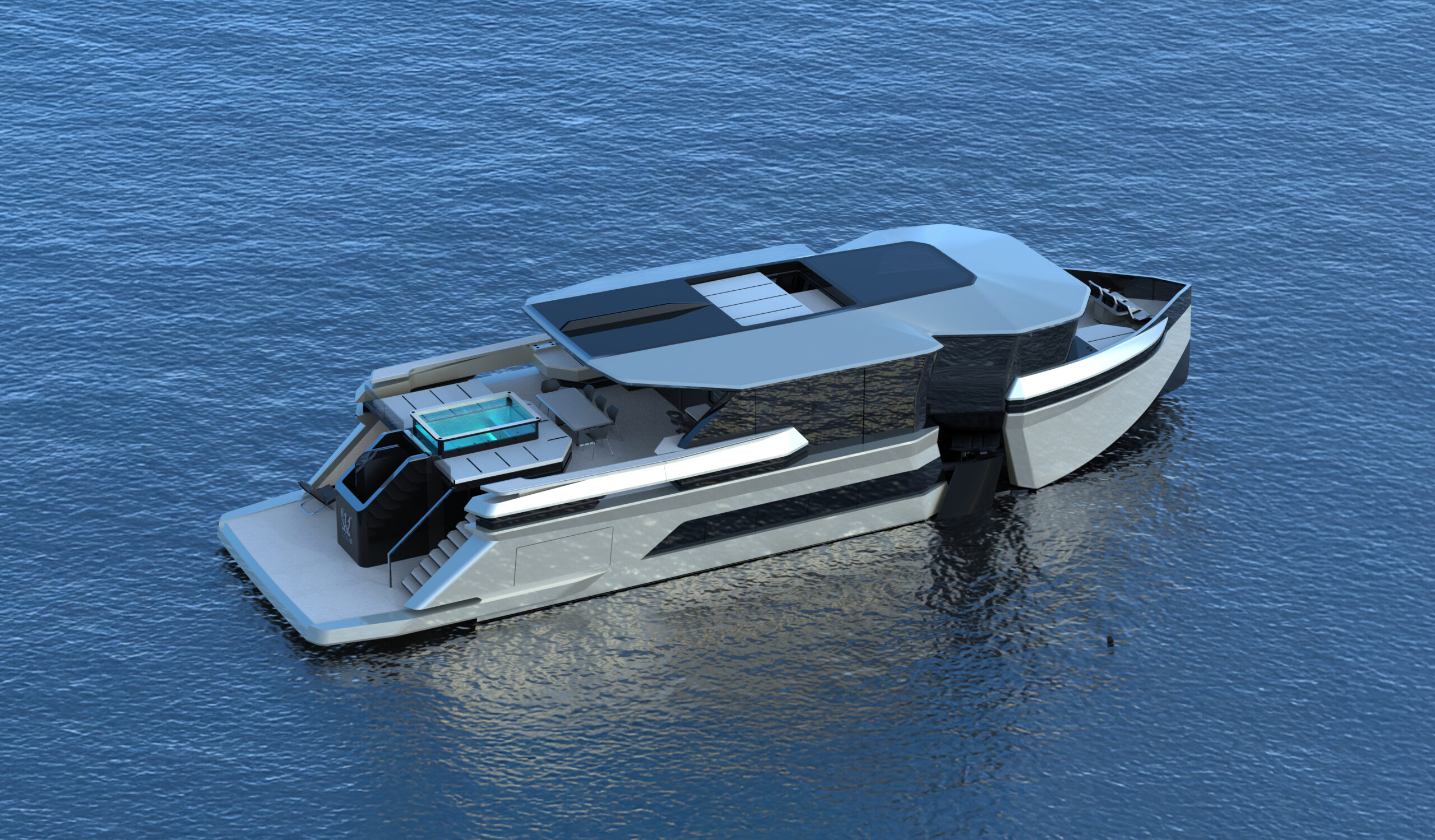
Ghost carries high-efficiency solar panels across the near-complete surface of the superstructure roof. In functional terms, the primary benefit is a reduction in generator dependency during foiling and at anchor, which supports the quiet operation that ENATA lists as a design objective. The arrangement also extends range and reduces reliance on shore power during extended cruising – a practical consideration for operators in areas with limited marina infrastructure.
The broader propulsion architecture has not been disclosed in detail at this stage. What is confirmed is that the combination of reduced hydrodynamic drag in foiling mode, together with the solar contribution to hotel load, is central to the efficiency claims.
Layout and owner-operator handling
The interior volume made available by Ghost’s full-beam superstructure is one of the more practically significant aspects of the specification. Total living space is quoted at 185 sq.m – 133 sq.m of primary interior exclusive of cabins, and 52 sq.m of exterior deck – across a layout that accommodates three to five cabins and a beach club aft with direct water access. The vessel is designed to remain within pleasure craft registration throughout.
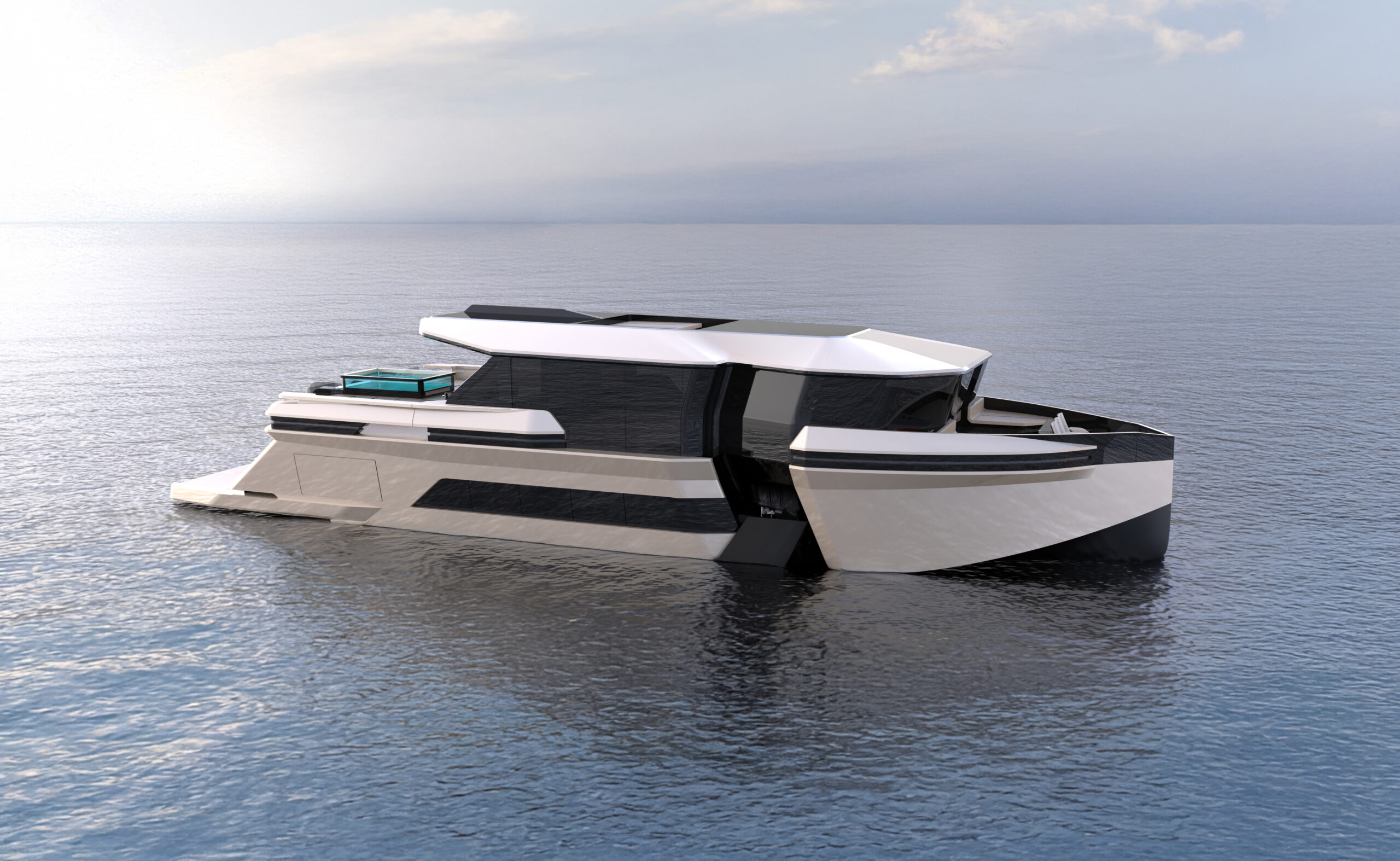
Bozca Design’s exterior treatment follows a coherent structural logic: continuous longitudinal lines, an angular superstructure, and a silhouette with clear directionality. The interior works against this with warmer materials and floor-to-ceiling glazing along the full saloon length. Handling is designed around a joystick system and front-seat configuration that allows principal operation without professional crew – consistent with the approach established on Spirit and a stated priority for the Foiler range.
“Every structural and aesthetic decision is made with intention. There are not decorative elements, only forms that serve performance, reliability, and clarity” comments Timur Bozca, Head of Bozca Design.
Production model and market context
The decision to pursue Serial Production Yacht at this scale and performance level is the element of the Ghost programme that carries the broadest implications for the market. ENATA’s approach – developing a semi-customisable platform with a dedicated manufacturing base rather than treating each hull as a bespoke commission – is intended to give Ghost advantages in pricing consistency and after-sales infrastructure that one-off superyacht builds cannot offer.
The Foiler brand has the advantage of a delivered, operating product in Spirit: prospective buyers and their technical advisors can evaluate a platform that has been built and used, not only rendered. Drawing on top-notch hydrodynamic expertise, Ghost’s foil technology will represent a meaningful step beyond what Spirit demonstrated.