Let’s have a look at the new edition of Nautica in Cifre – LOG, the only officially recognised statistical report in the sector. The figures show that Italy’s yachting industry is to reach record revenues in 2024, underlining the continuing strength of luxury yacht manufacturing in Europe.
On 17 September, on the eve of the 65th Genoa International Boat Show, the Forum Hall of the Blue Pavilion hosted one of the most eagerly awaited events: the presentation of the new Boating Economic Forecast, with updated figures for the Italian recreational boating industry.
At the heart of the conference was the new edition of Nautica in Cifre – LOG, the only officially recognised statistical report in the sector, produced by the Research Department of Confindustria Nautica in collaboration with the Fondazione Edison. The event confirmed the double vocation of the Genoa Boat Show: not only a global showcase for new products, but also a strategic platform for assessing the state of the industry and outlining its future prospects, consolidating the position of Italian yachting as one of the crown jewels of national manufacturing and a reference in global yacht exports.

2024: record turnover
The figures are clear: a total turnover of €8.60 billion in 2024, +3.2% compared to the previous year. This result marks the consolidation of an unprecedented growth cycle that has seen the sector double in size in just four years since the post-pandemic recovery.
“The 2024 results for the recreational marine industry are positive: the sector’s turnover has grown by 3.2%, reaching an all-time high of €8.60 billion,” said Piero Formenti, President of Confindustria Nautica. “Growth has been driven by the high-end segment and superyacht shipbuilding, which continue to lead the world market, while small boatbuilders have seen a decline of around -10%. The difficulties in this segment are due to a combination of factors, including excess inventory in certain markets, rising geopolitical tensions, weaker consumer confidence and a domestic regulatory framework that is still burdened by bureaucracy.”
The picture that emerges is of a resilient but polarised sector, with large yachts and luxury shipyards driving growth, while smaller boatbuilders face structural and cyclical headwinds.
Exports, the lifeblood of the industry
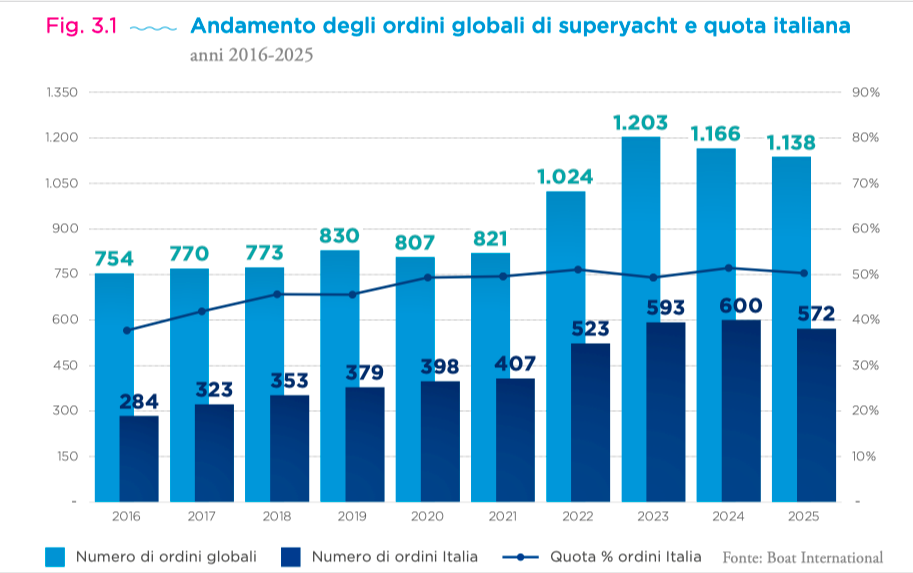
Among the main growth drivers, export performance once again stands out: 70.3 % of total turnover (around €6.05 billion) was generated abroad, compared to a domestic market worth €2.55 billion (29.7 %). The most significant figure comes from new buildings: 89 % of the units produced in Italy are delivered to international clients, consolidating the country’s leadership in global yacht and boatbuilding.
“In 2024, Italy confirmed its position as the world’s leading exporter in the recreational boatbuilding industry,” emphasised Marco Fortis, Director and Vice President of Fondazione Edison. “Exports of ‘pleasure and sports boats’ exceeded €4.3 billion (+7.5% compared to 2023), with an export propensity of around 90% of domestic production. The US remains a key market – especially for boats under 24 m – although tariff uncertainties have affected orders. This highlights the need to diversify export destinations and use international boat shows as business platforms and gateways for new partnerships, reinforcing the strategy of transatlantic marine trade.”
Superyachts: Italy accounts for half the world
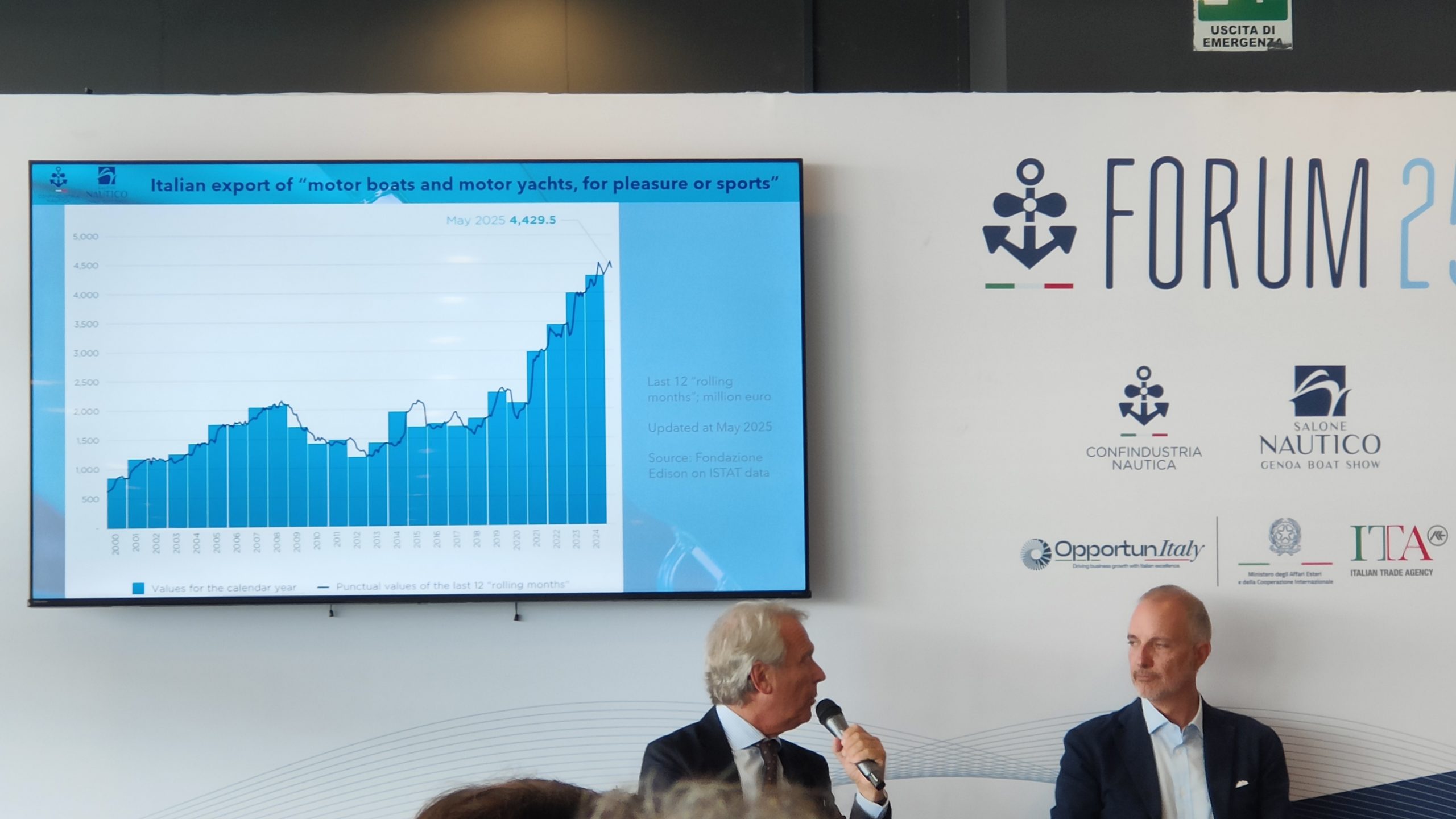
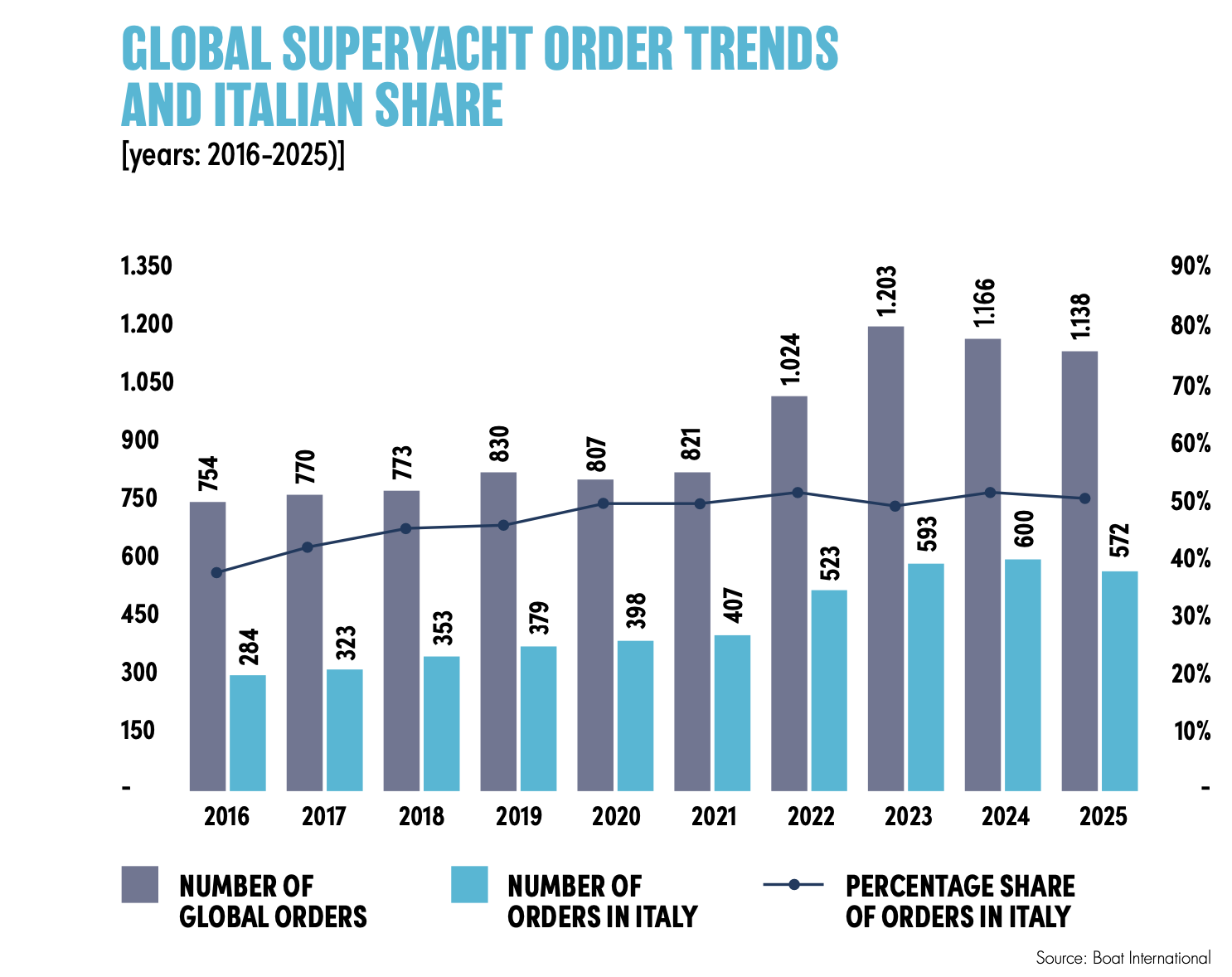
Another emblematic figure comes from the Global Order Book 2024, published by Showboats International: Italy tops the global ranking with 572 superyachts under construction, representing 50% of the world’s total orders. Turkey, in second place, is a distant third with 146 yachts, followed by the UK (81) and the Netherlands (69). The total length of Italian yachts under construction exceeds 22,000 m, a figure that speaks volumes about the supremacy of Italian shipyards in this market segment.
According to Nautica in Cifre – Monitor 2024/2025, this concentration of orders confirms the role of the superyacht sector as the driving force of the industry but also signals the first signs of stabilisation: the order volume registered a slight decrease of -4.6% compared to 2023, a trend typical of mature markets with established marine industry leadership.
Small boats: signs of strain
While the high-end market is booming, the small boat sector is showing signs of strain. Surveys carried out by Confindustria Nautica show that 60% of companies building boats under 24 m expect their turnover to fall, with only a small minority forecasting growth.
“Based on the sentiment of leading Italian operators, the difficulties in small boat building, combined with the uncertainty of the US tariffs, could trigger a global slowdown in 2025,” explains Stefano Pagani Isnardi, Director of the Research Department at Confindustria Nautica. “However, entrepreneurs expect a recovery between 2026 and 2027. The first signs of this turnaround could already be seen at our Genoa International Boat Show, where new models and attention to evolving market trends could rekindle owners’ confidence.”
The Monitor highlights the most critical factors weighing on the sector: high interest rates, persistent inflation, geopolitical tensions and excess inventory, particularly affecting SMEs.
Employment and contribution to GDP
Far from being a niche sector, the Italian yachting industry provided employment for 31,480 people in 2024 (+2.6% compared to 2023) and contributed €7.40 billion to Italy’s GDP, equivalent to 0.337% of the national total. This makes recreational boating one of the country’s most profitable manufacturing sectors, alongside fashion and agri-food, and confirms its role as a strategic pillar of the Made in Italy economy.

Nautical tourism and marina services: post-Covid normalisation
In addition to manufacturing, nautical tourism and marina services continued their positive trend, albeit with more moderate growth compared to the immediate post-pandemic boom.
• Permanent moorings: +2%
• Transient moorings: +2.3%
• Revenue from storage: +3.2%
• Maintenance services: +2%
• Fuel sales: +1.6%
• Ancillary services: +2.3%
In the charter market, expectations for 2025 remain positive: 50% of operators forecast revenue growth, 47% expect stability and only 7% foresee a slight decline. The demand for experiential boating holidays, increasingly focused on sustainability, is consolidating as a long-term trend.
Exports: a twenty-year success story
Between 2000 and 2024, exports of recreational and sports boats will grow from €850 million to €4.3 billion, an extraordinary increase of +405.8%.
This makes the sector one of the most dynamic of Italy’s manufacturing surplus industries. In fact, recreational boating now ranks 5th in terms of export growth among manufacturing sectors with a trade surplus of over €2 billion, competing with much larger industries.
Looking ahead: challenges and opportunities
The international outlook remains complex: global GDP growth is forecast at 3.2%, the Eurozone lags at +0.8% in 2024, while global trade faces headwinds and US trade policy adds uncertainty.
For the Italian yachting industry, the challenge is twofold: to consolidate its leadership in the luxury segment and to revitalise small boatbuilding through innovation, sustainability and regulatory simplification.
As Pagani Isnardi pointed out, a recovery could take place as early as 2026/2027, driven by new model launches and renewed confidence among yacht owners.
The year 2024 will be remembered as a milestone for the Italian yachting industry: record turnover, world leadership in yacht building and continued export growth. But the Genoa Boat Show also highlighted the challenges ahead: supporting small boatbuilders, navigating geopolitical turbulence and diversifying export markets.
As Marco Fortis emphasised, international boat shows remain fundamental business and networking platforms. Once again, the Genoa International Boat Show proved to be not only the “home of Italian yachting”, but also a barometer of an industry that looks to the future with confidence, fully aware of the challenges it faces.