Technology is advancing at an extraordinary pace, shaping and guiding our daily lives in ways we have never seen before. Experts from industries, research institutes, as well as national and international organizations, continually provide new perspectives on these rapid developments. Many of these innovations are now being implemented into the maritime sector. Consequently, the maritime organizations and industries are asking: “As ships undergo technological transformation, how should those who design and operate them respond to these changes?”
Industry 5.0 and yachting
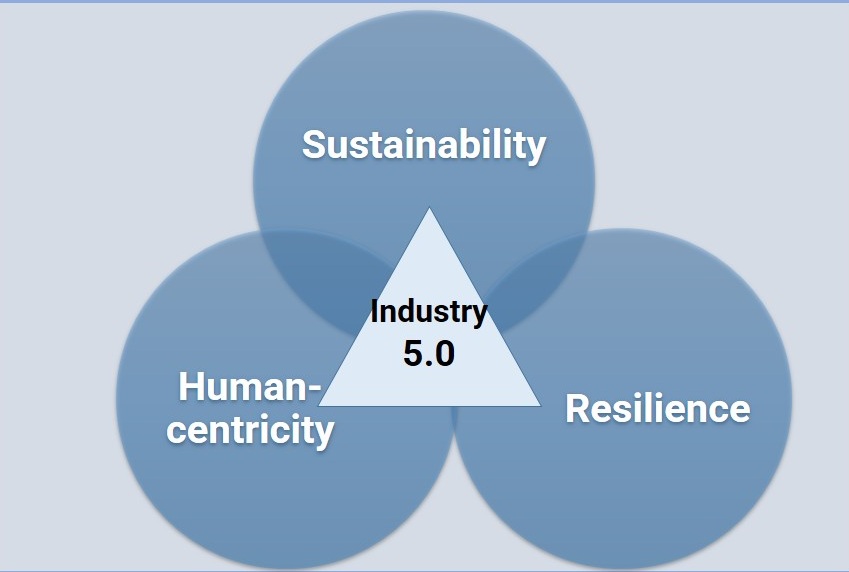
Industry 4.0 represented the transition to automation and digitalization. In contrast, Industry 5.0 is a cultural revolution, not just a technological one. The concept of Industry 5.0 first appeared in 2015 in a Linkedin article by Michael Rada, a business executive. In his article, Rada emphasized the importance of restoring the environment and people in the industrial process (Fig. 1).
The impact of Industry 5.0 in the yachting industry has made it possible to integrate sustainability and technological innovation through the combined use of automation, artificial intelligence, and advanced energy systems.
This translates into greater efficiency in yacht-building processes, reduced environmental impact and emissions, increased resilience of on-board infrastructure, and the possibility of developing highly customized solutions for yacht owners. Many manufacturing companies have seized this opportunity to transform their offerings from product alone to a servitisation strategy, based on a product plus services model, further strengthening the relevance of YachtTraining for crews and professionals.
Training requirements
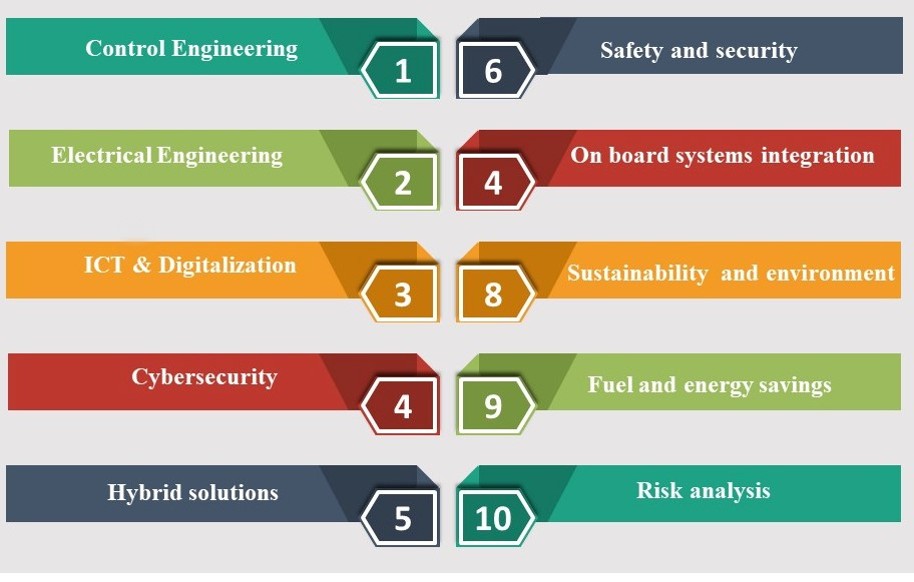
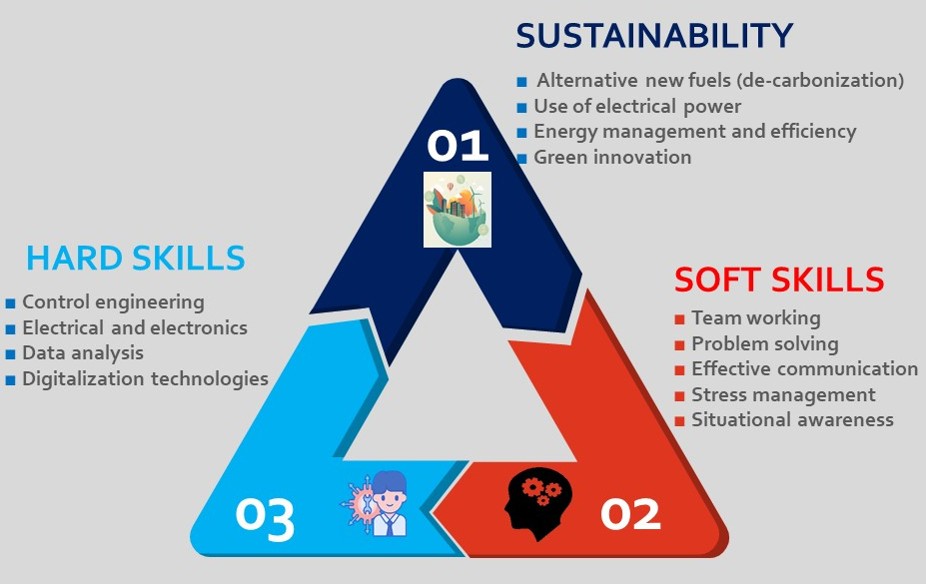
A survey by a professional association identified 10 key skills ranked as priorities by seafarers for their learning (Fig.2) to keep pace with changes in the industry. When designing a training course, these key skills can be mapped onto elements of the triangle diagram model (Fig.3), which serves as a framework to structure and integrate the identified competences.
Some of the subjects included in this model are:
• Control and electrical engineering
• ICT and digitalization
• Data analysis for decision-making
• Risk analysis
• Emergency procedures in the event of a system breakdown
• Implementing cybersecurity during the design and operation of the ship
Incorporating full-mission simulators as part of the learning process supports role-playing and collaborative exercises, leading to better knowledge acquisition and retention. Another important factor is the preliminary assessment of the participants’ preparation in order to evaluate their competence level, especially in SuperyachtCrewSkills development.
The IMO “Standard for Training and Certification of Watchkeepers” (STCW) Convention
The International Maritime Organization (IMO) STCW Convention for seafarers, established in 1984, includes 8 chapters, each dedicated to specific professional roles. The most recent version, STCW 2010, is also known as the ‘Manila Amendments’ (MK III), which was further amended between 2014 and 2016.
In the era of environmental and digital transition, maritime authorities have already introduced regulations to digitize and harmonize certificates of competency, leading to safer, faster, and more transparent procedures. A comprehensive review of the Convention will be carried out in two phases:
• first, it will identify gaps resulting from new technologies;
• second, it will develop the necessary amendments.
Subjects such as new and alternative fuels, the human element, emerging technologies, e-certification, cyber risks and cybersecurity are anticipated. The final version is scheduled for publication in 2028. Unfortunately, the yachting industry does not have an STCW; so private companies or industry associations set their own training criteria, increasing fragmentation risk.
STCW in a nutshell:
• Applies to ships subject to SOLAS
• Defines minimum standards for training and certification of shipboard personnel
• No equivalent standard in the yachting segment
• Result: scope for private courses and industry initiatives, often poorly coordinated
Are soft skills important?
Hard skills are the technical knowledge that we can demonstrate through proven competence. Soft skills are the personal and interpersonal skills that influence how we interact with others and approach our work. These include communication skills, teamwork, conflict resolution, stress management, leadership, and decision-making. Soft skills are the common thread running throughout an entire professional career. In an increasingly complex and confined operating environment such as that of a ship, these skills are essential as key drivers of human performance in a social context.
The challenge consists of ensuring that the acquired knowledge has a positive impact on working practices. This introduces an essential asset: the “human element”, increasingly accepted as “the greatest source of risk to safe and effective shipping”.
The term “complete mariner” is the name of the ideal seafarer who owns the insight to understand:
• How to make the best use of technology and when not to use it
• How to cooperate with or manage colleagues as necessary
• How and when “to deviate” from the established rules when they do not meet any longer the requirements of the situation
The need of a system culture
In today’s maritime context, it is essential that seafarers develop a systems-oriented mindset, rather than focusing on individual components. For our purposes, a system is a group of components capable of working together to transform inputs into outputs through a process, as shown in Fig. 4.
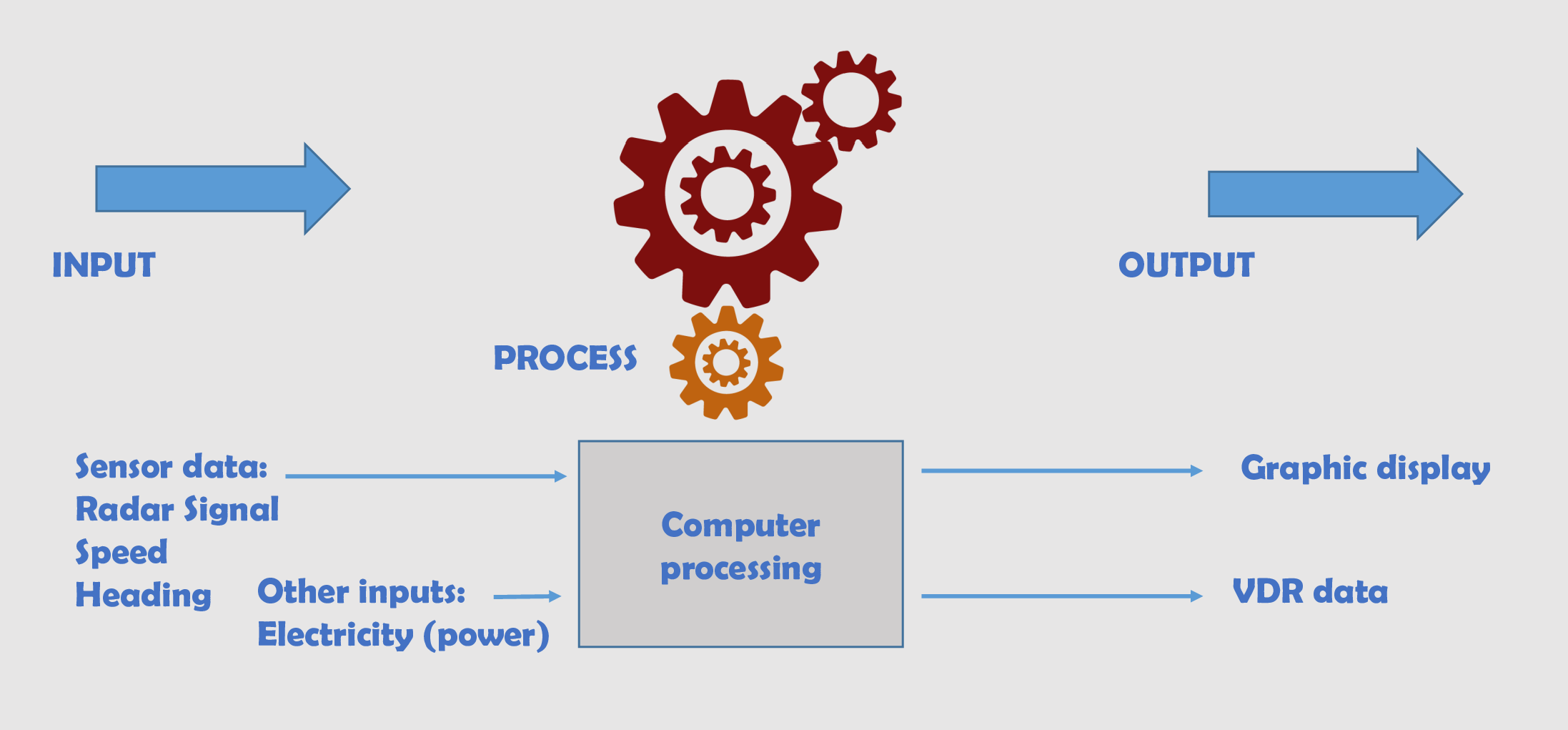
Yachts, like ships, are complex systems where propulsion, navigation, safety, and communication technologies interact continuously. A comprehensive understanding of how these elements interact within the broader vessel ecosystem enhances operational awareness, supports life cycle assessment for proactive maintenance, and improves safety. Training programs should emphasize the systems integration concept, encouraging learners to analyze cause-effect relationships and systemic dependencies. By doing so, seafarers become capable of diagnosing complex issues, cross collaborating with other departments, and contributing to the vessel optimum performance through proper Human Centered Design Yachting understanding.
Teaching Cadets
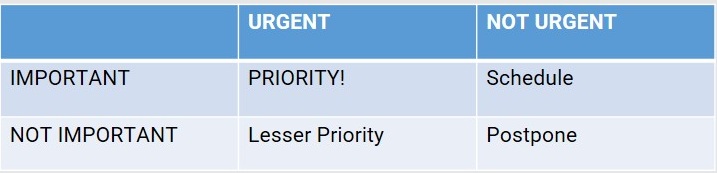
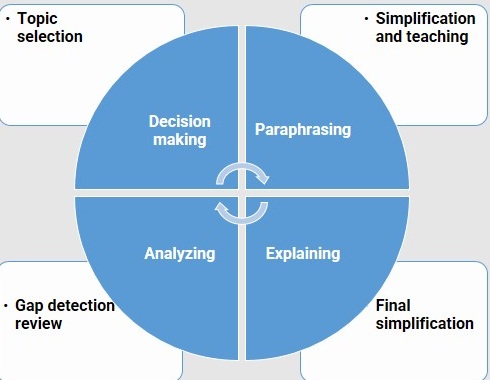
The training of cadets combines periods at sea and in the classroom with time management and deep learning tools. The two teach techniques most commonly used by Academies are the Eisenhower Matrix and the Feynman Technique (Fig. 5-6). The former helps to classify daily navigation, maintenance and emergency activities into Urgent/Important quadrants. The latter requires students to explain procedures such as route calculation or radar use aloud, identifying gaps and reinforcing operational memory.
In addition to these, the Reflective Logbook is used to record successes and mistakes, the Pomodoro Method for concentrated study sessions and Learning Analytics to monitor progress and personalize training courses. This integrated approach fosters rapid skill transfer and prepares officers for sea challenges.
Remember: A senior officer knows the sea but is not very familiar with digital systems, while a junior cadet is a digital native but inexperienced in the face of a storm. The solution is clear: reciprocal mentorship.
E-learning
The benefits and flexibility of e-learning are well known. It allows the user to study anywhere and anytime, results are easy to track, it is less expensive than classroom training, and can be tailored to personal needs. While cost efficiency is perhaps the most evident advantage to e-learning as a training method, there are other unique benefits to consider:
• Consistency of message is crucial, especially in areas related to safety or company policies;
• Easily updated teaching resources that can be shared and customized for various learning requirements;
• The ability to interact with learners through questions, role-playing and case simulations.
On the other hand, the overall effectiveness of e-learning as currently employed has revealed some weaknesses. Often, the quality of the teaching content is low and offers no added value.
The lack of direct contact with the instructor can demotivate learners. Another problem is the on-board internet infrastructure, which is not always adequate for the purpose. The requirements for effective e-learning must include strong alignment with objectives, meaningful methods for assessing learning, real-life problem-solving experiences, and post-hoc verification of acquired skills with the support of a supervisor or others with experience in the subject.
Where e-learning may not deliver the expected results is when it is aimed at people who are new to the subject, or when students have to perform physical tasks, such as servicing or overhauling a machinery. Therefore, a combination of digital e-learning combined with practical in-person training is the optimal approach, reinforcing best practices in Maritime Elearning methods.
Sharing experience for better design and operation
The integrated supply chain criterion has a strong impact on the training of yachting stakeholders. Knowledge of topics such as ergonomics and Human Centred Design (HCD) is limited and is almost always directed at technical office staff. Some examples of user-unfriendly design are:
• A layout of the bridge instrumentation not complying with ergonomic principles
• Lack of alarm management philosophy resulting in an overflow of alerts
• Poor visibility of essential navigation instruments
Knowledge of ergonomic design and HCD among both designers and seafarers allows communication through a shared language, which helps designers know what questions to ask and what issues to be aware of.
HCD is the tool that encourages designers to prioritize user needs, behaviors, and preferences. A report on the problems encountered by users reveals that:
• 87% had problems due to inadequate design or layout.
• 40% never had the opportunity to report on an inadequate design.
• Only 30% of users state they were involved during the design phase.
Conclusions
Training means creating culture, and culture influences our behaviour. Faced with the technological advances we are witnessing, we need to think outside the box. Training requires an integrated approach that involves all those responsible: from the designer to the shipyard, on-board operators and management companies.
Today, the development of professional skills must be seen as a continuous process that spans the entire professional career. There are educational tools that allow knowledge to be shared easily and at low cost. A final point concerns the increasing responsibility of on-board personnel, who are often required to make decisions. This should not be confused with a claim to infallibility. A well-trained crew with the right tools has a greater awareness of the situation, which means less chance of error.