The MECSPE Observatory for the second quarter of 2025 highlights how the Italian manufacturing sector is investing primarily in efficiency, automation and digitalisation, without neglecting customisation, energy transition and sustainability.
The manufacturing industry continues to be one of the most significant sectors for the Italian economy, with more than 490,000 active companies in the country.
Data on sector performance show signs of resilience: in the first nine months of 2025, revenues increased or remained stable for 7 out of 10 companies compared to the same period of the previous year, and about 2 out of 3 (65%) are progressing consistently with the goals set for the current year. Three out of 10 companies declare themselves satisfied with their overall performance, with nearly 6 out of 10 moderately satisfied.
These findings emerge from the MECSPE Observatory conducted by Nomisma for the second quarter of 2025, presented during the opening conference of the third edition of MECSPE Bari, the event dedicated to manufacturing innovation in Central and Southern Italy, organized by Senaf and hosted at the Fiera del Levante in Bari.
Efficiency, automation and digitalization
Italian manufacturing is approaching 2025 with a strategic focus on efficiency, automation, and digitalization. According to the Observatory, investments in innovation are concentrated primarily on these areas, followed by customization, energy transition, and sustainability. It is a cautious but competitiveness- and resilience-oriented sector.
However, the context is not free from challenges. On the operational front, the order book shows that around 30% of companies consider it adequate or exceeding expectations, while nearly 40% view it as partially or highly insufficient.
Looking ahead, about one-quarter of companies say they have confidence in the market for 2026–2027, while more than half express moderate confidence, as they face challenges such as the end of the Transition Plan 5.0, the introduction of tariffs, and persistent difficulty in finding suitable human resources.
Among these issues, the human-resources question is a key factor in ensuring efficiency and competitiveness in Italian manufacturing. The sector has long reported difficulties in finding qualified personnel: 40% of companies indicate problems in recruitment, and there remain issues linked to skills (38%) and labor costs (28%).
Do you want to stay updated about the latest news of the manufacturing sector?Subscribe to the Click the Gear newsletter!
Transition 5.0: what companies expect
On the digitalization front, however, the picture is more encouraging: 6 out of 10 companies report having reached a good level of digital maturity—a result consistent with the innovation and sustainability goals promoted by the Transition Plan 5.0.
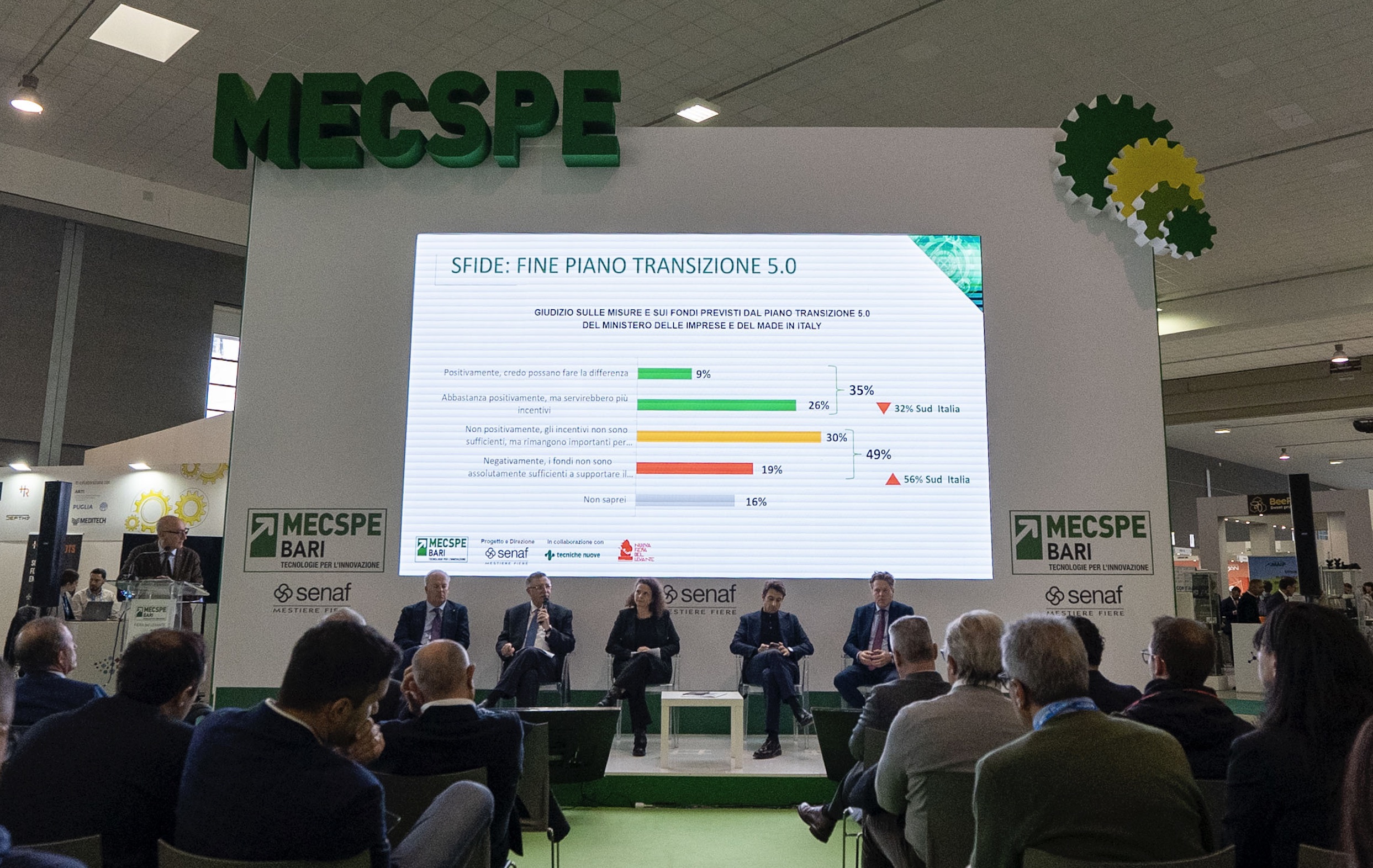
This process is supported by internal digital skills: more than 8 out of 10 companies declare themselves very, fairly, or moderately satisfied with their staff’s competencies in technological innovation. But when it comes to the Transition Plan 5.0—now approaching its expiration—the judgment of companies remains mixed: only 35% evaluate it positively or fairly positively, while about half consider the measures insufficient.
This is a significant figure highlighting the crucial role of public support tools in sustaining the sector’s investments. To domestic concerns are added international uncertainties related to the introduction of tariffs: nearly 6 out of 10 companies express concrete worries, and a similar share (58%) says they have already experienced direct impacts on their business, prompting many companies to rethink commercial strategies and supply chains.
Expectations for the end of the year are divided between optimism and caution, with a manufacturing sector that continues to invest in innovation while having to deal with market uncertainties and structural complexities. And it is precisely in this evolving scenario that companies need reference points like MECSPE, which for over 20 years has supported entrepreneurs in their transformation processes by presenting the most innovative solutions for improving production processes.
The third edition of MECSPE Bari reaffirms itself as a reference platform for Central and Southern Italy: over 350 exhibiting companies, more than 80 conferences, and 13 thematic halls dedicated to training, technologies, and strategies for building the new Italian manufacturing sector.
Factories of the Future: People, Technologies and Territories for the New Manufacturing
The opening event, a talk titled “Factories of the Future: People, Technologies and Territories for the New Manufacturing”, focused on the themes of the MECSPE Observatory along with the strategic role of human capital, technological innovation, and territorial development in transforming Italian manufacturing.
Speakers included Gianna Elisa Berlingerio, Director of the Economic Development Department of the Apulia Region; Mario Aprile, President of Confindustria Bari and BAT; Angelo Giuliana, General Director of the Meditech Competence Center; Giuseppe Acierno, President of DTA – the Apulian Aerospace Technology District; and Ivo Nardella, President of Senaf – Tecniche Nuove Group.
The event offered an opportunity to connect technologies, skills, and territories, providing companies with concrete tools to address market challenges and seize innovation opportunities.
What did they say?
The interventions
Gianna Elisa Berlingerio
Our region is experiencing a phase of strong evolution, in which digital transformation, investment in innovation, and skills development intersect with the ability of territories to attract businesses and talent. It is along this path that we are strengthening regional policies and tools to support the production system on a journey toward international openness and reinforcement of strategic supply chain.
Mario Aprile
MECSPE brings the best of technological innovation for the manufacturing industry to Bari. And it is upon these new technologies that we can build a new industrial miracle here in Bari: a territory increasingly competitive, with new technologically advanced production investments. We are working toward this goal, to build a Bari industrial city-branding strategy, an agency for attracting manufacturing settlements capable of coordinating with local institutions and creating the best possible conditions for international investors.
Angelo Giuliana
The major technological challenges facing companies today are mainly two: the implementation and management of artificial intelligence and cybersecurity. The first represents an extraordinary opportunity, while the second has become an essential necessity. We see companies becoming increasingly aware, though often held back by a lack of skills and investment.
The NRRP has played a decisive role: many companies have accelerated digitalization, automation, and competitiveness thanks to these resources. In terms of data, however, maturity is still uneven. The real leap will occur when companies understand that managing and protecting data is not a technical exercise but the foundation for adopting AI in a widespread and secure way, unlocking the full potential of manufacturing in Southern Italy.
Giuseppe Acierno
The MECSPE event is certainly an ideal setting to analyze the growth of the Apulian aerospace system, understand how technology and innovation have been the main drivers of growth, and how aerospace and defense manufacturing can continue to contribute significantly in terms of added value.
Ivo Nardella
In manufacturing, the skills challenge today is as decisive as the technological one. The data from the MECSPE Observatory confirm that difficulties in finding qualified resources with the right skills represent one of the main obstacles to business growth. In a context where automation, artificial intelligence, and digital process integration are becoming strategic levers, without skilled people and continuous training, innovation does not generate competitiveness or efficiency.
Bridging this gap is essential, especially in dynamic regions like Apulia. This is precisely why MECSPE in Bari has a special value: it is a driver of connection between young talent, companies, and institutions of Southern Italy, and an accelerator of the training that the production system requires.
Our commitment is to strengthen, through MECSPE, a manufacturing ecosystem capable of attracting skills, spreading technical culture, and supporting company growth. In a moment of great change, MECSPE confirms itself as the place where Italian manufacturing finds tools, ideas, and opportunities to become more innovative, digital, and efficient.
[1] Movimprese Data – Unioncamere, 2nd Quarter of 2025.
[2] MECSPE Observatory on the manufacturing industry for the second quarter of 2025 conducted by Nomisma on a sample of 350 Italian manufacturing companies, using the CAWI (Computer Assisted Web Interviewing) method carried out in October-November 2025.