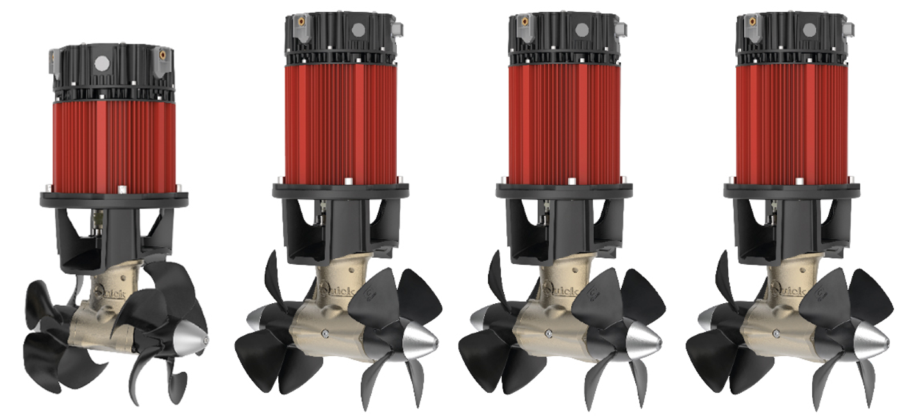
The complete development of the QSY range extends Quick Group’s brushless electric thruster technology across a broad spectrum of applications, from day cruisers to large yachts. The project does not simply represent an expansion of the product offering, but the completion of a technological architecture based on brushless synchronous motors, proportional control and integrated electronic power management.
A range designed for continuity
The QSY series comprises configurations with tunnels ranging from 140 to 300 mm, power supplies of 12, 24 and 48 V, and thrust ratings from 50 to 350 kgf. The expansion of the range addresses a specific design requirement: to provide boatbuilders with a more homogeneous progression of performance, avoiding dimensional gaps that can complicate the integration of the thruster into the hull structure.
In this respect, the introduction of the 215 mm tunnel represents a significant step. The 120 and 140 kgf versions bridge the gap between the 185 and 250 mm tunnels, increasing the granularity of the range and allowing the system to be selected not only according to the required thrust, but also to the available installation space and the characteristics of the vessel.
Brushless technology and proportional control
At the core of QSY technology is the brushless synchronous motor, combined with an integrated inverter and native proportional control. The absence of brushes reduces wear and contributes to greater operational continuity, while electronic torque management allows thrust to be modulated with a high degree of precision.
The immediate response to torque demand makes it possible to move from very fine control to high power demands. This is particularly relevant in manoeuvring assistance systems, where precision, response speed and the ability to sustain extended operating cycles are becoming increasingly important design parameters.
Optimisation does not concern the motor alone. The development of the new range has also involved the gearboxes, with the aim of limiting losses and converting a greater proportion of the available power into useful thrust. Reducing inefficiencies also helps to limit dissipated heat, noise and vibration, with benefits for both efficiency and onboard comfort.
48 V and power management
The availability of 48 V configurations is playing an increasingly important role in the management of higher power levels. For a given power output, increasing the voltage allows the current to be reduced, simplifying the electrical management of the system. The QSY range reaches up to 23 kW in its most powerful configuration, the BT QSY 300-350 at 48 V.
This architecture is consistent with the evolution of onboard systems, characterised by increasing electrification and increasingly integrated energy management. The thruster is therefore no longer an isolated actuator but is becoming part of an interconnected manoeuvring system.
Pacific: control enters the digital ecosystem
Completing this evolution is the new Pacific range of controls (below), developed to fully exploit the capabilities of QSY thrusters while also opening the system to integration with other technologies. The range comprises the T1, T1XL and T2XL models, with configurations dedicated to single, multiple and multihull installations.
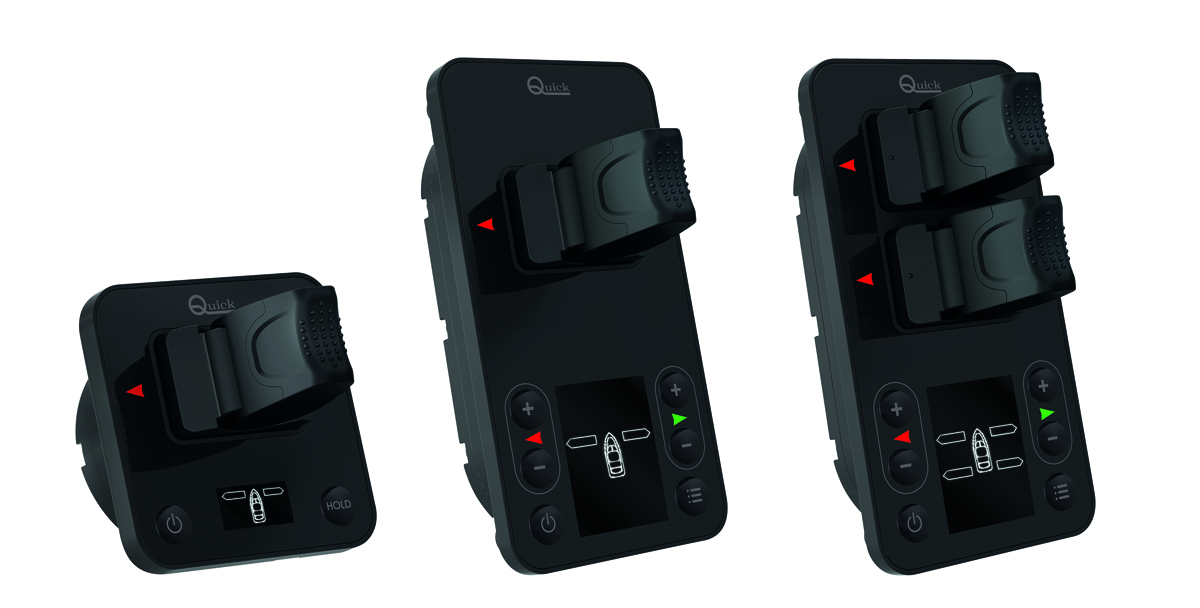
Pacific also represents the first concrete application of QCentric (below), the digital ecosystem developed by Quick Group to progressively connect different products and functions through a common architecture. Integration with the NMEA 2000 network, together with the possibility of interfacing, through dedicated gateways, with third-party manoeuvring systems, represents a central element of this approach.
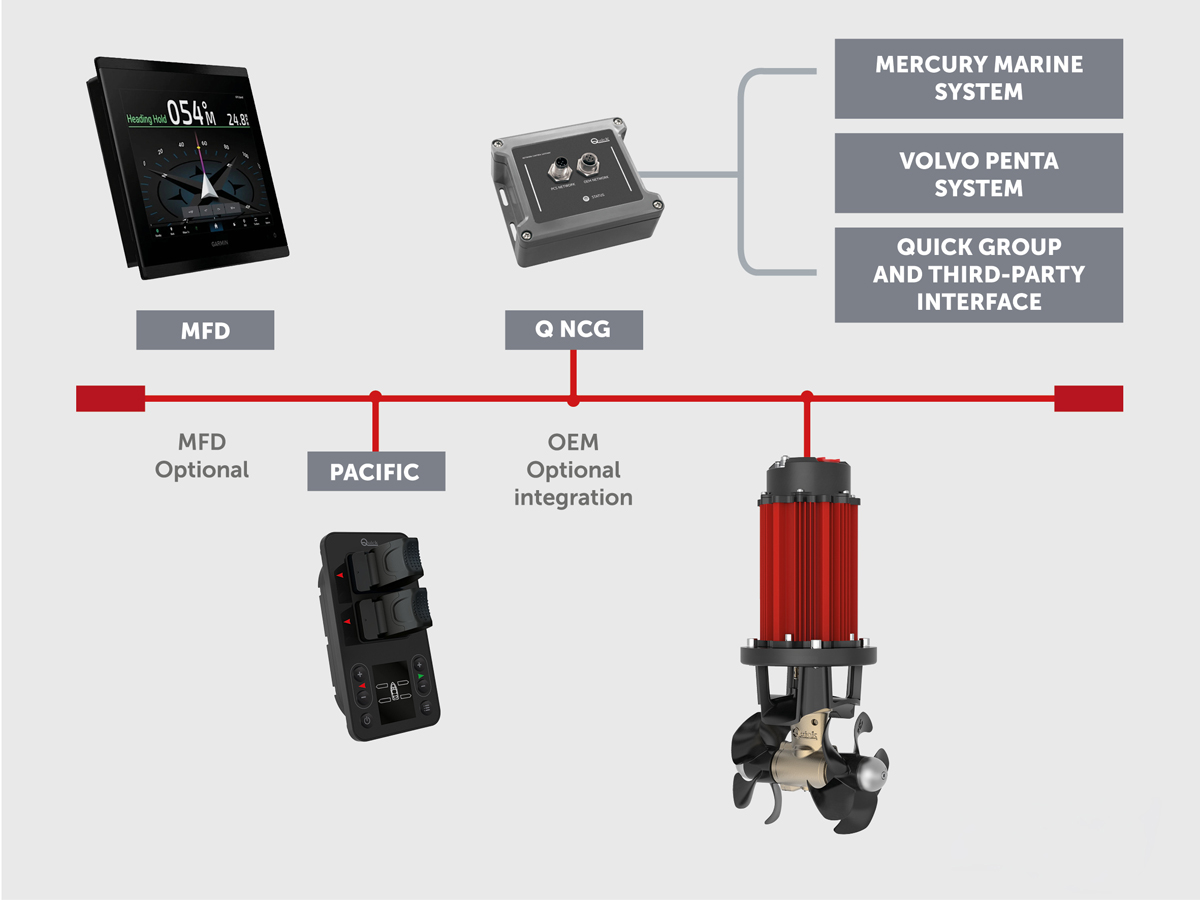
Control electronics integration
The inverter integrated into the motor reduces installation complexity: the thruster requires the power supply and a CAN bus connection, while the system intelligence is distributed across the different units within the network. This results in a more compact architecture, with fewer intermediate components and a consequent simplification of installation and maintenance activities.
The combination of QSY and Pacific therefore defines a system in which mechanical performance, control electronics and digital communication are designed as parts of a single architecture. It represents a significant step in the evolution of manoeuvring systems: from the individual thruster to the intelligent actuator, integrated into an increasingly connected onboard network and oriented towards assisted vessel operation.
From technology to market engagement
The new QSY range and Pacific control systems will be presented by Quick Group at the main autumn boat shows, starting with the Cannes Yachting Festival, where they will be exhibited at stand PAN357. The programme will continue at the Salone Nautico di Genova, at Padiglione B Superiore, stand TG20-TH19, with an additional quayside presence at dock YE801A, and will be also presented to the US market at the IBEX Show in Tampa, Florida (6-8 October 2026), booth 3-1547.
The autumn programme will conclude at Metstrade, where Quick Group will be present in Hall 1, stands 01.153 and 01.251, while Sanguineti, a Quick Group brand, will be present in the Superyacht Hall 7, stand 07.120. This presence at the sector’s leading international events will accompany the launch of the new solutions, providing an opportunity for direct engagement with boatbuilders, designers and industry professionals.