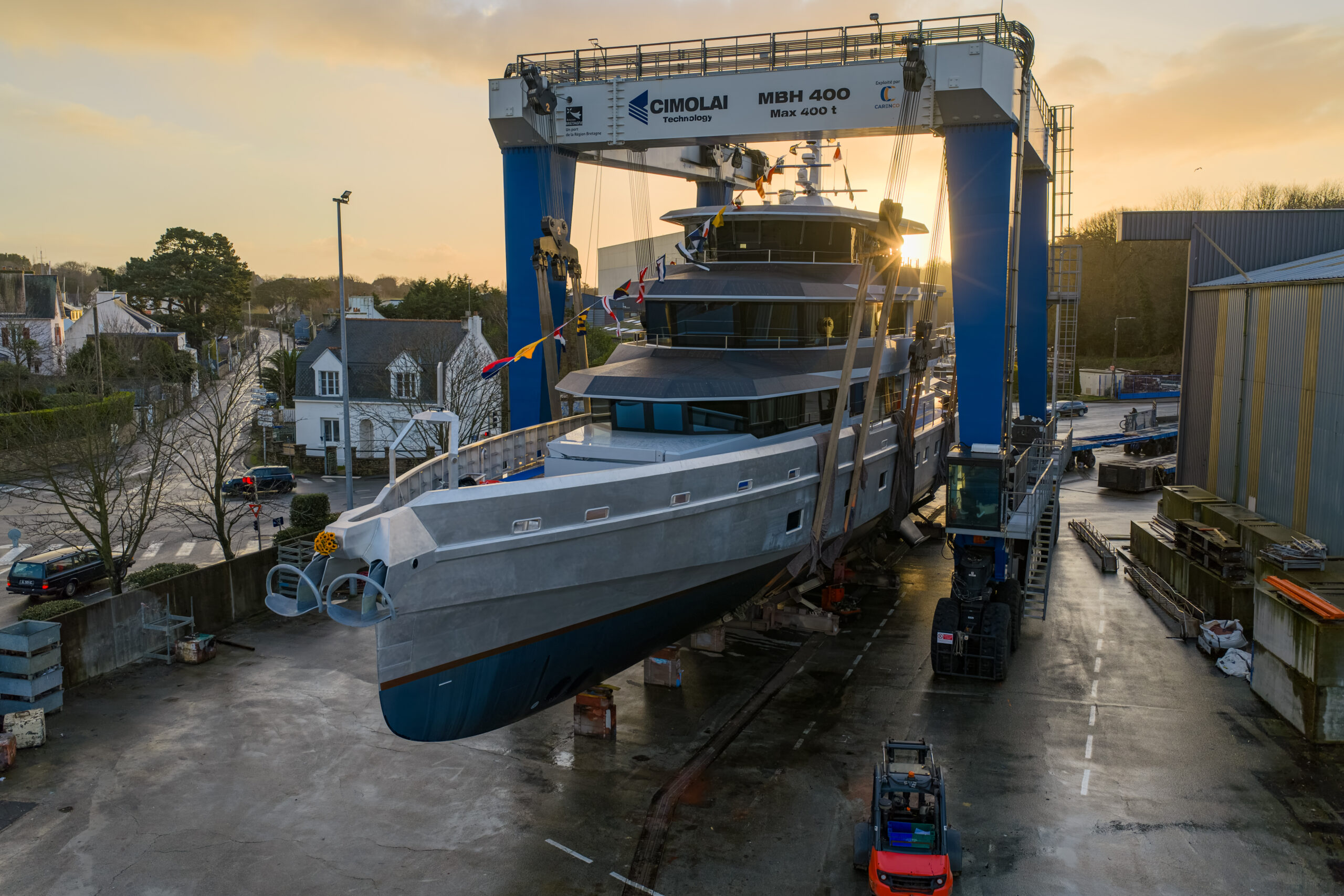
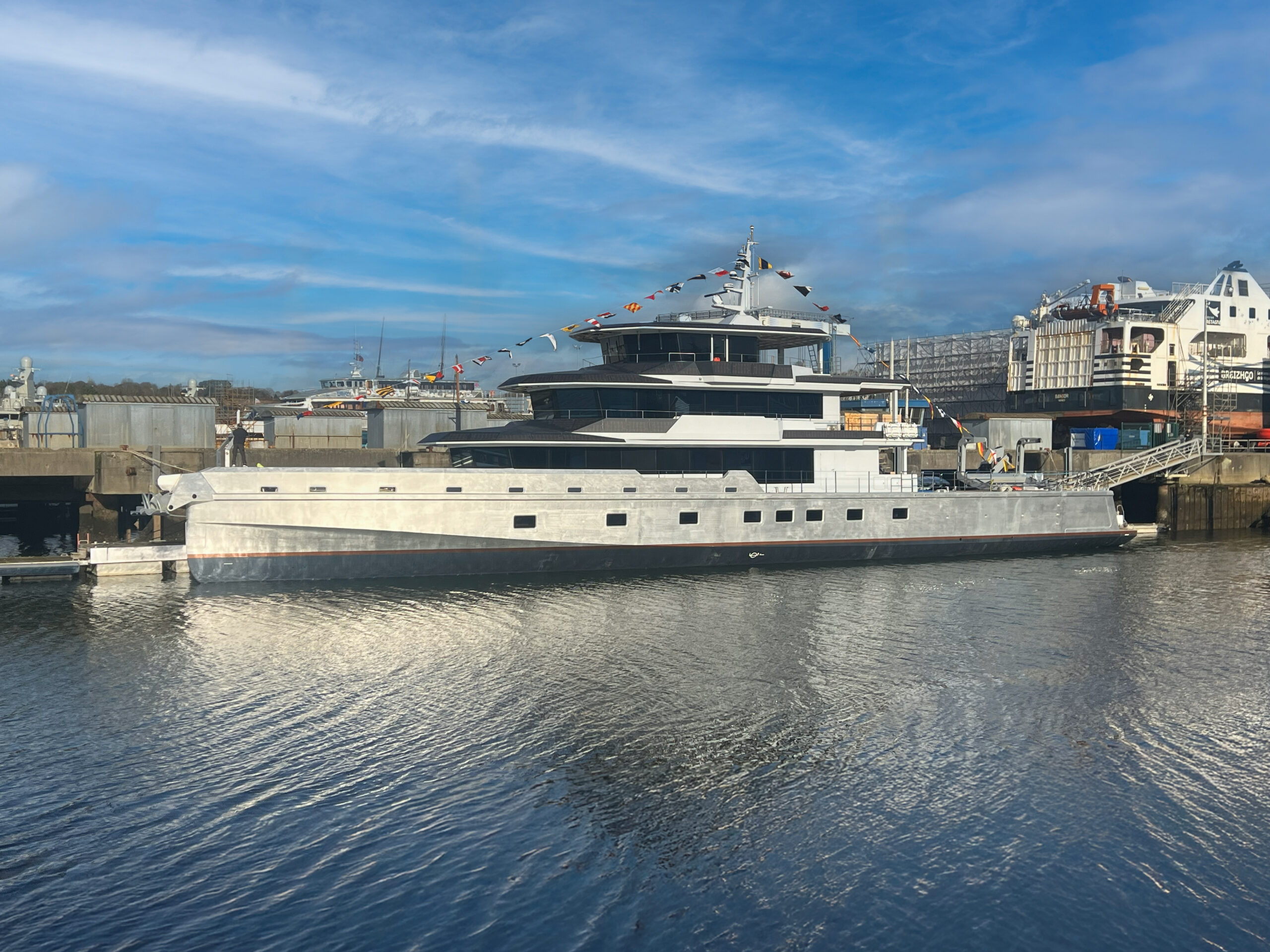
With a beam of 9.1 m and a draft of just 2.02 m, Explorera is the longest yacht ever built in-house at the Concarneau yard. The project represents a significant achievement in applying aluminium and composite construction techniques at this scale under Lloyd’s Register classification.
A collective effort
The project brought together a notable team of collaborators. Humphreys Yacht Design, the Lymington studio founded in 1974 and renowned for its performance sailing yachts, handled the naval architecture and exterior styling, while Milan-based m2atelier designed the interiors.
Construction began in autumn 2021, with the yacht completing her sea trials ahead of the January 2026 launch.
“The launch of this 50 m motor yacht marked a new milestone for JFA Yachts,” says Frédéric Jaouen, CEO of the shipyard. “This ambitious and technically complex project embodies our expertise in aluminium construction combined with composite materials. We are proud to have collaborated with Humphreys Yacht Design to bring such an exceptional vessel to life.”
Clients at the centre
Founded in 1993 by Frédéric Jaouen and Frédéric Breuilly, JFA Yachts has spent three decades building a reputation for custom yacht construction in Brittany. The shipyard is located in Concarneau, a historic fishing port that is now also home to a centre for yacht building and refit services.
JFA’s philosophy centres on working “with” clients rather than “for” them. This approach attracts owners seeking a more personal and collaborative building experience than that typically offered by larger production yards.
What distinguishes JFA’s approach is its willingness to adapt to the client’s organisation rather than impose its own. During the construction of the 50 m explorer superyacht, the yard followed the technical specifications and document structure established by the owner’s team, organising all studies according to the client’s chaptering system.
A larger yard, by contrast, would typically require the client to conform to its internal processes and organisation. This flexibility also extends to day-to-day operations, with JFA’s management team working directly alongside the owner’s representatives throughout the build process.
A boutique shipyard
With approximately 50 employees and facilities including six covered build halls and a 2,000-tonne ship lift capable of handling vessels up to 65 m, JFA occupies an interesting position in the market: large enough to tackle complex projects, yet small enough to maintain the artisanal attention that defines boutique builders.
The yard has delivered notable projects over the years, including the 43 m Axantha II and the award-winning Bystander, a 42 m support vessel that exceeded 500 gross tonnes. Its portfolio also includes the 33.5 m carbon catamaran Mousetrap and the Long Island 78 power catamaran.
Looking ahead, the yard’s ambition for the coming years is to consistently have a project in the 40 to 50 m range, a size that matches its capabilities and expertise.
The brief
The design brief called for an explorer yacht suited to family use and capable of sustained periods of self-sufficiency when cruising remote areas of the planet.
Efficiency, comfort and safety were paramount, with no compromise between high autonomy and environmental responsibility. The yacht needed to accommodate 10 guests in five suites while providing quarters for a crew of 10, all within a carefully optimised hull positioned at the edge of the 500 gross tonne threshold.
An explorer for global cruising
Humphreys Yacht Design developed the project over two years in close collaboration with the client. Today, the studio is led in partnership by founder Rob Humphreys and his son Tom, supported by a team of experienced yacht designers and naval architects.
Their racing yacht heritage and experience in trans-oceanic design have established the company as a creator of advanced sailing and motor yachts that champion sustainable, forward-thinking design.
For Explorera, the result is a fast displacement hull form optimised through what Tom Humphreys describes as “one of the most comprehensive model testing programs we’ve ever undertaken”.
“We took a highly integrated approach to the design, striving to marry all the technical, functional, and client-specific requirements with a rigorous naval architecture effort to underpin her operational abilities,” Humphreys explains. “Intensive CFD work was ultimately validated by model testing at MARIN.”
Development through CFD and model testing
The CFD campaign, conducted by Cape Horn Engineering, employed RANS computational methods and was validated against three reference hulls with known performance characteristics.
The team investigated multiple development hulls before arriving at the final configuration, adding appendages incrementally to quantify the effect of each element on total resistance. This level of analysis is unusual for a yacht of this size and reflects the priority placed on efficiency throughout the design process.
Rob Humphreys adds perspective on the engineering constraints: “This has been an absorbing and thoroughly engaging design challenge for the team at HYD. Positioned at the edge of the 500 GRT threshold with efficiency, comfort, safety and handling qualities uppermost in every aspect of the design process.”
The numbers reflect this rigorous approach. At her 12-knot economical cruising speed, the yacht achieves a range exceeding 5,000 nautical miles. A top speed of 20 knots is available in hybrid boost mode, with normal cruising anticipated between 12 and 16 knots.
Aluminium and composite construction at scale
JFA has been combining aluminium hulls with composite superstructures for two decades on sailing yachts, and more recently on the Long Island 78 power catamaran.
What made Explorera different was the scale of the project and the requirements of Lloyd’s classification, which demanded extensive laboratory testing and rigorous calculation verification with the classification society.
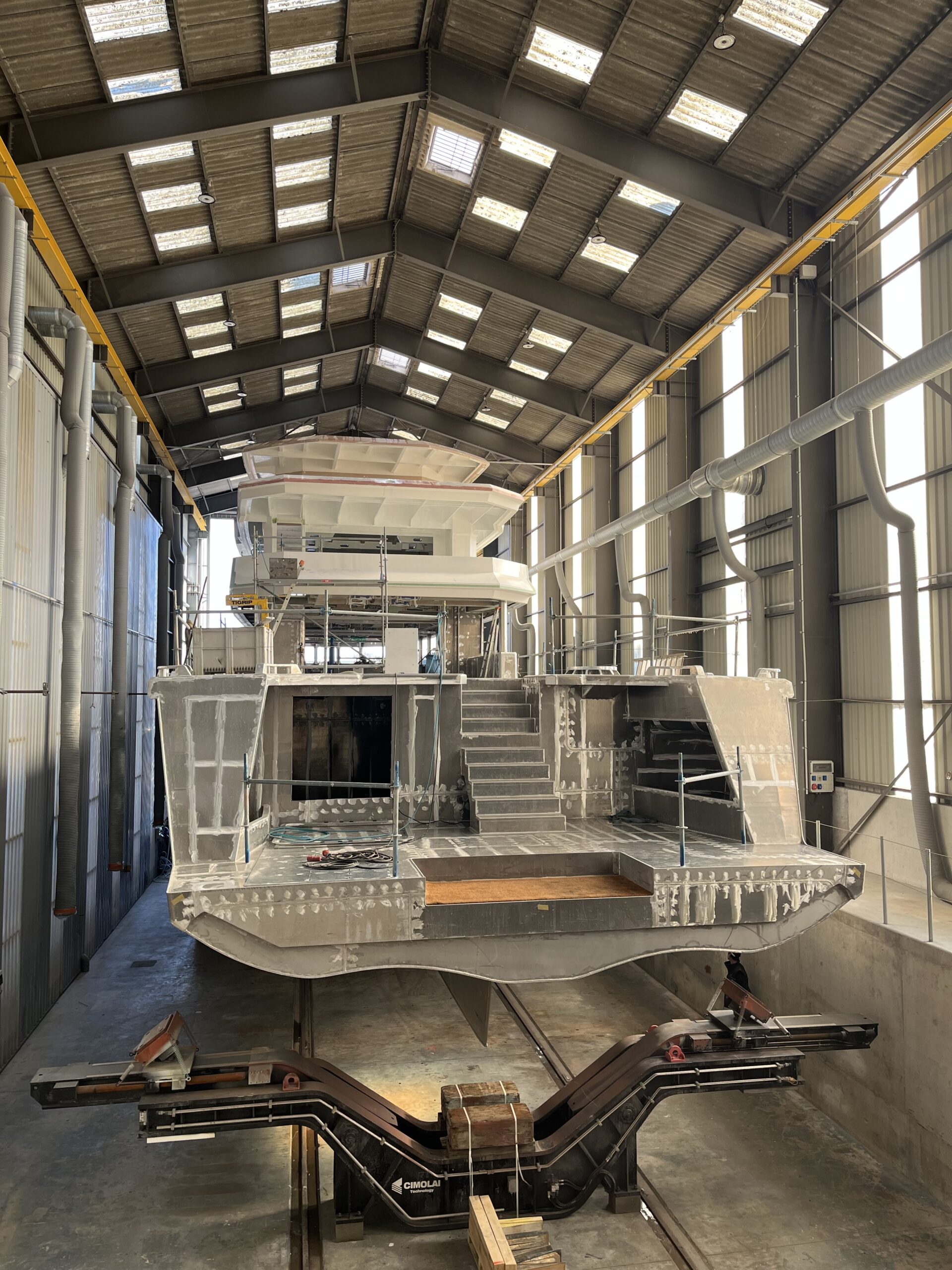
The aluminium hull was built externally and towed to Concarneau, a common practice among superyacht builders in northern Europe. At the yard, JFA constructed the main deck superstructure sides in aluminium, installing and welding these sections onto the hull upon arrival.
The composite upper deck was then bonded to the aluminium structure using techniques refined over years of sailing yacht construction. The team assembled all other composite decks and superstructure elements through lamination before lifting the entire composite upper deck and bridge deck onto the yacht as complete units.
This hybrid aluminium and composite construction approach serves multiple purposes. The aluminium hull provides the strength and durability required for extended ocean cruising, while the lighter composite superstructure helps optimise displacement and lower the centre of gravity for improved stability and seakeeping.
Hybrid propulsion and sustainability
The parallel hybrid propulsion system pairs twin MTU 12V 2000 M72 diesel engines with ZF PTI/PTO gearboxes and 290 kW Danfoss electric motors driving twin shafts.
An expansive array of solar panels and a high-capacity battery system enable silent, emissions-free operation for extended periods when at anchor, in harbour or during low-speed cruising.
This configuration directly addresses the brief’s requirement for minimal environmental impact.
Explorera can operate in full electric mode in sensitive areas, preserving the pristine environments that attract explorer yacht owners to remote destinations. The ability to cruise silently also enhances the onboard experience, allowing guests to enjoy anchorages without engine noise or exhaust fumes.
When additional power is needed, hybrid boost mode combines diesel and electric propulsion to reach the 20-knot maximum speed.
Layout and onboard systems
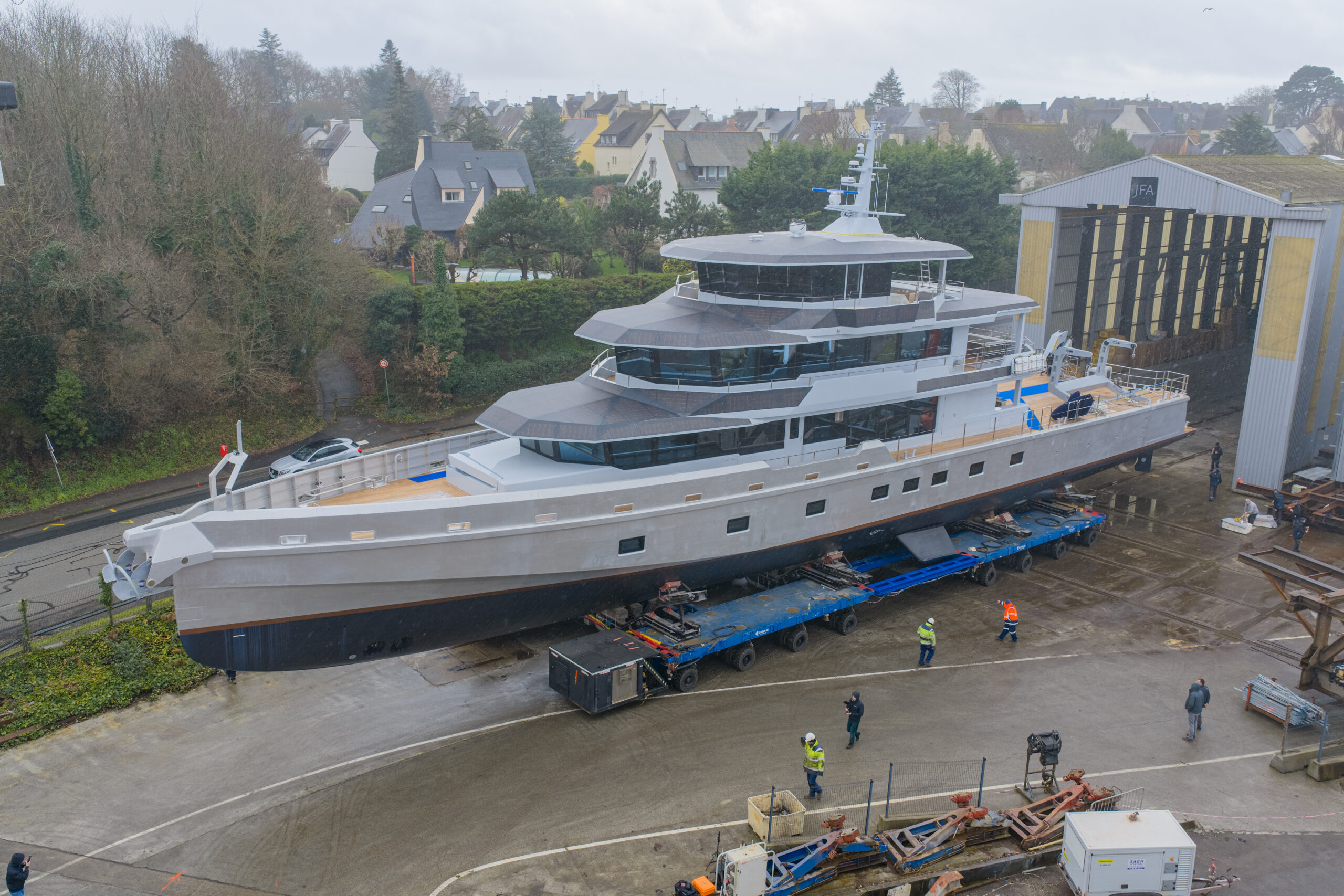
The exterior design by Humphreys features large panels of glazing and single-level decks that facilitate 360-degree views, creating what the studio describes as “important connections with the yacht’s environmental surroundings”.
Despite being designed for serious ocean passages, the yacht maintains an elegant profile with relatively low forward freeboard that hints at her sailing yacht design heritage.
The Owner’s Suite occupies the upper deck, featuring a private lounge and office area with an exterior lounge space and Jacuzzi. Four guest cabins on the lower deck complete the accommodation.
On the main deck, the galley, saloon and dining area are complemented by an exterior lounge with bar and integrated barbecue.
Comfort is ensured by a stabilisation system combining a large gyro with fins, effective both at anchor and underway.
Engineering achievements
One notable engineering achievement is the centreline walkway on the tank deck, a feature uncommon on yachts of this size.
This corridor connects the engine room, which houses the main engines and generators, with the forward technical space containing the gyro stabiliser, air-conditioning plant, watermaker, black-water treatment system and freshwater pumps.
The walkway itself accommodates the main switchboards, stabiliser actuators and storage areas. This arrangement allows the crew to move between technical spaces directly and discreetly, maintaining clear separation from guest areas throughout the vessel.
Three crane systems for an explorer yacht
Three crane systems serve the yacht’s extensive toy inventory.
A dedicated C-davit handles the 9.25 m tender, ensuring ease and speed of launch even in a seaway. A secondary deck crane provides multi-functional lifting capability, with reach extending over the aft deck, stern platform, engine room and lazarette.
A third crane, concealed in the foredeck, manages the rescue boat and jet skis.
This arrangement allows the crew to deploy and retrieve watercraft efficiently without disrupting guest activities.
Interiors by m2atelier
The interior design comes from Milan studio m2atelier, founded by architects Marijana Radovic and Marco Bonelli.
Their “Sustainable Minimalism” philosophy, summarised as “Less is Enough”, emphasises fluidity, spatial optimisation and the elimination of superfluous elements. The studio has built an impressive portfolio in the superyacht sector, with recent projects including work for Codecasa, Vitters and the Azimut Grande series.
The result complements Humphreys’ exterior design language: spaces that feel open to the outside, with extensive glazing ensuring natural light and a constant connection with the sea.
The interiors are designed for the realities of extended cruising, where owners and guests will spend weeks or months aboard, requiring environments that feel like home rather than a hotel.
Complexity and lightness
Looking back at the five-year journey from contract to launch, the JFA team points to two memorable milestones: the moment when the aluminium hull was joined to the composite superstructure, and the day the completed yacht emerged from the building hall.
This 50 m explorer is a complex vessel with numerous sophisticated systems onboard, yet she remains a light boat with strong performance characteristics.
For JFA Yachts, this combination of complexity and efficiency validates its position in the custom superyacht market and demonstrates what a dedicated boutique yard can achieve when partnered with the right design team and an engaged client.