Royal Huisman’s Next Leap in Sustainable Superyachting with AERA: technology serving simplicity
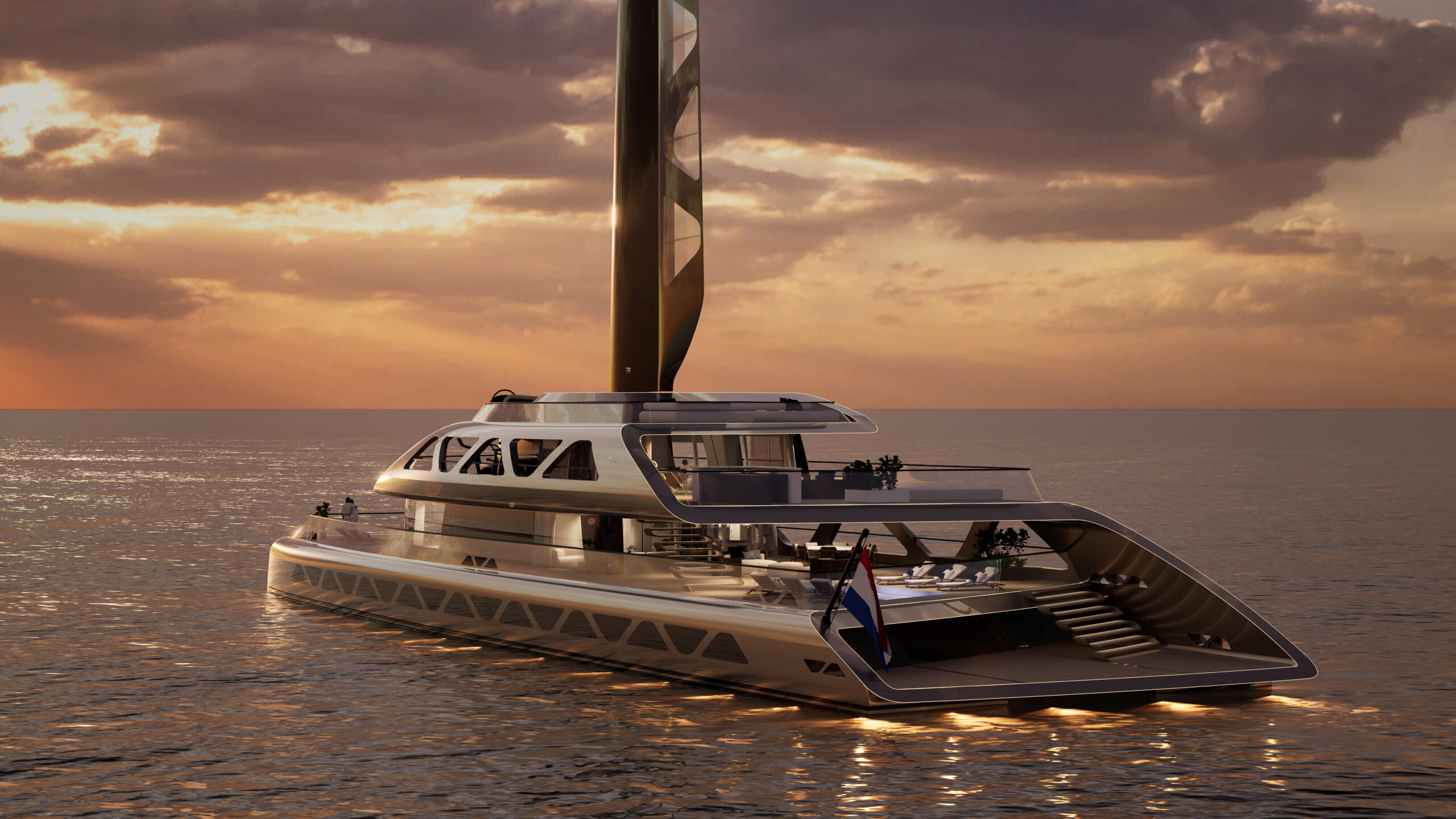
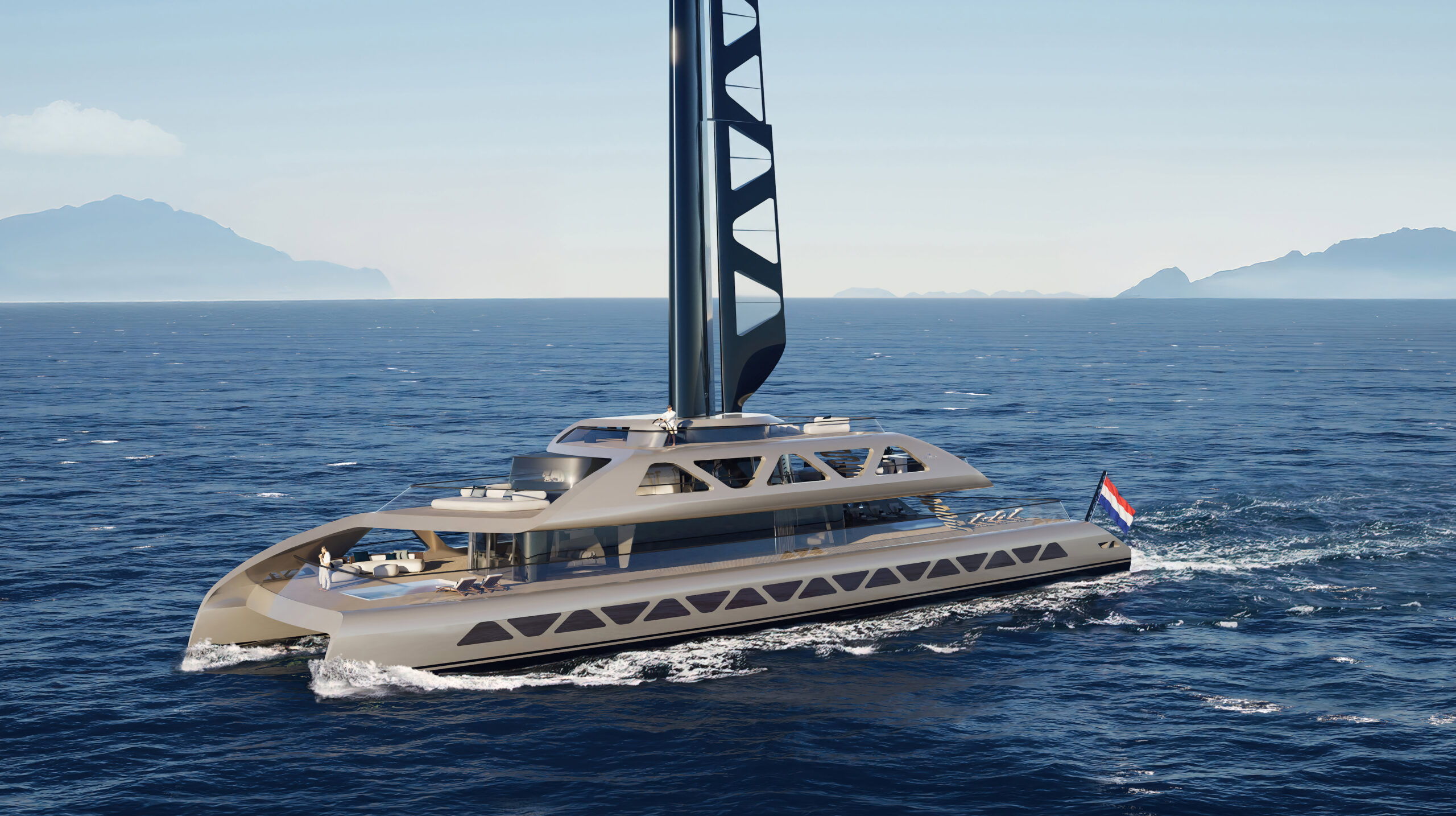
A new generation of clean-energy superyachts is emerging from the Netherlands. Royal Huisman, the shipyard that built Ethereal – the world’s first hybrid superyacht – has unveiled AERA, a 50-m catamaran concept that merges wind, hydrogen, and electric propulsion into a seamless system of intelligent automation. This visionary project positions AERA at the forefront of sustainable superyachts, redefining expectations for the future of eco-conscious luxury at sea.
Developed with Rondal, Artemis Technologies, and Cor D. Rover Design, AERA embodies the shipyard’s “Project Tidal Shift” commitment to reducing environmental impact through innovation. The result is a vessel that can sail, motor, and anchor with near-zero emissions, while maintaining the craftsmanship and refinement for which Royal Huisman is renowned. By combining advanced hybrid propulsion systems with renewable energy integration, AERA sets a new benchmark in performance and responsibility.
A New Tack for Clean Cruising
Royal Huisman’s legacy in sustainable innovation dates back to 2008, when it launched Ethereal, a 58-m ketch equipped with a pioneering hybrid propulsion system and an integrated lithium-ion storage bank. AERA builds on that foundation, representing a significant leap toward a truly circular, clean-energy yacht ecosystem and advancing the evolution of zero-emission yachts.
The challenge was to create a yacht that combines the ease of a motoryacht with the thrill of sailing, without the mechanical complexity and crew demands that often discourage owners from using their sails. By rethinking propulsion from first principles (integrating aerodynamic, hydrodynamic, and energy systems into a single architecture) the shipyard’s design team set out to remove those barriers entirely while advancing next-generation hydrogen propulsion yachts technology.
“We know from research that sailing yachts don’t hoist their sails as often as they could,” says Jan Timmerman, CEO Royal Huisman. “With AERA, you set a destination, and within a minute you’re sailing – no rigging, no winches, no sheets. It’s as easy as running a motoryacht but powered by the wind.”
Engineering the Wing Sail Revolution
At the heart of AERA stands a 35-m (115-ft) Wing Sail: an unstayed, rotating, carbon-composite airfoil with 245sq.m (2,640sq.ft) of surface area. Developed by Rondal in collaboration with Artemis Technologies, it adapts America’s Cup (from previous editions, with rigid-wing catamarans) and SailGP wing technology to the world of cruising superyachts, introducing a new era of automated sailing yachts.
The wing rotates 360° for optimum performance on any point of sail and can depower completely while staying upright. Its trailing-edge flaps, actuated hydraulically, adjust up to 30 degrees to control lift and thrust. There are no sails to hoist, no rigging, and no winches: all movements are managed by twin electric motors at the mast base and a fully automated control system. AERA’s concept specifically notes the wing can be inclined horizontally for stow/clearance or extreme conditions.
Artemis Technologies CEO, Iain Percy, a double Olympic gold medallist and 4-time America’s Cup veteran, calls the system “a bridge between high-performance racing and clean maritime technology.”
“We started by asking why superyachts that already have sails weren’t sailing more often,” Percy explains. “The answer was: complexity. So, we focused on automation – using our experience in simulation and control systems to make sailing effortless.”
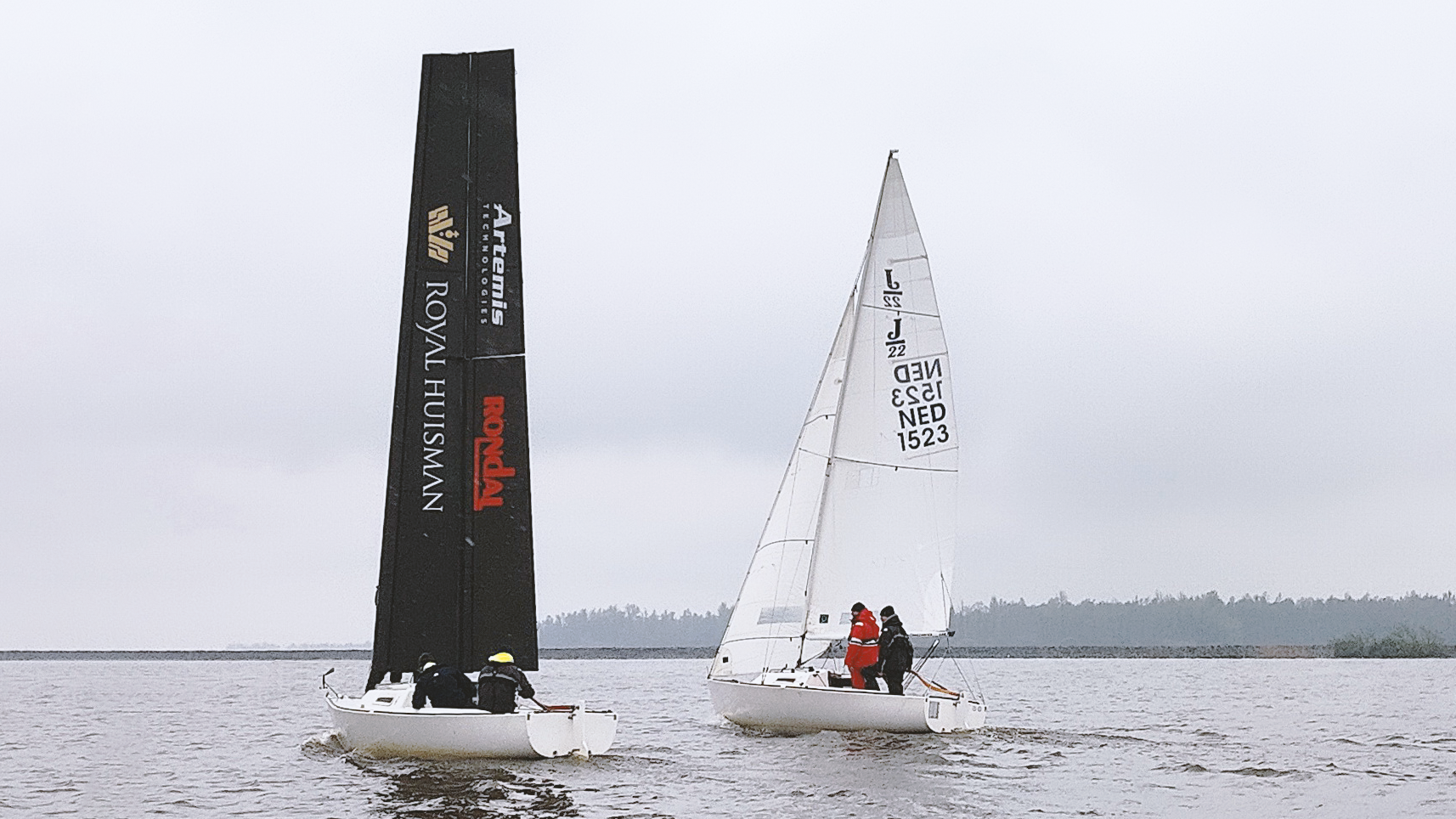
- Height: 35m / 115ft
- Sail area: 245m² / 2,640sqft
- Rotation: 360° continuous
- Structure: carbon fibre with Mylar flaps
- Control: automated electric & hydraulic actuators
- Power equivalent: +60–80% vs. triangular rig
- Heel angle: <2° during normal sailing
Hybrid Energy Architecture
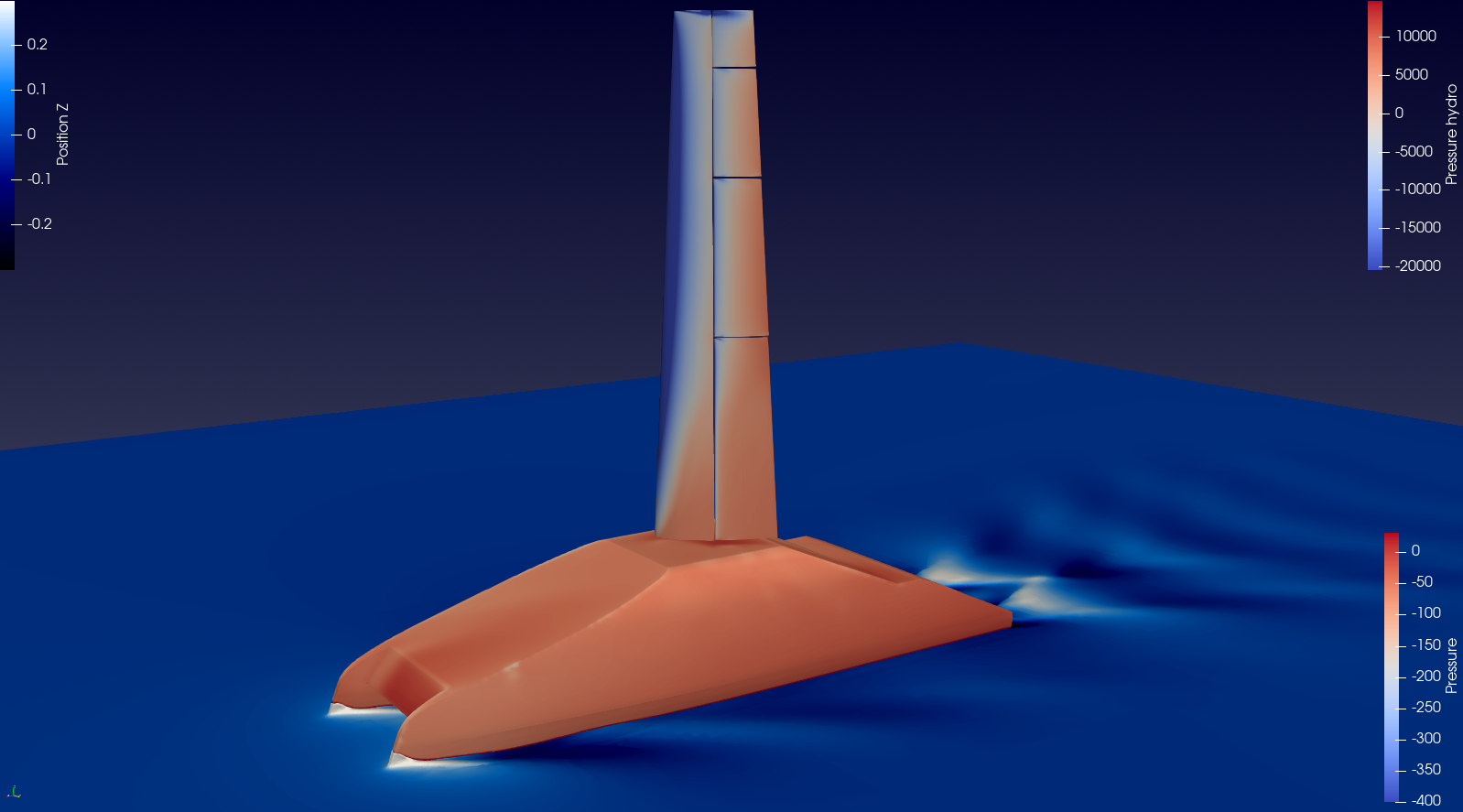
Complementing its advanced rig, AERA integrates a hybrid Energy Storage System (ESS) combining 3 sustainable power sources:
- a 580kWh lithium-ion battery bank charged through hydro-generators while sailing;
- a 60kW hydrogen PEM fuel cell drawing from three 62kg pressurised hydrogen tanks;
- 2 variable-speed gensets compatible with Hydrotreated Vegetable Oil (HVO) fuel.
Together, they allow the yacht to operate silently and emission-free for up to 72 hours at anchor. The battery bank alone provides 11 hours of full ‘hotel load’, powering air conditioning, galley, and lighting. The hydrogen system extends autonomy while remaining vibration-free and odorless. When additional power is needed, the HVO gensets reduce CO₂ emissions by up to 89%, particulates by 80%, and NOx by 8% compared to conventional diesel.
“The goal is seamless energy management,” says Royal Huisman’s Innovation Director. “The yacht decides the most efficient energy source for each condition – whether it’s sailing with regenerated power, running silently at anchor, or crossing oceans on HVO.”
Hydrogen storage and fuel cell integration are certified under Lloyd’s Register Approval-in-Principle (AIP), marking an industry first for yachts under 500GT. The system builds on experience from hydrogen-powered America’s Cup chase boats, adapted to marine-grade safety and redundancy standards.
| Source | Output | Duration / Function |
|---|---|---|
| Battery bank | 580kWh | 11 hrs silent hotel load |
| Hydrogen fuel cell | 60kW (3,000kWh total) | 72 hrs zero-emission mode |
| Hydro-generators | 4 × 15kW | 40kW at 12 knots |
| HVO gensets | 2 × 515kW | backup / transatlantic range |
Propulsion Integration and Control Systems
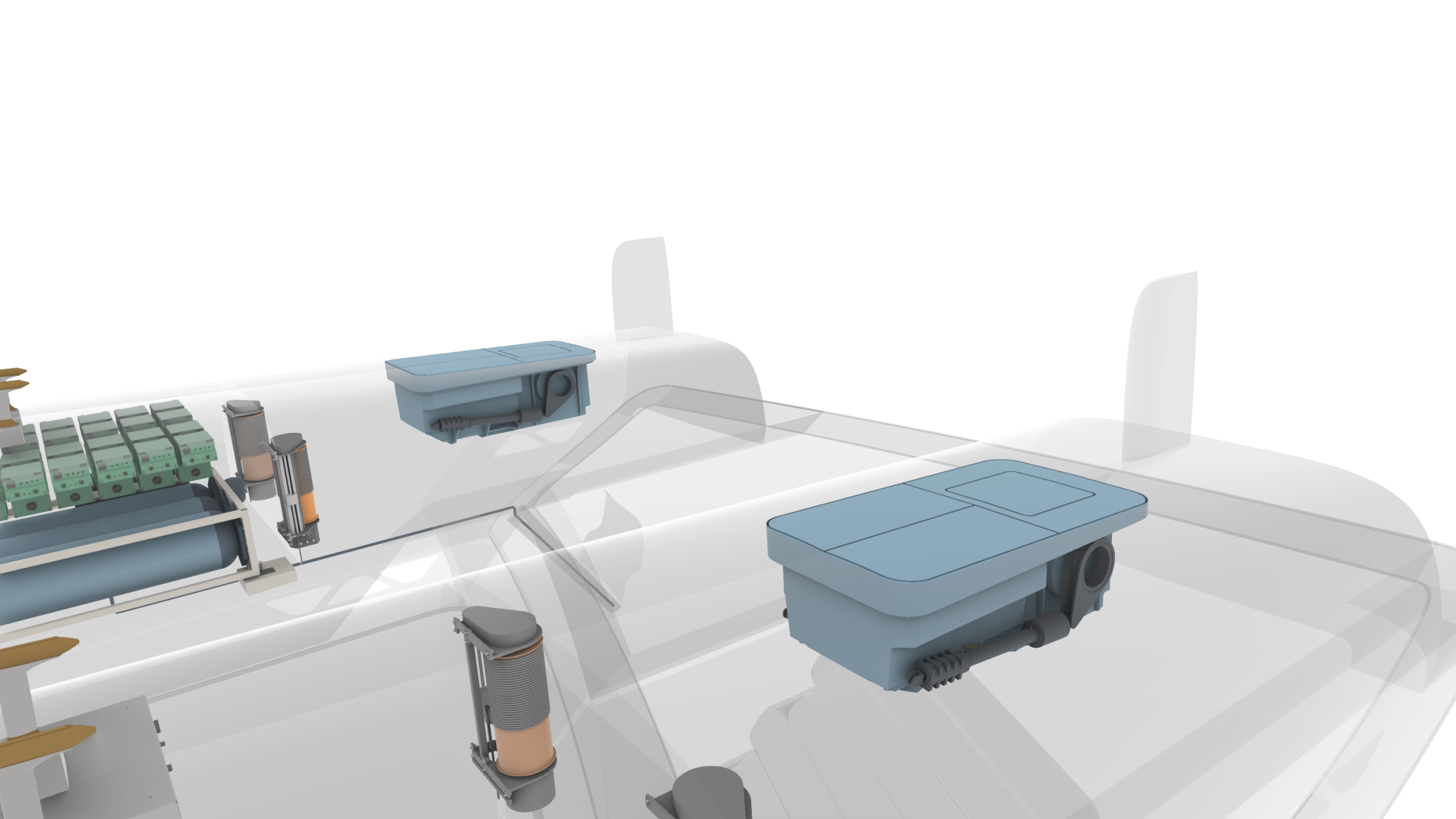
AERA’s propulsion architecture is equally advanced: two 500kW retractable azimuthing thrusters (RPS units) deliver 12-knot cruising speed and 14-knot maximum. Developed by Rondal and Royal Huisman, these forward-facing propellers can rotate independently for agile manoeuvring and eliminate the need for stern thrusters.
When retracted, the drive legs nest within the hulls, dramatically reducing drag. When extended, they can operate in ‘motorsailing’ mode, blending electric thrust with aerodynamic lift from the Wing Sail. Both drives can also regenerate electricity under sail, feeding power back into the ESS.Introduced on Royal Huisman’s Sarissa (2023), the RPS system won the 2024 Design & Innovation Award for its compact, vibration-free design. The technology represents a key step toward quiet, emission-free cruising in marine protected areas.
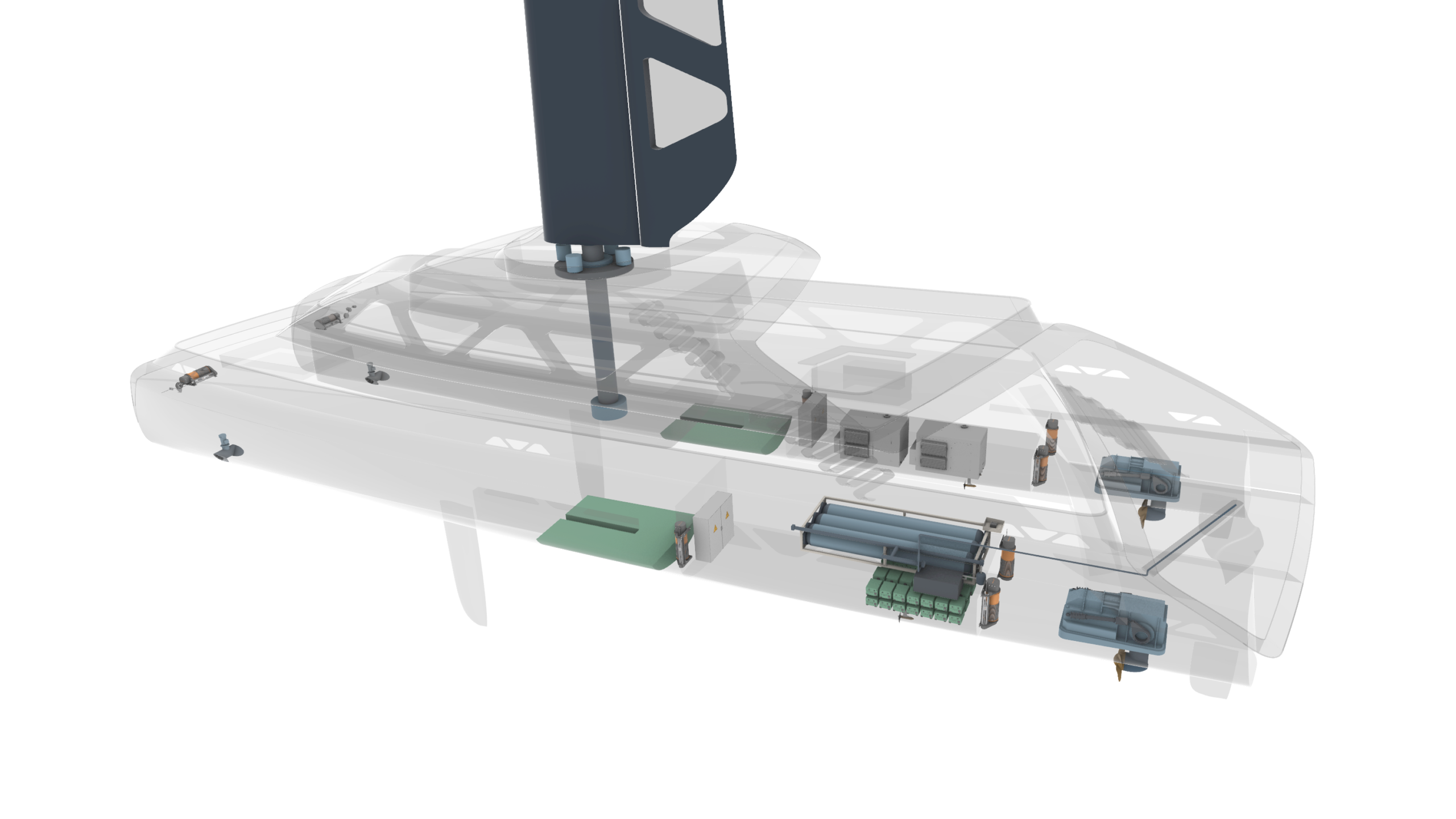
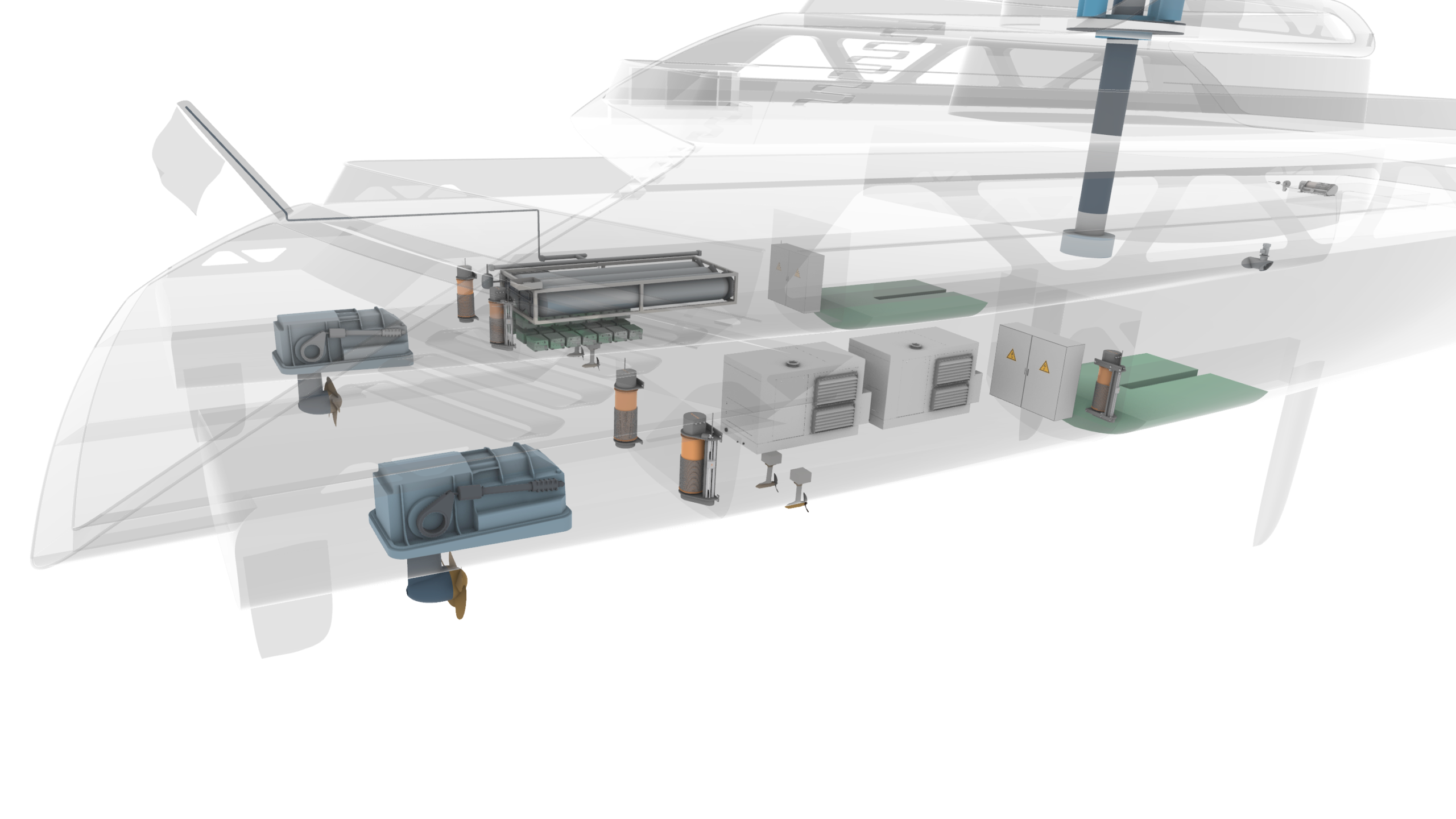
- Twin retractable 500kW azimuthing thrusters
- Integrated with onboard energy management logic
- Seamless transition between propulsion, hydro-generation, and battery recharge
- Independent control for precision manoeuvring
- Near-silent operation in harbour mode
Designing for Experience and Efficiency
Cor D. Rover’s architectural vision translates this technological sophistication into a coherent lifestyle experience. His asymmetrical lattice superstructure, inspired by bridge architecture, provides strength with lightness while maintaining the yacht under 500GT.
“The catamaran was the ideal platform,” Rover explains. “It offers psychological stability, a natural balance for the fixed wing, and phenomenal deck space for outdoor living.”
The spaces on board
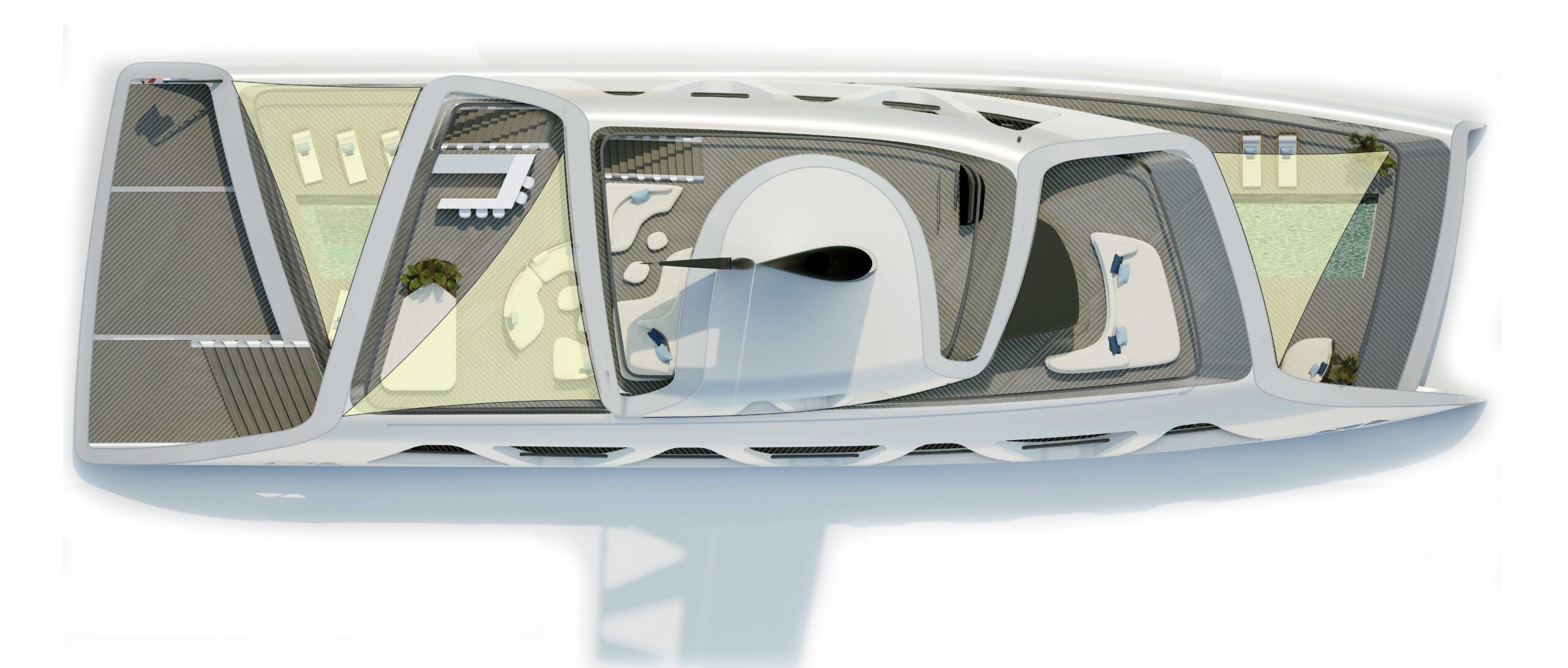
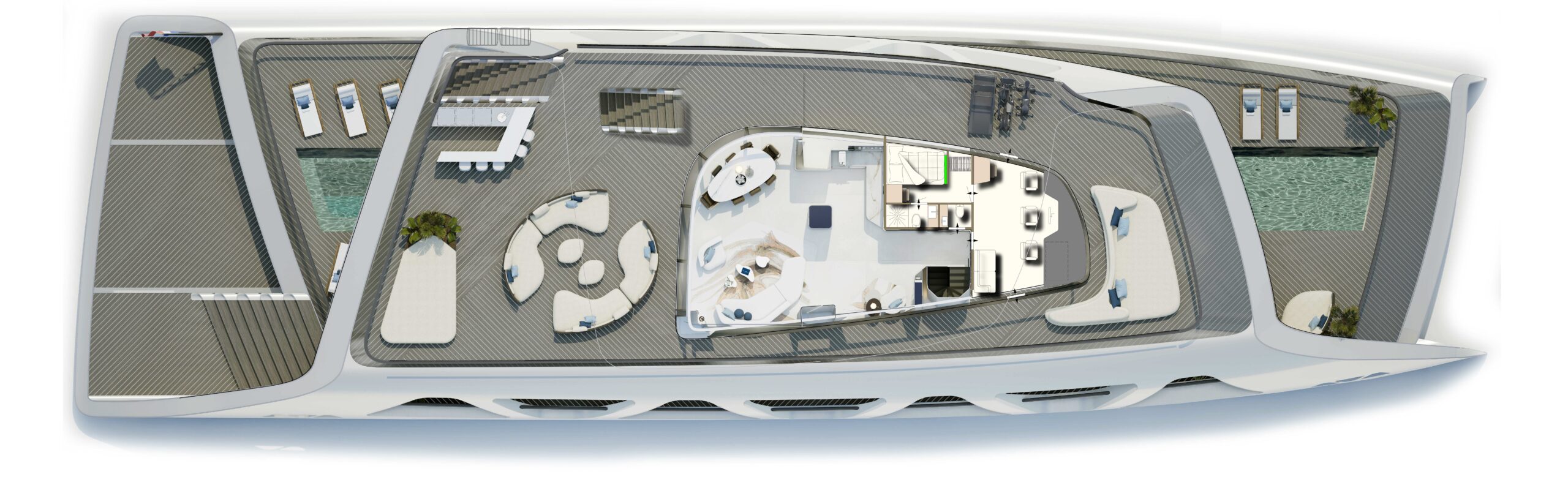
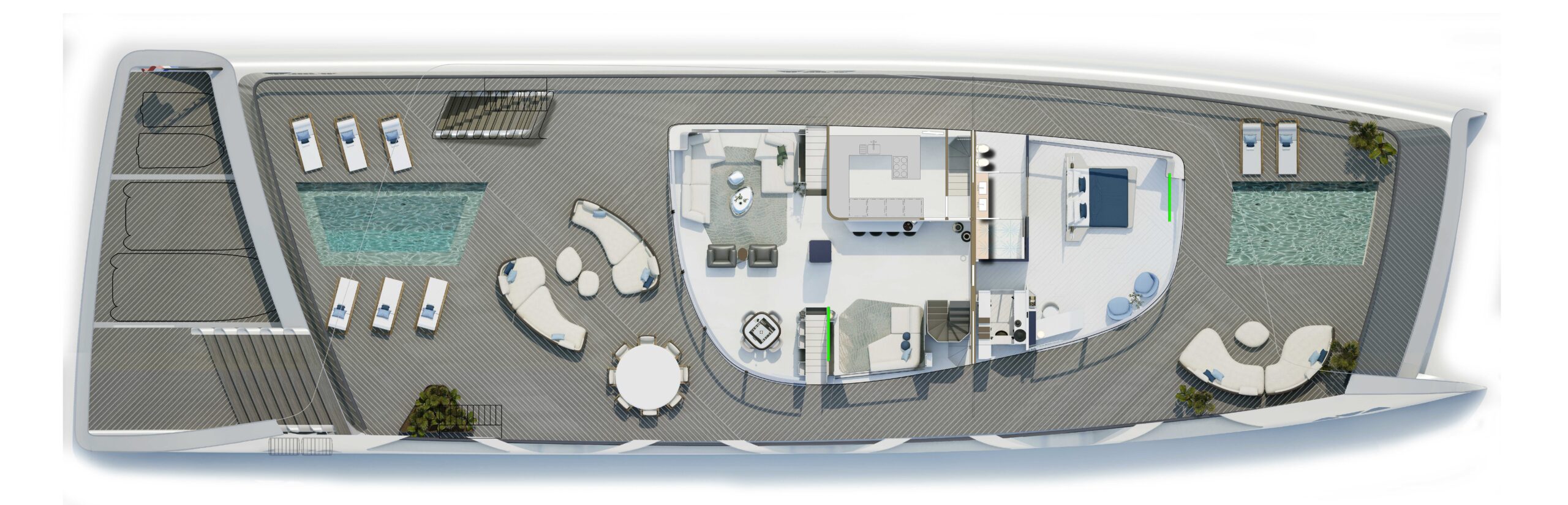
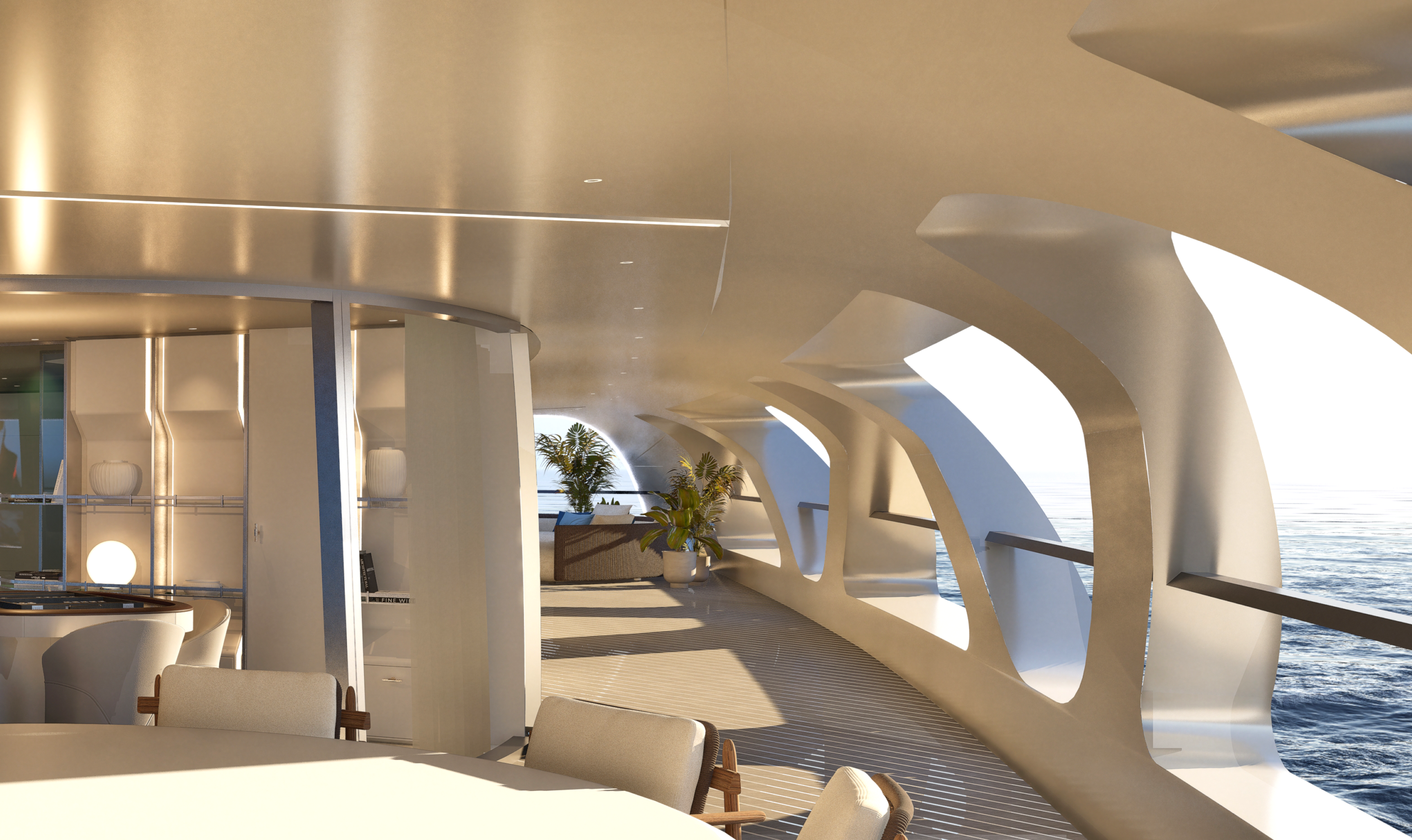
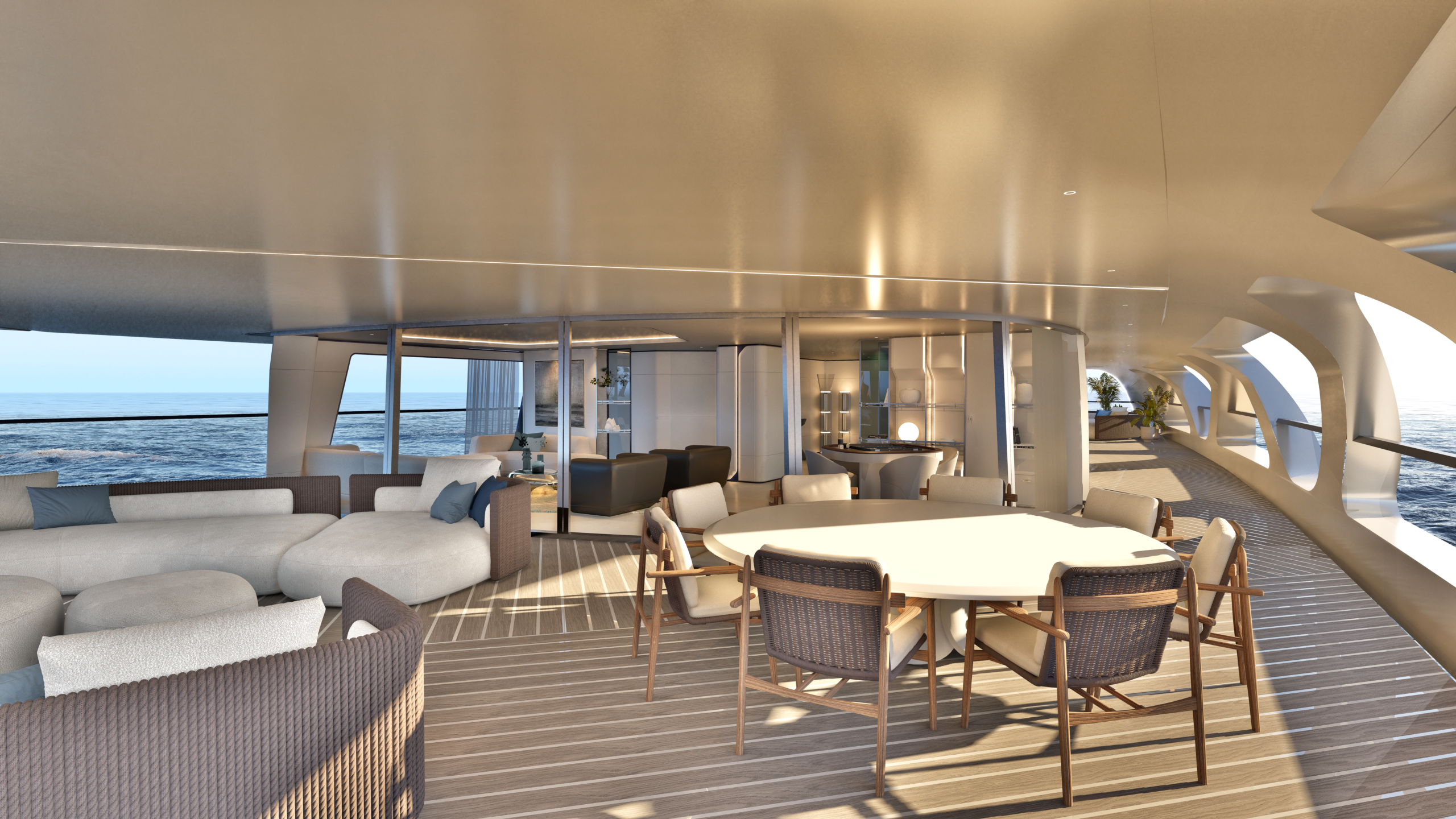
AERA offers 694sq.m (7,470sq.ft) of exterior area – comparable to a 70-m monohull – distributed over 3 decks. Modular living pods connected by shaded walkways create distinct ‘destinations’ aboard, encouraging guests to move through zones of light, air, and shade. This design also cuts HVAC load by shielding windows beneath deck overhangs.
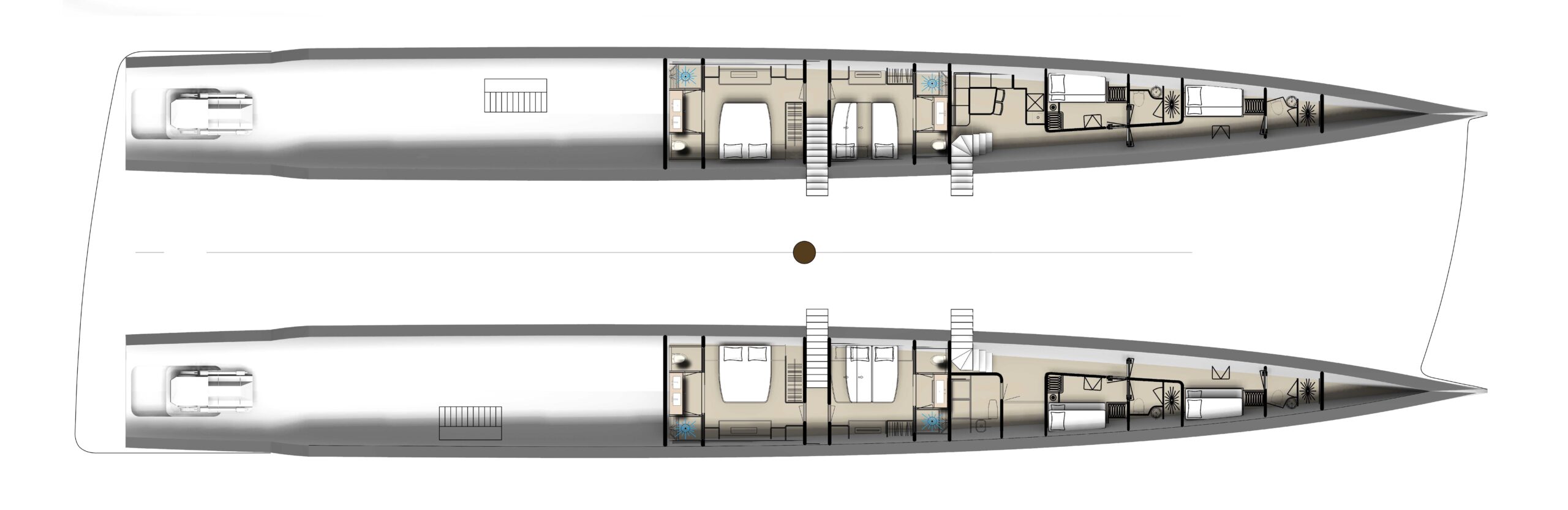
The main-deck owner’s suite spans 44sq.m, with a 153sq.m private terrace featuring a pool and massage room. 4 guest cabins occupy the hulls, and the crew complement totals 7 plus a captain. With less than 2 degrees of heel under sail, the yacht offers exceptional comfort and safety in motion.Another standout feature is the laser fibre-optic exterior lighting system developed with Fibr8.com. Continuous glowing threads trace AERA’s geometry, accentuating her form at night with minimal energy use and maintenance – technology already proven on Phi and Special One.
- Asymmetrical dual-hull layout for hydrodynamic efficiency
- Lattice superstructure reduces weight and solar load
- Shaded walkways minimise HVAC demand
- Aluminium construction for recyclability
- LED/laser hybrid exterior lighting with low power draw
Materials, Certification, and Validation
Constructed in aluminium with composite wing structures, AERA meets Lloyd’s Register notation 100A1 SSC YACHT Mono G6, LMC, and Hybrid Power standards. Her systems architecture allows full monitoring through Royal Huisman’s proprietary alarm and control software, integrating propulsion, power management, and environmental sensors into a single digital platform.
Each innovation (from hydrogen storage to retractable propulsion) has undergone simulation, prototype validation, and safety evaluation by the shipyard’s engineering partners. The project team emphasises that AERA is not a theoretical design: it is ready for build and scalable for future custom projects.
“When others say it’s impossible, we investigate – and often prove it can be done,” says Timmerman. “AERA demonstrates that sustainable luxury can be effortless, safe, and technically robust.”
Technology Meets Responsibility
AERA also aligns with global maritime trends. Wind-assisted propulsion systems are already reducing emissions in commercial shipping by up to 19% annually. AERA applies the same logic to the superyacht sector, aligning with European FuelEU Maritime goals and the YETI sustainability rating.
For Royal Huisman and Rondal, this concept is part of a wider industry transformation. “Each system we develop for AERA – from the wing sail to the hydro-generators – can be transferred to other yachts,” says the R&D team. “It’s about modular sustainability: making innovation scalable.”
A Blueprint for the Next Decade
With AERA, Royal Huisman redefines what hybrid yachting can achieve. The concept integrates automated sail control, hydrogen energy, and intelligent power management into one cohesive system. Its combination of radical efficiency, refined design, and proven technology makes it not a dream, but a credible path forward.
In an era where sustainability and innovation must coexist, AERA shows that elegance and responsibility can share the same deck. As her name – derived from the Latin aer, meaning air – suggests, she moves with the wind and breathes with the planet.
AERA is not merely a design concept but a manifesto for the future of yachting. It merges the artistry of Cor D. Rover with the precision of Artemis Technologies and the innovation legacy of Royal Huisman. Every component – from the hydrogen tank to the lattice frame – embodies one philosophy: to sail in harmony with nature, without compromise.
| Length overall | 50m / 164ft |
| Beam | 14.5m / 47ft |
| Draft | 3–7m (9–24ft) |
| Gross tonnage | <500GT |
| Hull / Superstructure | Aluminium |
| Wing Sail | 35m height / 245m² area |
| Propulsion | 2 × 500kW retractable azimuth drives |
| ESS | 580kWh Li-ion + 60kW H₂ fuel cell |
| Cruising speed | 12 knots |
| Range | 2,750nm @ 8 knots |
| Zero-emission mode | 72 hours |