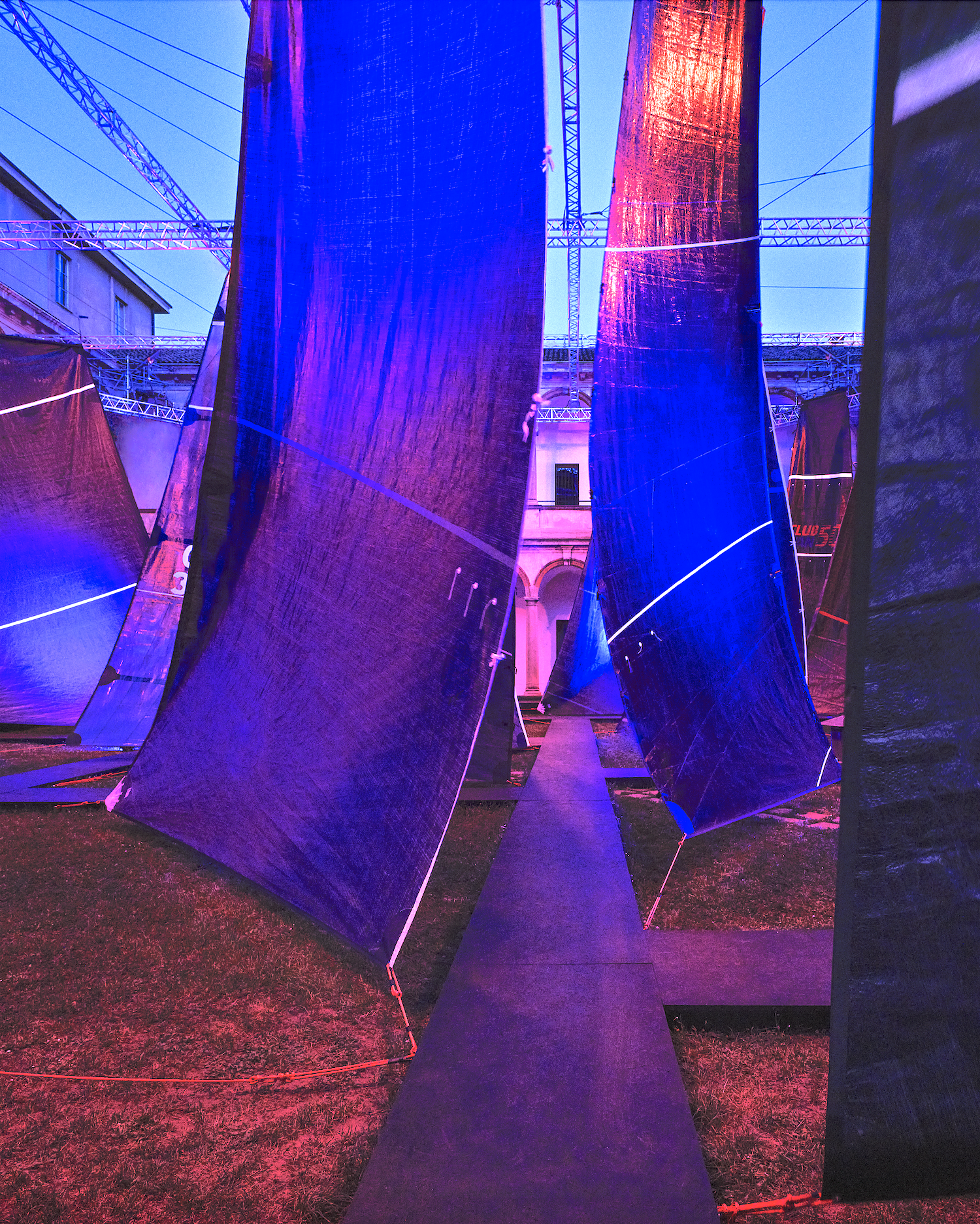
Sanlorenzo has taken its stage at Milan Design Week 2025 with the evocative installation Wind Labyrinth
created by architect Piero Lissoni, who is the shipyard’s Art Director since 2018.
The piece formed part of the INTERNI CRE-ACTION exhibition and was situated in the Cortile del Settecento (also known as the Cortile delle Balie), an elegant 18th Century courtyard at the University of Milan. The architectural understatement of this historic setting heightened the visual and emotional impact of the installation, offering an atmospheric backdrop for a design experience rooted in symbolism and vision.
The convergence of Creativity and Action
The shipyard transcended the boundaries of conventional display formats. Rather than presenting a static
exhibit, Sanlorenzo reimagined the courtyard as an immersive environment. This curatorial choice dovetails
with the overarching theme of this year’s exhibition: the convergence of Creativity and Action, where
design becomes a tool for responsibility and forward momentum.
Wind Labyrinth serves as a tangible manifesto for the future of sustainable yachting – an industry redefined by aesthetics, technological progress, and environmental awareness.
From Technical Waste to Poetic Structure: The Art of Upcycling
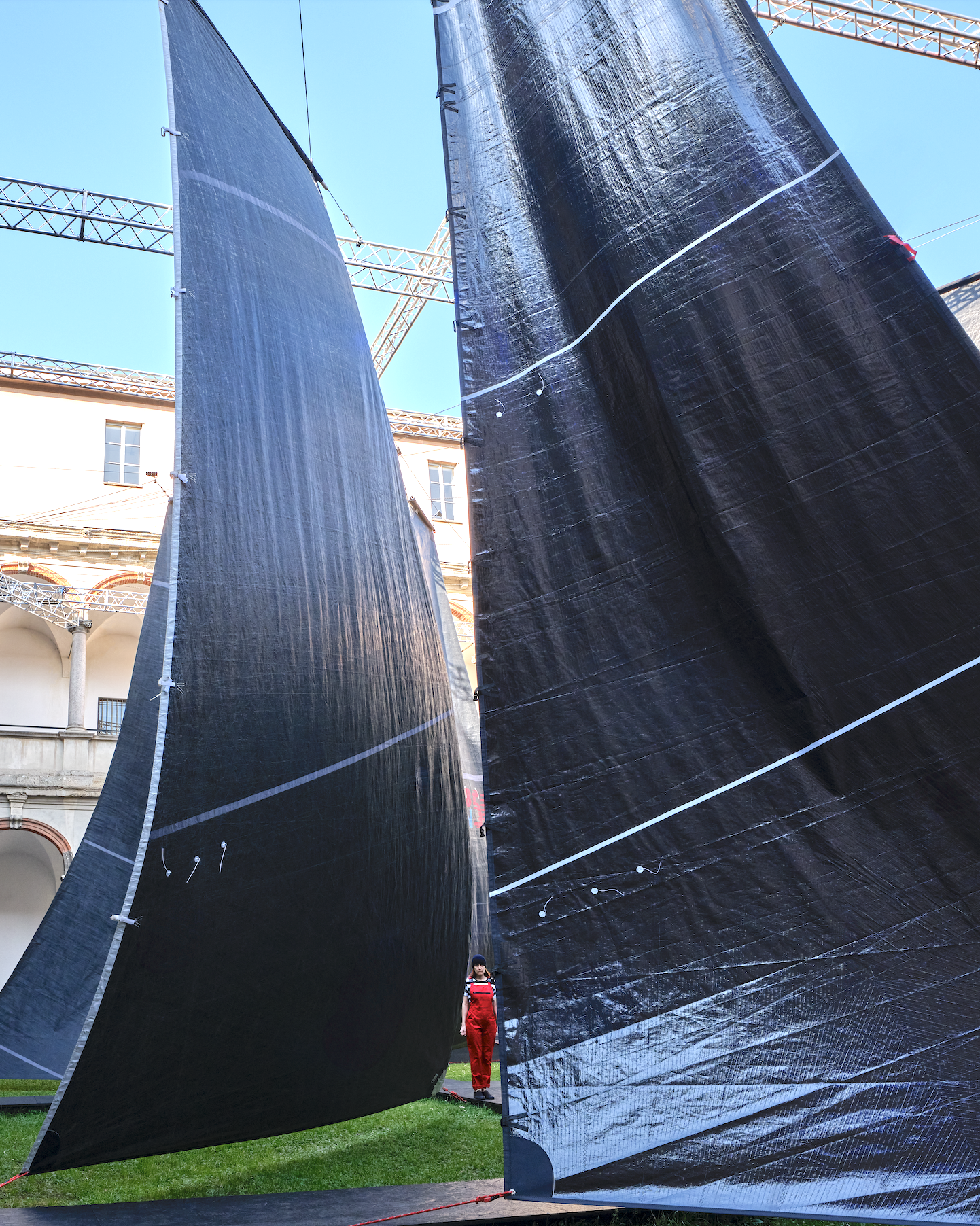
The installation takes the form of a walkable labyrinth, constructed from discarded sails that once graced
the world of competitive sailing. Through a process of imaginative upcycling, these high-performance
textiles – originally bound for landfill – are transformed into sculptural and architectural elements. Lissoni’s
vision arranges them into an open-air maze, where light and air pass effortlessly through the woven fabrics,
evoking the kinetic essence of wind at sea and the fluid grace of a yacht under sail.
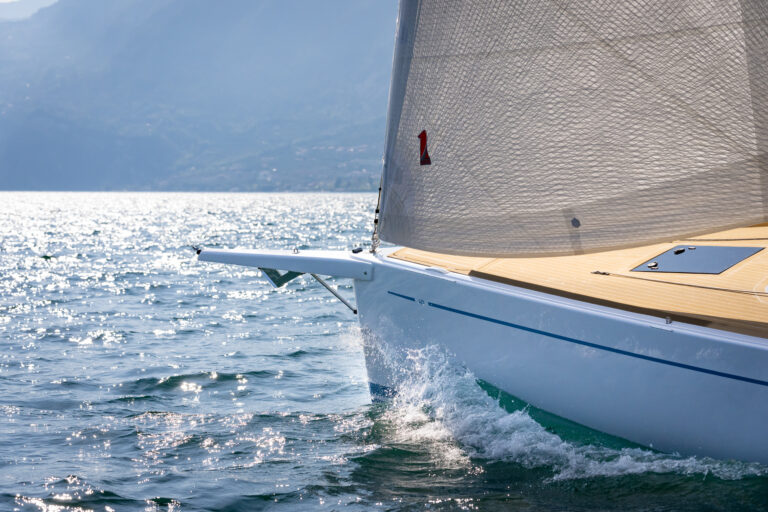
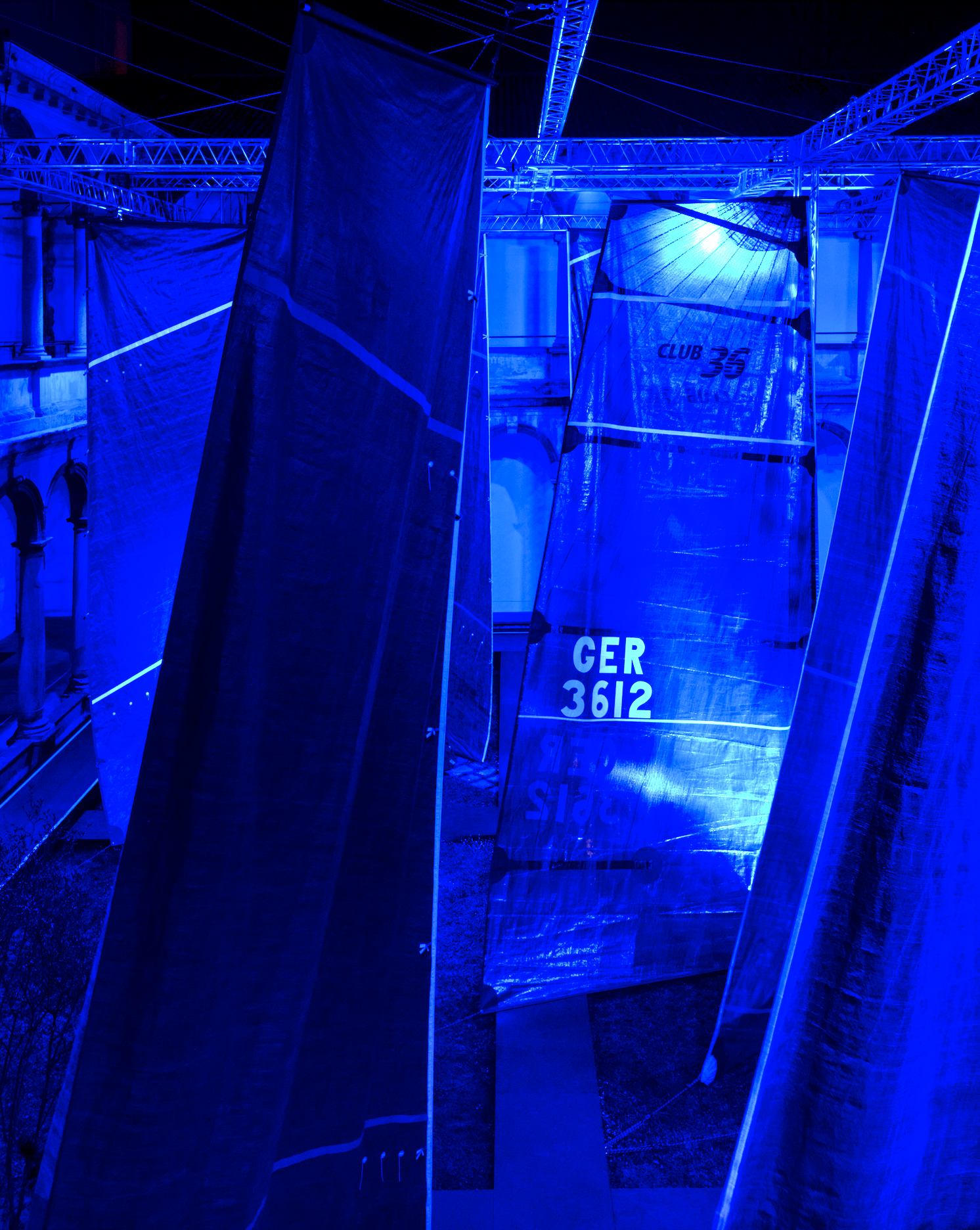
Adding further depth, the sails themselves come from one-design yachts built by Nautor Swan, the
prestigious Finnish shipyard celebrated in regatta circuits. Now part of the Sanlorenzo family as of summer
2024, Nautor Swan’s legacy infuses the installation with added resonance. Wind Labyrinth becomes both an
homage to nautical craftsmanship and a poetic dialogue between two protagonists of marine design
excellence.
A Multisensory Voyage
Far from a mere decorative gesture, Wind Labyrinth unfolds as a total experience – a space to be navigated
like a yacht on the open sea.
Visitors are invited to explore the space as though part of a yacht crew poised at the starting line of a
regatta. The large black sails, positioned as if hoisted and ready to be drawn tight, are steered by shifting
shadows and invisible currents of air and evoke the tension and excitement of an imminent departure.
The experience unfolds with quiet intensity; the gentle layering of birdsong, distant echoes, and the
murmur of the sea forms an atmospheric soundscape that deepens the sense of immersion.
Enveloped by a silent choreography of moving sails, one feels both anchored and adrift – suspended in a moment of stillness just before the race begins.
Philosophical Meditation
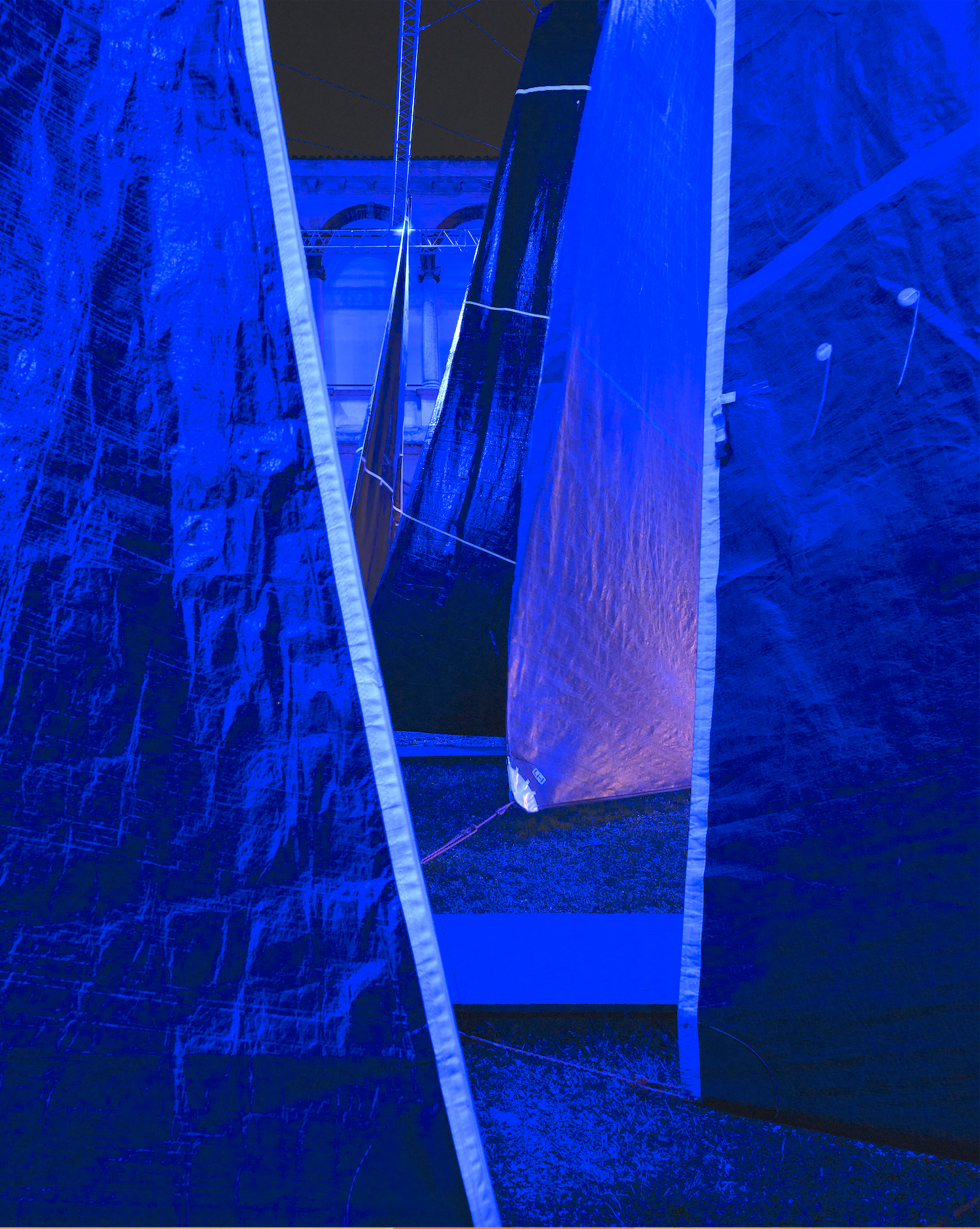
Due to limitations on the maximum height of the supporting scaffolding, the sail heads had to be furled,
creating a sense of enclosure – almost as if the space were capped by a virtual ceiling, lending the
impression of a room filled to its limits.
Such quality invites reflection on the relationship between enclosure and openness, stillness and motion,
presence and perception. In this way, the installation becomes not just a visual spectacle but a
philosophical meditation.
Innovation and Ecology
With this latest project, Sanlorenzo reaffirms its ambition to steer the future of yachting away from pure
luxury and towards a culture of design that is reflective, responsible, and attuned to contemporary
challenges. The use of recycled materials, the integration of historical architecture, and the emotional
storytelling all reinforce the shipyard’s ongoing commitment to eco-friendly yacht design and aesthetic
experimentation.
Massimo Perotti, Executive Chairman Sanlorenzo, reflects on the project’s significance:
“With the Wind Labyrinth installation, through which we pay tribute to the spirit of Nautor Swan, we
reaffirm our commitment to sustainability and to a vision of yachting that is deeply integrated within an
ecosystem of excellence and innovation.”
Setting Course for Venice: A Cultural Odyssey
Wind Labyrinth is the latest expression of the shipyard’s ongoing commitment to redefining the
relationship between art and the sea. A pioneer in luxury yachting, Sanlorenzo was the first to collaborate
with leading architects and designers on yacht interiors. Through its platform Sanlorenzo Arts, the brand
supports innovative artistic dialogue, blending creativity with high-end nautical design. Its presence at
Milan Design Week forms part of a wider cultural initiative, which has included institutional partnerships
such as its patronage of the Peggy Guggenheim Collection (2020–2022) and its role as main sponsor of the
Italian Pavilion at the 59th Venice Biennale—marking a world first for a yacht builder. This long-standing
dedication to the arts and to Venice will culminate in Casa Sanlorenzo, a permanent cultural hub exploring
the intersection of art, marine technology, and design.
A Conscious Luxury that Listens to the Wind
In Wind Labyrinth, Sanlorenzo defines a new vocabulary for luxury: one where the material language of the
wind, the tactility of sailcloth, and the rhythm of motion converge in a narrative of transformation.
The installation celebrates not just the elegance of sailing, but its symbolic power, as a metaphor for
navigating change, embracing complexity, and designing with conscience.
This is a future-facing vision for the nautical industry, in which beauty and performance are no longer at
odds with ecological intelligence. Here, design is a strategy for impact; storytelling becomes a vessel for
awareness; and innovation emerges as a shared voyage into uncharted waters.
From Impossible Machines to Underwater Worlds
In 2023, La Macchina Impossibile (The Impossible Machine) presented a kinetic sculpture inspired by the
mechanical ingenuity of Leonardo da Vinci. Designed to envision a zero-emissions future, the metallic
structure featured a continuously rotating propeller, powered by a green methanol energy system
developed with Siemens Energy.
The same installed onboard of 50 Steel, the first superyacht equipped with
a green methanol Reformer Fuel Cell System, capable of producing up to 100 kW zero emissions energy for
the hotellerie.
A year later, SUB – Sustainable Underwater Balance invited visitors into a dreamlike marine landscape: an
artistic and ecological tableau submerged in symbolism. The centrepiece was the BGH-HSV (Hydrogen
Support Vessel), a 10-m foiling catamaran developed by Bluegame, a brand of Sanlorenzo, and designed to
support racing teams in the America’s Cup. Entirely powered by hydrogen, the vessel embodied the fusion
of form, function, and sustainability.
Like its predecessors, Wind Labyrinth goes beyond static exhibition. It continues the legacy of transforming
prestigious design events into platforms for bold ecological storytelling where technology, beauty, and
responsibility set sail together. Under Lissoni’s creative direction, the shipyard has consistently
demonstrated how architectural language and marine innovation can coalesce to inspire new ways of
thinking about the sea.