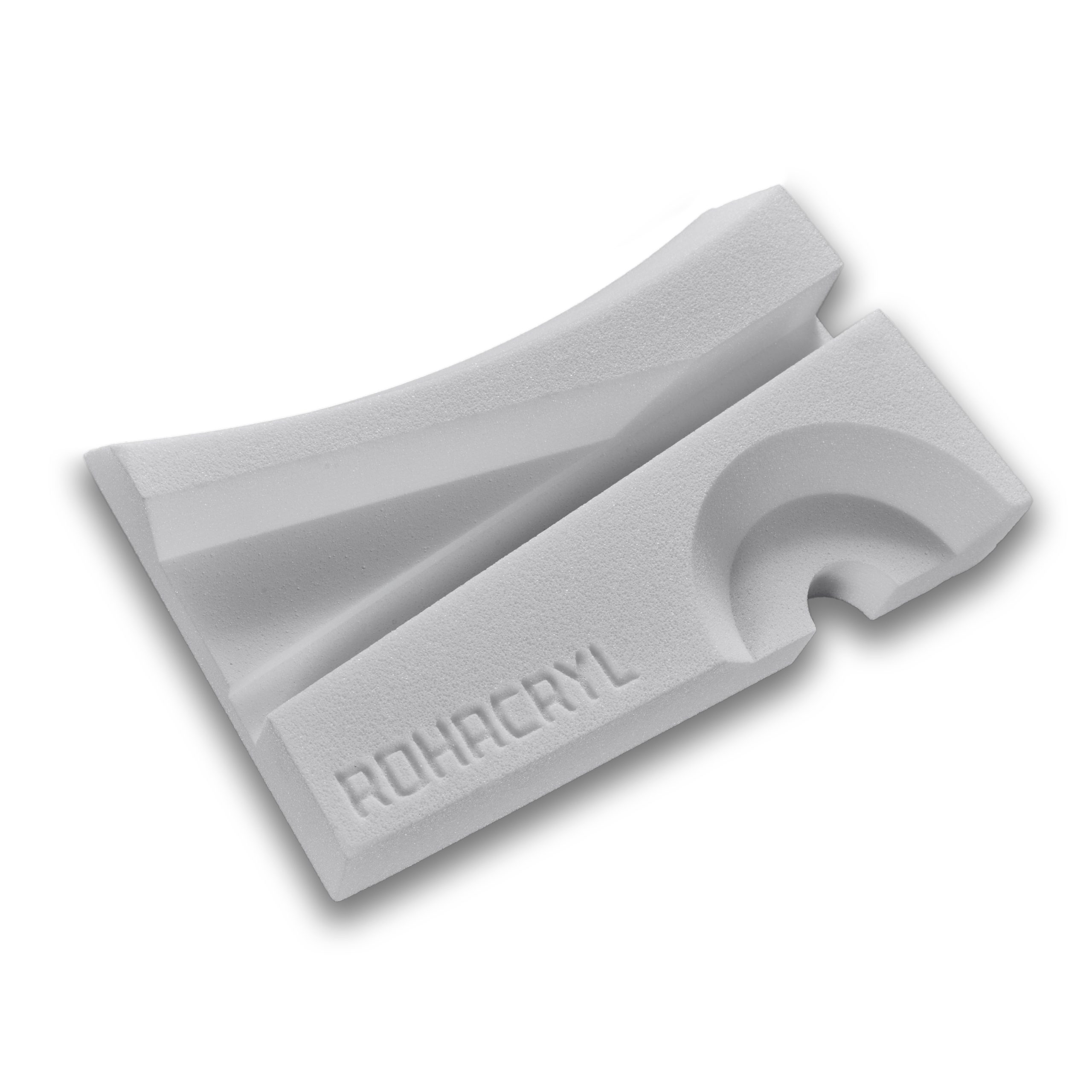
ROHACRYL™, produced by Evonik and distributed in Italy by Vink Italia, is a new generation of lightweight marine foam developed for marine composite applications, designed to combine weight reduction, high mechanical performance, and improved environmental sustainability.
ROHACRYL introduces into the shipbuilding industry a material that combines lightness, mechanical reliability, and sustainability. It provides a practical alternative to conventional foams and paves the way for broader adoption of acrylic-based core materials in shipbuilding.
Several advantages
According to the company, compared to traditional core materials such as PVC, PET, or SAN, ROHACRYL shows low resin uptake, which reduces raw material consumption and overall costs while maintaining comparable strength levels. Its lower density enables the production of lighter components without compromising stiffness and stability – an important factor in shipbuilding, where weight reduction directly affects performance and fuel efficiency.
From a technical perspective, the foam offers high thermal stability, allowing faster and more reliable manufacturing processes. Its isotropic, small, and homogeneous cells ensure uniform material properties and consistent mechanical performance. This enables the use of lower densities while maintaining strength, providing benefits in terms of lightweight construction and easier processing.
Practical implementations
In marine construction, ROHACRYL can be used in several structural components:
• for superstructures, it allows the use of very low densities while still achieving class-A surfaces, even in dark colors;
• for decks, it provides high shear strength and stiffness;
• in interiors and bulkheads, thinner cores allow greater design freedom and cost savings;
• in transoms, the material contributes to maximum stiffness and improved fatigue resistance.
A first practical implementation was carried out in the Swiss Solar Boat project, where ROHACRYL was used in parts such as bulkheads, stringers, and covers to improve structural integrity and reduce weight. Further applications are under development to expand its use in marine environments.
Certifications and sustainability
In terms of certification, the material is currently undergoing approval by DNV, one of the leading classification societies in the maritime sector. This certification will facilitate the integration of ROHACRYL into both new and existing designs.
Sustainability considerations are embedded throughout the entire lifecycle. ROHACRYL production is characterized by a low carbon footprint, with the potential use of recycled raw materials. During manufacturing, reduced resin absorption and lower overall weight further contribute to minimizing environmental impact. Compatibility with new acrylate-based resins and the possibility of monomer recycling at end-of-life support a more circular material cycle.