Within the recreational boating sector, collision prevention remains one of the areas with the greatest potential for technological advancement. Increasing coastal traffic density, the coexistence of highly heterogeneous vessels – from large yachts to small craft operating without AIS – and the continued reliance on human judgement often limit the effectiveness of traditional solutions based solely on range detection or indiscriminate radar target alerts.
WATCHIT Eye, developed in partnership between Watchit and Azimut, addresses these limitations through a systemic approach based on AI, sensor fusion and a new logic for maritime risk assessment. Rather than simply improving obstacle detection, it transforms navigation into a predictive process in which available data are interpreted to anticipate potentially hazardous situations, a key evolution in collision avoidance technology.
The concept originated within the Azimut|Benetti R&D environment, with the aim of transferring advanced prevention models into the recreational marine domain.
From data to prediction
In navigation, the most critical variable is not how close an obstacle is, but how much time remains to avoid it. Conventional systems typically assess risk primarily in terms of distance. Instead, WATCHIT introduces a time-based model in which parameters such as vessel speed, relative trajectories, environmental conditions and the commander’s reaction time are integrated into a predictive framework, redefining standards for predictive maritime safety.
The platform can be described as a predictive navigation system capable of transforming heterogeneous data – AIS, GPS, electronic charts, vessel kinematic data and visual sensors – into a dynamic risk representation. Through AI and sensor fusion algorithms, the system builds a real-time simulation of the vessel’s navigation environment. It does not merely determine where the vessel is; it also estimates what may happen in the next seconds or minutes, anticipating potential collisions or hazardous deviations.
The AI reconstructs a dynamic model of both the vessel and its operational context, enabling the system to evaluate not only the current situation but also the likely short-term evolution of the navigation scenario. This predictive capability allows warnings to be issued earlier, when the vessel’s master still retains sufficient operational margin to take corrective action.
Predictive analytics and machine vision
The system architecture is based on 2 main components designed to operate in synergy: WATCHIT Insight and WATCHIT Eye.
Insight represents the analytical and predictive engine of the platform. It processes digital navigation data to build a dynamic model of the operational environment and the potential interactions with surrounding vessels. By analysing trajectories and simulating route evolution, Insight can identify potential collision scenarios or hazardous deviations earlier than conventional systems, reinforcing its role in advanced AI navigation systems.
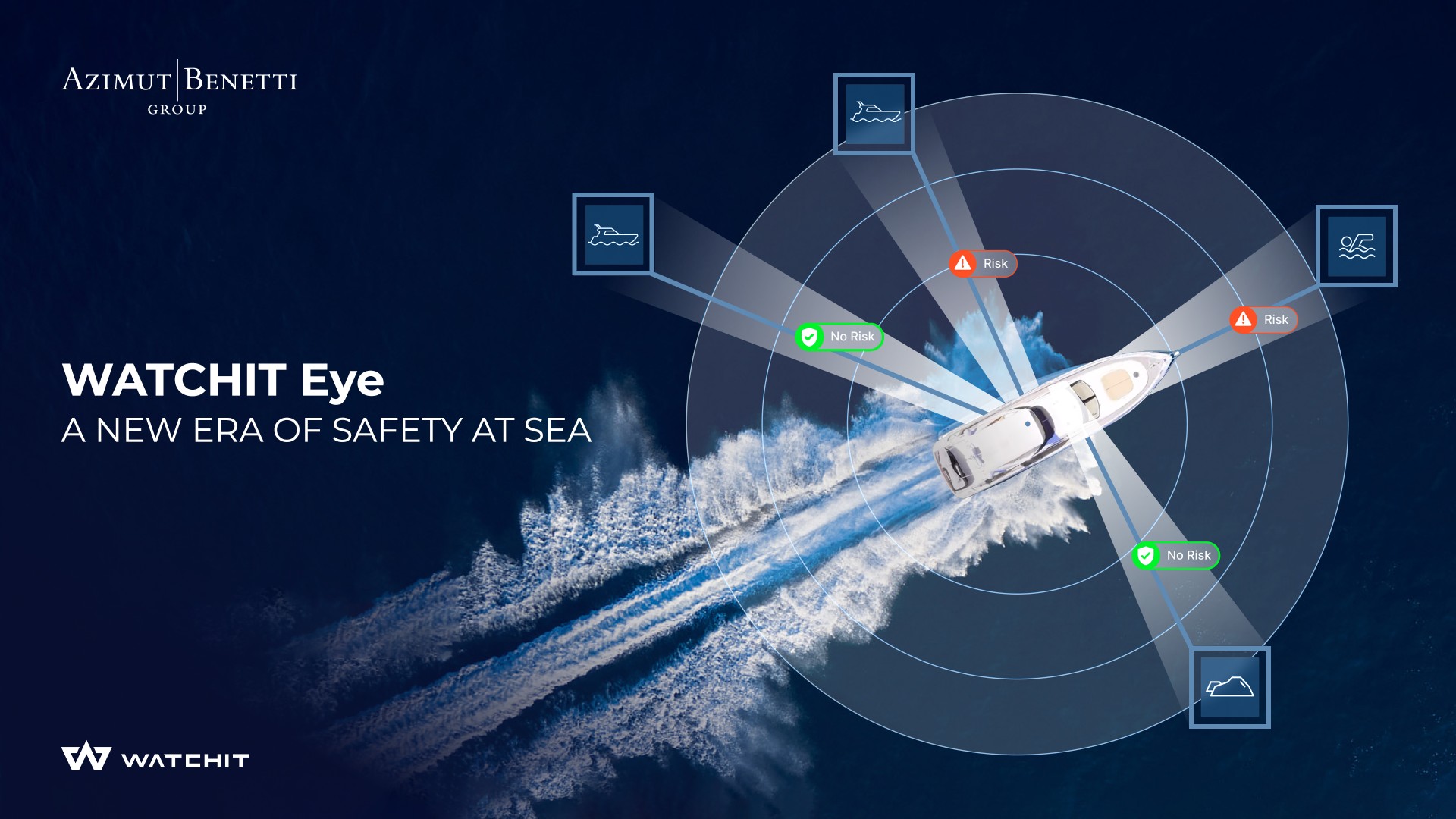
Eye, by contrast, provides the machine vision capability. Based on optical sensors and visual recognition algorithms, it detects objects that are not present in digital traffic data, such as small craft without AIS, buoys, floating debris, coastlines or harbour infrastructure.
Integration between the 2 components takes place through a sensor fusion process that correlates data from multiple sources: when Eye visually detects an object, Insight verifies whether a corresponding target exists in AIS traffic data. If no match is found, the object is classified as a non-cooperative target and its trajectory is analysed relative to the vessel’s course.
This mechanism allows the system to distinguish between targets that are merely present in the surrounding environment and those representing a genuine collision risk. The result is a significant reduction in irrelevant alerts, helping to minimise cognitive load on the vessel’s master.
The system proves particularly valuable in complex operational contexts, including night navigation, reduced visibility due to fog, heavy traffic areas or coastal zones where numerous small vessels operate without AIS.
Computer vision and target recognition
One of the most significant elements of the WATCHIT architecture is the computer vision module designed to interpret the maritime environment visually.
The system relies on deep learning algorithms trained to recognise objects commonly encountered in marine environments. The processing pipeline consists of 4 main stages:
• TARGET DETECTION: cameras and visual sensors identify objects emerging from the sea surface;
• CLASSIFICATION: algorithms attempt to determine the type of object – vessel, buoy, harbour structure, coastline or other obstacle – assigning each target a probability score;
• TRACKING: once classified, the object is tracked over time to determine speed, direction and dynamic behaviour;
• RISK ASSESSMENT: these data are then integrated into the predictive model to assess potential collision risk, strengthening collision avoidance technology.
Contextual filtering
To minimise false positives and information overload, the software employs contextual filtering. Targets that are moving away, maintaining a steady safe course or remaining outside the risk envelope are automatically excluded from the alert process.
At the same time, the system prioritises alerts by flagging objects as hazardous only when they are confirmed by multiple sources or when their trajectory evolves into a potentially dangerous path.
As a result, the master receives fewer alerts, but they are clearer and accompanied by predictive information about the possible evolution of the situation, a key benefit for predictive maritime safety.
Time as the primary variable
One of the most distinctive aspects of the system is its dynamic alert management model. Unlike traditional systems based on fixed distance thresholds, WATCHIT incorporates the concepts of time to impact and time to alert.
The system continuously calculates the remaining time before a potential collision and determines the optimal moment to generate a warning, thus avoiding premature alerts while ensuring that sufficient time remains for corrective manoeuvres.
The algorithms automatically consider several operational parameters, including vessel speed, navigation area, surrounding traffic density and environmental conditions.
One of the most distinctive aspects of the system is its dynamic alert management model. Unlike traditional systems based on fixed distance thresholds, WATCHIT incorporates the concepts of time to impact and time to alert.
The system continuously calculates the remaining time before a potential collision and determines the optimal moment to generate a warning, thus avoiding premature alerts while ensuring that sufficient time remains for corrective manoeuvres.
The algorithms automatically consider several operational parameters, including vessel speed, navigation area, surrounding traffic density and environmental conditions.
Towards predictive navigation
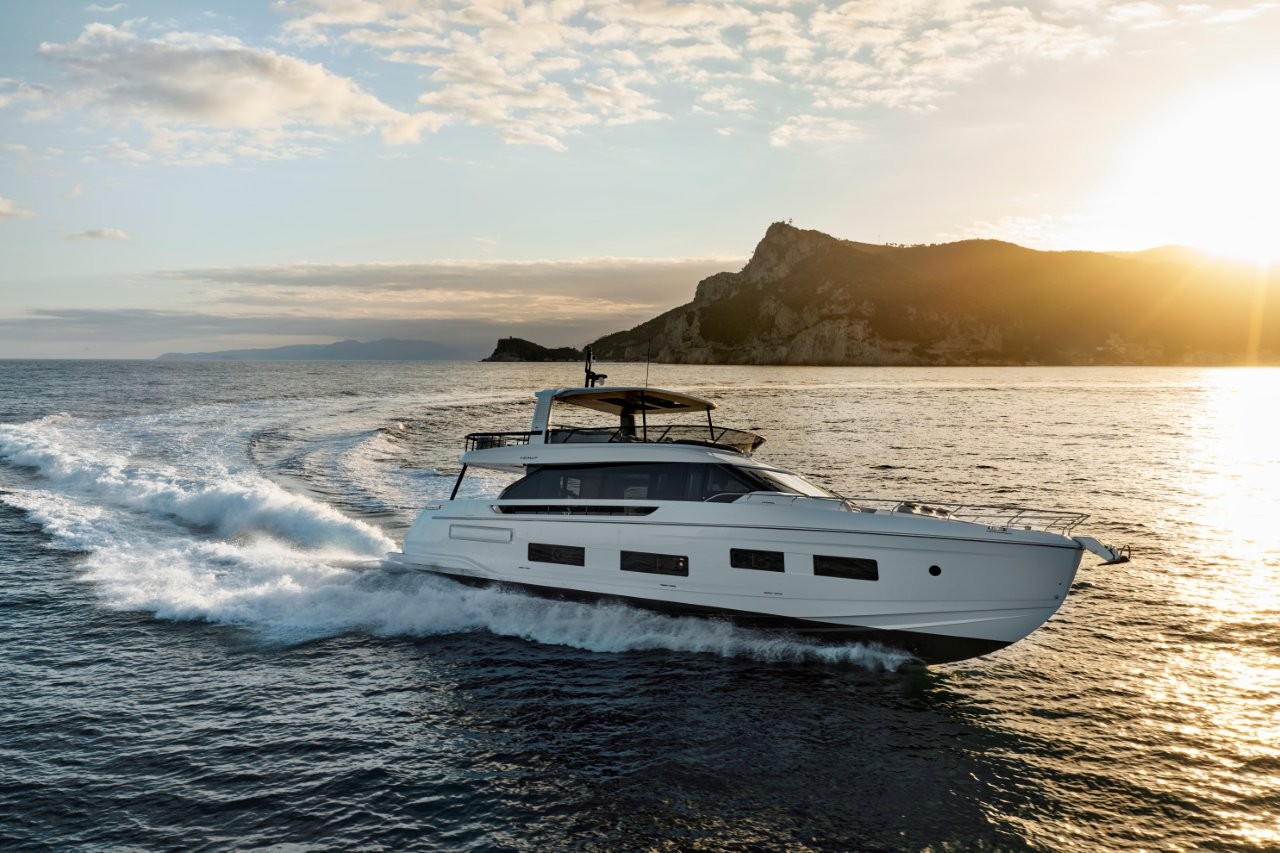
The first operational applications of the system have been introduced on next-generation vessels such as the Azimut Fly 82, where WATCHIT Eye has been integrated as an advanced navigation support tool in real operational scenarios, from coastal cruising to high-traffic areas.
The integration of sensors, traffic information, predictive modelling and AI algorithms represents a key step in the evolution of advanced decision-support systems for maritime navigation. The objective is not to replace the role of the vessel’s master but to support decision-making, reducing the risk of human error and improving the interpretation of complex situations, consolidating its role in maritime situational awareness systems.