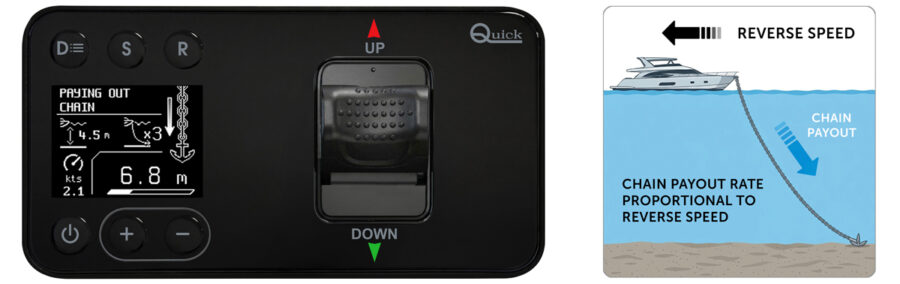
Quick Group is set to conclude a year marked by significant milestones, innovation and strategic growth with the launch of its Intelligent Anchoring System, a new approach to yacht equipment and onboard operations. Set to be unveiled on 17 November at Metstrade 2026, at RAI Amsterdam, the system marks a further step in the development of Quick Group’s integrated technology architecture, building on a series of key innovations introduced throughout the year.
A year of innovation
The year’s milestones began with further enhancements to the Quick Gyro stabilizer range, the result of a continuous development process focused on greater efficiency, a more compact design and improved stabilization performance. These advances have been achieved through the optimization of mechanical systems, electronics and control algorithms. At the beginning of 2026, Quick Group further strengthened its offering with the introduction of an extended warranty programme, doubling the coverage period from two to four years.
In early autumn, at the Cannes Yachting Festival, Quick Group unveiled an expanded range of QSY brushless proportional thrusters, introducing new thruster units and a 215 mm tunnel to offer a comprehensive solution for vessels of all sizes, from smaller boats to large yachts. The expanded range was presented alongside the new Pacific control range, a next-generation control system developed to unlock the full potential of QSY thrusters while providing a more intuitive digital user experience and straightforward plug-and-play installation.
Also unveiled at the Cannes Yachting Festival, QCentric is Quick Group’s new open, scalable, CAN bus-based system architecture, designed to bring together an expanding range of the Group’s products, including windlasses and thrusters, alongside external systems and third-party solutions. At the heart of a shared technological framework, QCentric enables seamless connectivity between products and functions, providing native integration capabilities across both Quick Group technologies and external systems.
New Pacific controllers and QCentric drive the evolution of smart anchoring
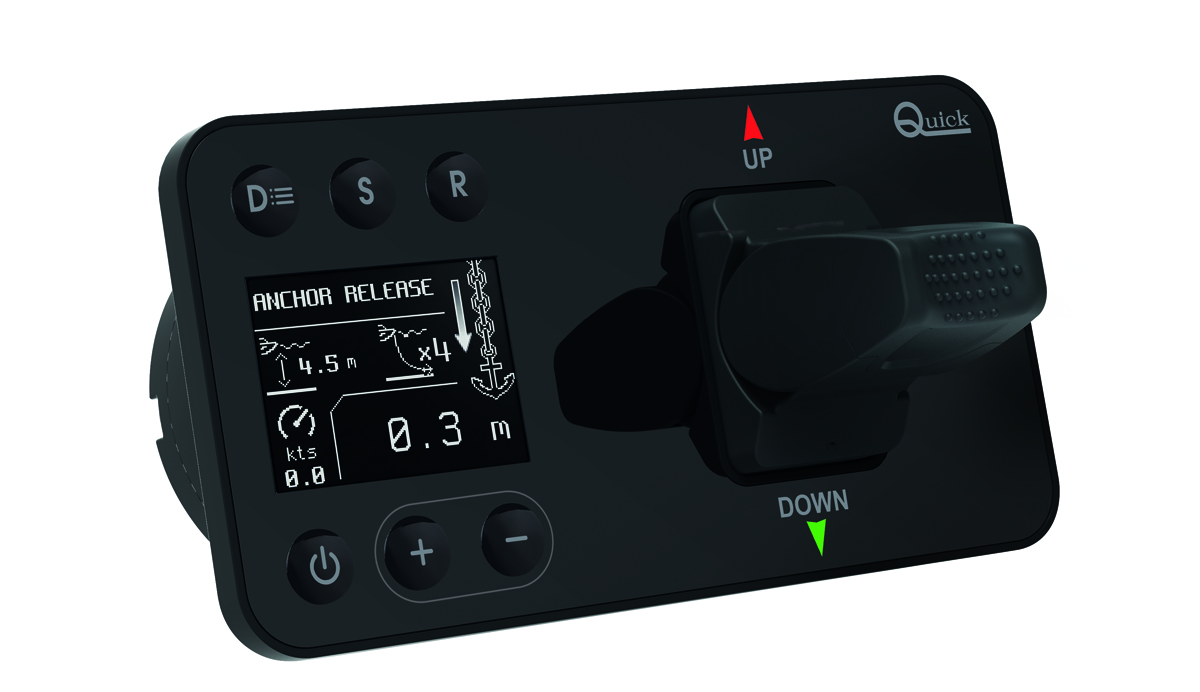
Now, the company is set to build on this ecosystem by combining all these advances with core products from the rest of the Quick range, and in particular its windlasses. The aim is to introduce the next stage of smart boating by leveraging QCentric together with the new Pacific W1XL and Pacific W2XL controllers (below), the latest additions to Quick Group’s Pacific control range dedicated to windlass management. Designed to support proportional control, advanced monitoring and an intuitive user experience, they seamlessly connect the operator, the windlass and boat data for smarter anchoring operations.
We are a global market leader in windlass production and supply, with approximately 30,000 windlasses delivered to OEMs each year. While the bulk of the market supplies windlasses which use a simple on-off relay, we have developed proportional motors and a control system that uses data from QCentric and NMEA2000 networks to deliver more control over anchoring operations. We call this our Intelligent Anchoring System.
Stefano Lenarduzzi, CEO of Quick Group
The system bridges the gap between conventional windlass solutions and fully integrated anchoring systems, combining proportional speed control with navigation data and advanced diagnostics. Its CAN bus architecture simplifies installation through reduced cabling and plug-and-play connectivity, while enabling handheld controls and seamless access to system information via standard multifunction displays (MFDs) at the helm.

Intelligent control throughout the anchoring process
The patent-pending Intelligent Anchoring System is designed to optimize every stage of the anchoring process, combining automated controls, real-time monitoring and advanced safety features. Before deployment, it checks the status of key components to ensure safe operating conditions. During anchoring, it continuously monitors chain length, vessel position, speed, heading and water depth, automatically adjusting payout speed and calculating the optimal scope ratio based on depth and user-defined parameters. Real-time feedback and intelligent safety functions enhance situational awareness, detect potential anomalies and allow operators to retain full control throughout the maneuver. During retrieval, the system progressively adjusts the windlass speed as the anchor approaches the bow, minimizing impact, mechanical stress and wear on onboard equipment.
Our objective was to bring greater intelligence and predictability to one of the most critical onboard operations. By combining advanced control algorithms with real-time vessel and anchoring data, we have created a system that supports the crew throughout the entire anchoring process, improving safety, awareness and overall user experience.
Lorenzo Mongiardo, Chief Technical Officer of Quick Group
A scalable architecture for connected onboard systems
The system’s scalable architecture means it can be applied to a standalone windlass installation or dual-windlass configurations. Further, its native support within the Quick ecosystem and its ease of integration with third-party solutions through the NMEA 2000 marine network standard opens the door to a fully integrated ecosystem comprising engine controls, thrusters, steering gear, windlasses and anchoring operations.
Quick Group will be on hand to discuss its QCentric ecosystem and the first stages of its smart anchoring solution, as well as displaying products from across its many ranges, at three stands in Metstrade from 17 to 19 November. Booths 01.153and 01.251 in Hall 1 at RAI Amsterdam will feature a broad range of products from the Group’s entire catalogue, including a selection of its new lighting range, the QSY thrusters and the new Pacific controls, doors, hatches and ports from the Nemo range, and more. Quick Group will also be displaying at booth 07.120 in the superyacht hall where it will have several elements from the Sanguineti and Nemo ranges as well as the XR8 windlass, which features on recent launches such as the Azimut 44M.