In the nautical world, underwater spotlights and marine LED lighting systems are constantly evolving. Among the most revolutionary products is miniWuwled, the latest innovation from AmperMarine, designed for maximum efficiency without compromising the integrity of the hull.
No drilling, maximum output
Designed for non-metallic hulls, miniWuwled is characterised by a completely hole-free installation, an advantage that eliminates any risk of seepage, micro-fractures or structural damage: an innovation destined to change the habits of shipyards and shipowners.
Its technology is based on a wireless energy transfer system capable of transmitting power through a non-conductive hull wall, up to 40 mm thick, with an efficiency of up to 80%, with no cables, no critical passages, and no compromise on performance.
The result is reliable and powerful underwater boat lights: up to 12W of LED power, managed by remote drivers, with a light intensity of 1,500 lm.

The features of the miniWuwled system
The miniWUWLED system consists of three main elements:
- The transmitter, the technological heart of the system
- The projector, the illuminating element
- The fastening support kit, which varies according to the solution chosen
Each unit is identified by a unique QR Code imprinted on the transmitter cover, together with the supplier’s logo and product name: a guarantee of traceability and after-sales support. The supported supply voltage is 12V or 24V, with a maximum absorption of 2A or 1A respectively.
The operating distance between transmitter and spotlight ranges from 3 mm to 40 mm, and it is essential to maintain a minimum distance of 40 cm between the transmitter and any sensitive electronic devices, such as pacemakers or metal components.
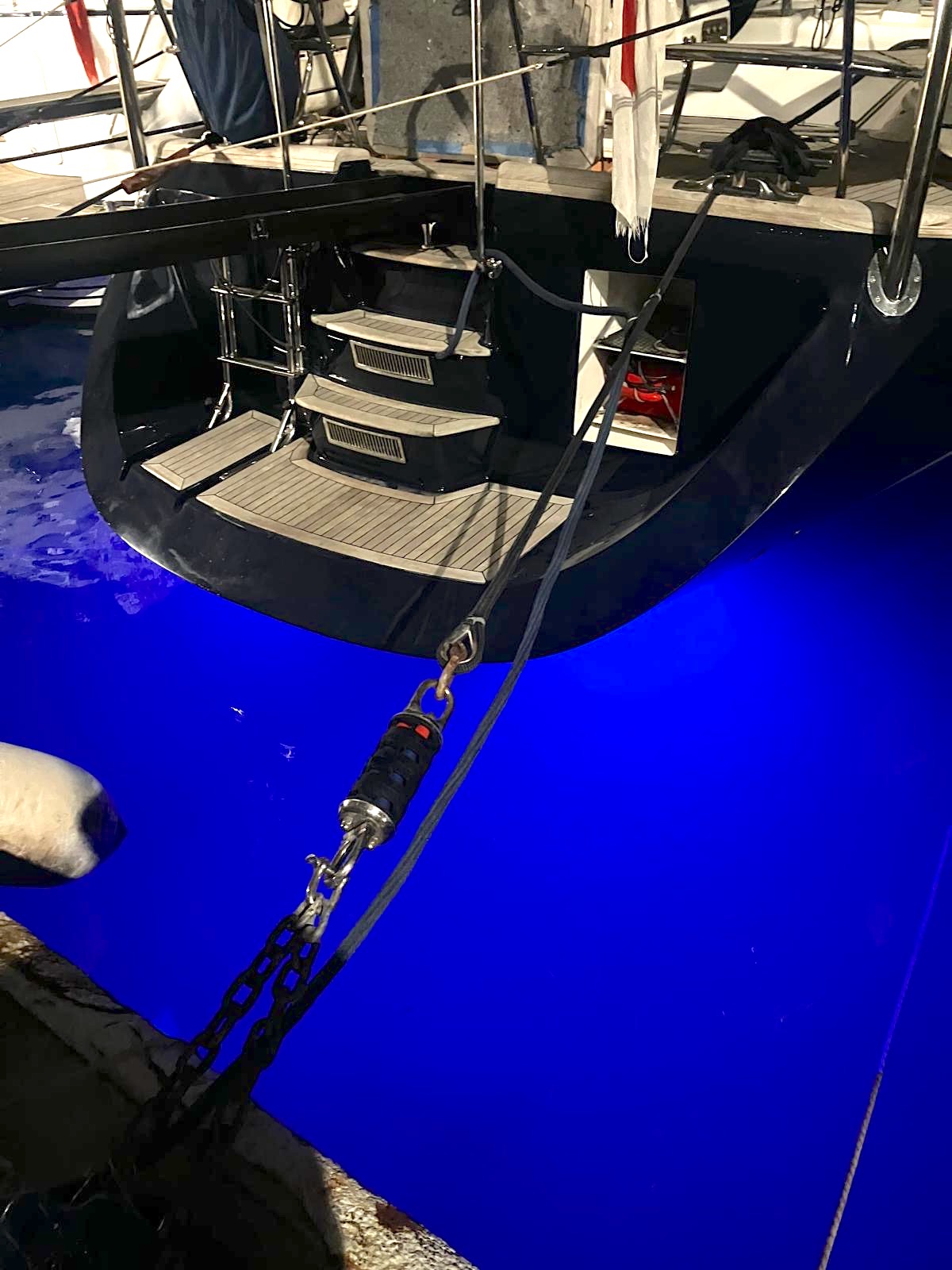
Installation flexibility and engineering simplicity
The miniWuwled spotlight was born with a clear design philosophy: simplify installation without sacrificing high performance. Precisely for this reason, the system has been designed with different fixing methods, able to adapt to the needs of shipyards and shipowners. Three options are available, all designed to guarantee stability and safety.
The first method is the simplest and most direct: bonding. Transmitter and spotlight are applied directly to the hull. This is the ideal solution for quick installations, without invasive intervention, while keeping the hull structure intact.
The second option provides a more flexible approach: gluing the transmitter inside the hull and mounting the spotlight using two supplied brackets, fixed externally with screws. This configuration allows the spotlight to be removed, if necessary, even without running the boat dry, simplifying maintenance or system upgrades.
Finally, the third method is designed for those who want the ultimate in modularity. Thanks to an accessory kit consisting of two plates, one internal and one external, both the transmitter and the spotlight can be fixed in a robust but easily removable manner, using specific locking systems. An ideal solution for those working on charter boats or in environments where maintenance needs to be fast and programmable.