It takes time for a technology to cease being merely efficient and become part of the design culture. In the nautical sector, this time often coincides with the evolution of the way we experience boats: with the transition from occasional use to prolonged stays on board, with the growing demand for real autonomy, with an idea of comfort that is no longer accessory but structural.
This change has had a direct impact on systems engineering, which is called upon to guarantee continuity of service, reliability, and ease of management even in complex operating conditions. In this process, the marine desalination systems have also changed their role. From a technical device confined to the engine room and used only in specific cases, they have become part of the everyday infrastructure of the yacht.
The watermaker’s evolution
To understand how this transition has translated into concrete design choices, it is useful to hear the point of view of those who have experienced this change firsthand.
Gianni Zucco, co-founder of HP Watermakers, has seen the role of the watermaker evolve alongside the way yachts are designed and experienced, accompanying shipyards and designers on a journey that has progressively brought water to the center of onboard design. A journey made up of applied solutions, problems solved in the engine room, and continuous dialogue with the world of boat building.
A capable technical partner
Founded in 1995 by the Zucco family, HP Watermakers has built its identity on a strongly engineering-based approach, focused on solving real problems encountered on board and on constant dialogue with shipyards, designers, and system integrators.
This vision has led the company to develop not just individual devices, but system architectures designed to integrate with the rest of the on-board system, positioning itself as a key player in marine system integration. This approach now allows HP Watermakers to act not only as a supplier of equipment, but also as a technical partner capable of contributing to plant design choices from the earliest stages of a project.
From machine to system
Looking at the evolution of the watermaker over the last 30 years, the most obvious changes concern not only the basic desalination technology but also the way in which it is integrated on board.
From equipment that required a high level of manual intervention and specialist management, we have moved to fully automatic systems, designed to communicate with the rest of the on-board system and to function reliably even in complex operating conditions. The watermaker has become an active node in the plant ecosystem, with direct repercussions on layout, energy management, and quality of service on board, strengthening the efficiency of modern onboard water systems.
For HP Watermakers, this evolution has meant rethinking the watermaker not as a standalone machine, but as a node in a larger system involving water production, treatment, distribution, and management. This transition has required a design increasingly oriented toward reducing operational variables and simplifying human-machine interaction.
30 years of changes
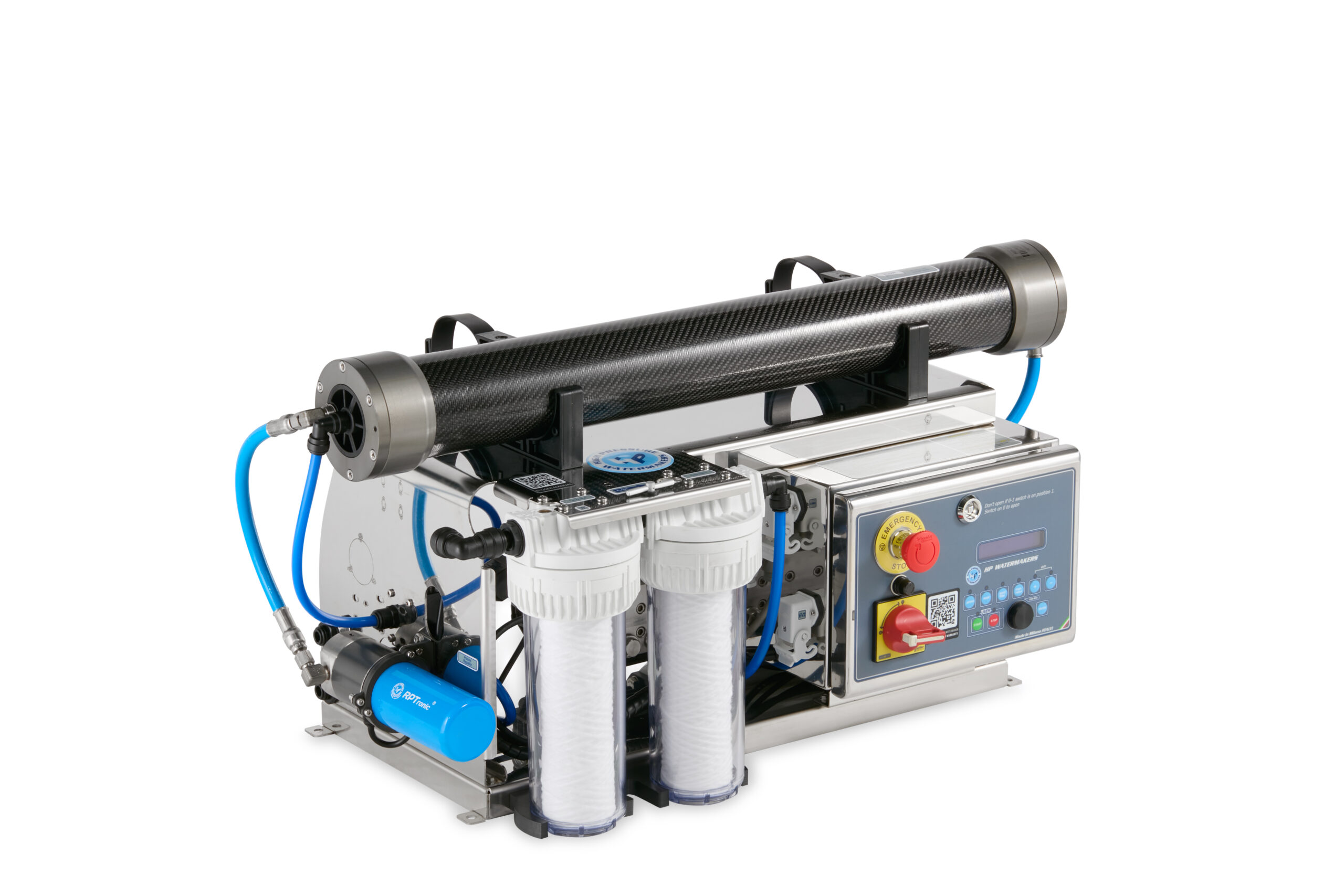
“Technology has made great strides in 30 years,” explains Gianni Zucco. “Back in 2003, HP revolutionized traditional systems based on manual pressure regulation and manual membrane washing with the introduction of the RP TRONIC system, which – even today, after more than 20 years – remains the only truly automatic pressure regulation system. Today, the watermaker is interfaced with navigation plotters, winterises automatically, and is connected to the internet.”
From an engineering perspective, pressure automation has made it possible to stabilise the osmotic process even when critical parameters such as seawater salinity and temperature vary, with direct benefits in terms of output, membrane lifespan and consistent water quality, further advancing marine desalination systems.
“The owner profile has also changed,” Zucco continues. “The average age has dropped, there is greater environmental awareness and a different focus on the quality of the onboard experience. Today’s owners don’t want to accumulate plastic, they want to drink cold, sparkling water straight from the kitchen tap, just like at home, and they want a short, controlled, and reliable water production chain.”
From Shipyard Requirements to Product
One of the distinctive elements of HP’s approach is the way in which a new product takes shape. Innovation does not come from abstract research or an exercise in technological style, but from concrete problems that arise during installation, use, or maintenance. The engine room, with its dimensional constraints, limited accessibility and system interferences, is often the real test bed.
Shipyards and designers are faced with space constraints, critical positioning in relation to the waterline, redundancy requirements, or requests for integration with existing on-board systems. These real-world conditions guide the design choices of HP, which works on solutions that are replicable but adaptable to very different contexts, reinforcing expertise in marine system integration.
Making everyone’s life easier: the birth of SCA
“Our products are designed to make life easier for everyone: shipyards, owners, and our own production,” says Zucco. “A prime example is the SCA model, which was initially created to meet the needs of a specific shipyard and has since become our best seller.”
The SCA project addresses one of the most recurring problems in the engine room: space. However, reducing size was not an end in itself, but the starting point for a broader reflection on standardization and modularity. Compactness was used as an industrial lever, not just as an installation advantage.
“With the SCA220 model, thanks to the introduction of custom 31530 membranes, which are 20% shorter than standard ones, we have created the most compact desalinator in its category,” explains Zucco. This choice has also led to a reduction in energy consumption and greater overall efficiency of the system, reinforcing innovation in yacht watermakers. “Using the same chassis, we produce 8 different models, from 100 to 440 l/hour. This allows us to harmonize internal production and greatly simplify management for construction sites.”
The result is an incremental development process based on real-world testing, field validation, and continuous refinement.
Innovating by Simplifying
One of the key concepts in HP Watermakers’ approach is innovation that reduces complexity, rather than adding to it. This principle finds concrete expression in the RP TRONIC valve, the true technological hub of the HP ecosystem.
In traditional systems, manual pressure adjustment was and still is one of the main sources of operational error, with direct effects on performance, membrane life, and system reliability.
“RP TRONIC was a real breakthrough,” says Zucco. “It not only allows automatic pressure regulation at startup but also keeps it constant during operation. During flushing, the valve opens completely without manual intervention, allowing the correct discharge of the brine,” confirming the evolution of advanced marine water systems.
Key steps
This automation has made a leap forward possible: the watermaker can now be integrated into on-board control systems, paving the way for remote management, automatic winterization, and advanced dock water treatment. RP TRONIC is, in fact, the technological basis on which solutions such as Part-NET, Sea0Spot, and AMCS are built.
Another key step was the shift away from closed proprietary logics in favour of a standard web-based language. “The translation of our logic into html5 was a quantum leap,” explains Zucco. “It allowed us to introduce the BiBi interface in 2017 and, subsequently, integration with the leading brands of on-board plotters.”
From an operational perspective, this means reducing downtime, simplifying troubleshooting, and making the water system accessible even to non-specialized personnel. The watermaker thus becomes an on-board appliance on a par with air conditioning.
The relationship with shipyards: from supplier to technical partner
Over the years, the relationship between HP Watermakers and shipyards has gradually evolved. Whereas in the past the watermaker was selected at an advanced stage of the project, today HP is increasingly involved in the preliminary stages, when the layout, plant architecture, and system management logic are defined.
This change reflects a greater awareness of the strategic role of the water system: autonomy, comfort, reliability, and reduced consumption have become central design parameters.
“Today, we are asked to study complete water management systems,” says Zucco. “From shore loading to desalination, to the distribution of purified, cold, and carbonated water on board.”
This vision gave rise to the Water Package concept, introduced by HP in 2018, which integrates water production, treatment, and distribution into a single, coherent architecture. This approach allows construction sites to reduce design complexity and fragmented responsibilities among multiple suppliers.
Standard and custom, a necessary balance
In the world of marine systems, the balance between standardization and customization remains one of the most sensitive issues. HP Watermakers has chosen a middle ground: standardizing the product through size reduction and modularity, making it possible to adapt to very different contexts.
“We have managed to standardize a product (SCA and SCAD) that fits everyone perfectly,” summarizes Zucco. “By minimizing its footprint, it fits on both super rib and superyachts.”
A look ahead
30 years after its founding, HP Watermakers operates in a context that is profoundly different from its beginnings. The increasing complexity of yachts, the growing focus on efficiency and automation, and the increasingly central role of on-board systems pose new challenges but also open up new opportunities.
The company continues to focus on what has defined its path: applied development, listening to the market, and solutions designed to really work on board.
“We will continue to tailor our approach to our customers,” concludes Zucco. “The nautical world is a small, artisanal world, where the slightest mistake can compromise decades of work.”