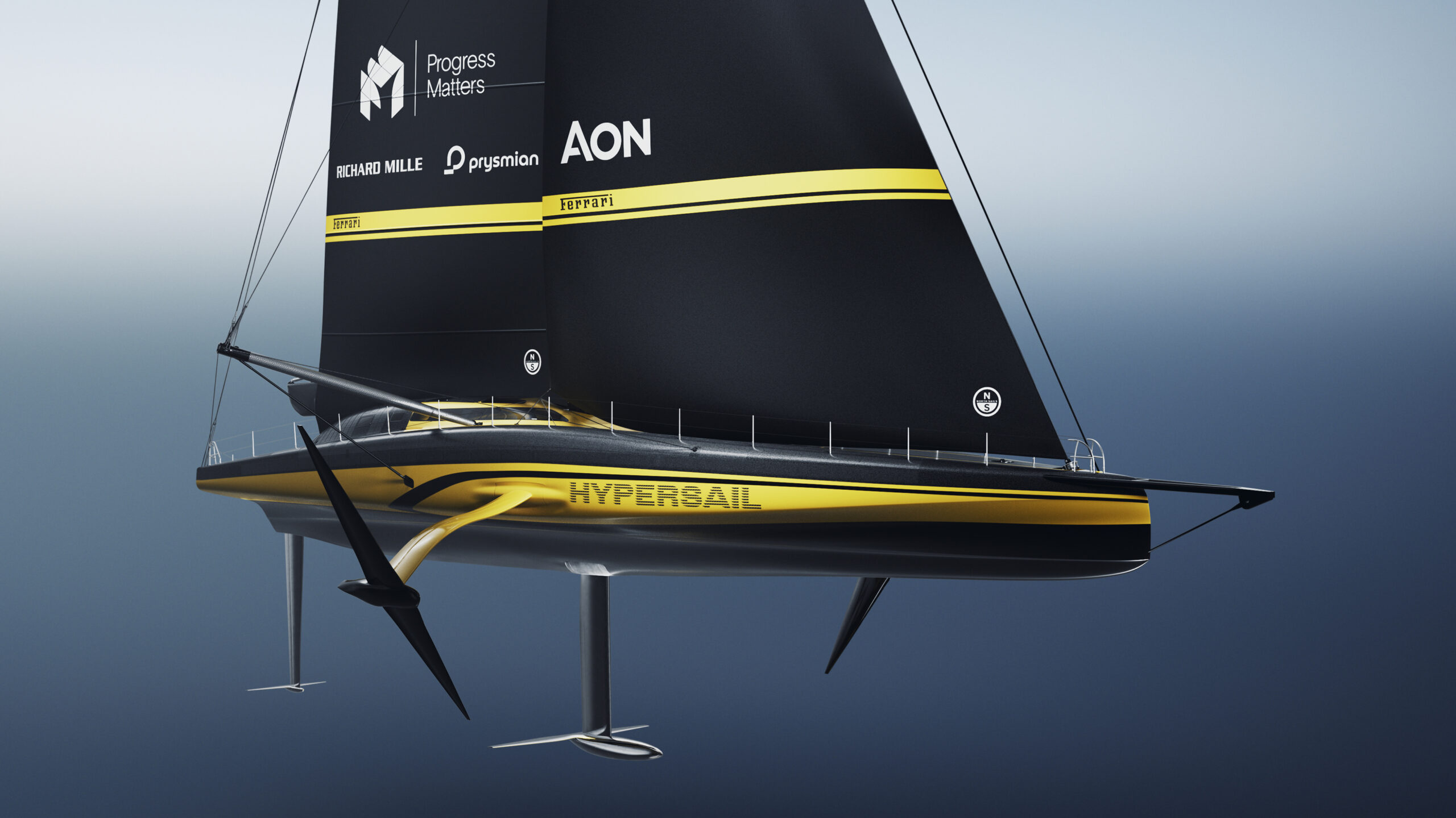
The livery of Ferrari Hypersail – the 100-foot full-foiling ocean monohull developed in collaboration with French naval architect Guillaume Verdier – was revealed during Milan Design Week.
On stage alongside Verdier were Ferrari Chief Design Officer Flavio Manzoni, Technical Team Lead Marco Guglielmo Ribigini, and the new Project Leader Enrico Voltolini, a former Luna Rossa sailor through Barcelona 2024 and now part of Ferrari’s sailing team following Giovanni Soldini’s departure from the project.
A lineup that underscores the initiative’s interdisciplinary nature: a design system where styling, engineering and naval architecture converge through aerospace inspired marine design. While Nautech has already covered the technological aspects in depth, the Milan presentation offered a more focused reading of design – not as a detached styling exercise, but as an active component of the development process.
Design and constraints: a shared process
Hypersail is an object heavily shaped by constraints. Aerodynamics, hydrodynamics, scale and energy integration define an extremely narrow design space. Within this framework, the Ferrari Design Studio acts as a synthesis layer, translating data and technical requirements into a legible form within advanced yacht design processes. As Flavio Manzoni explained:
“The process we followed is very similar to how we design our cars. It starts from aerodynamics – so from the most efficient shape to achieve specific targets.”
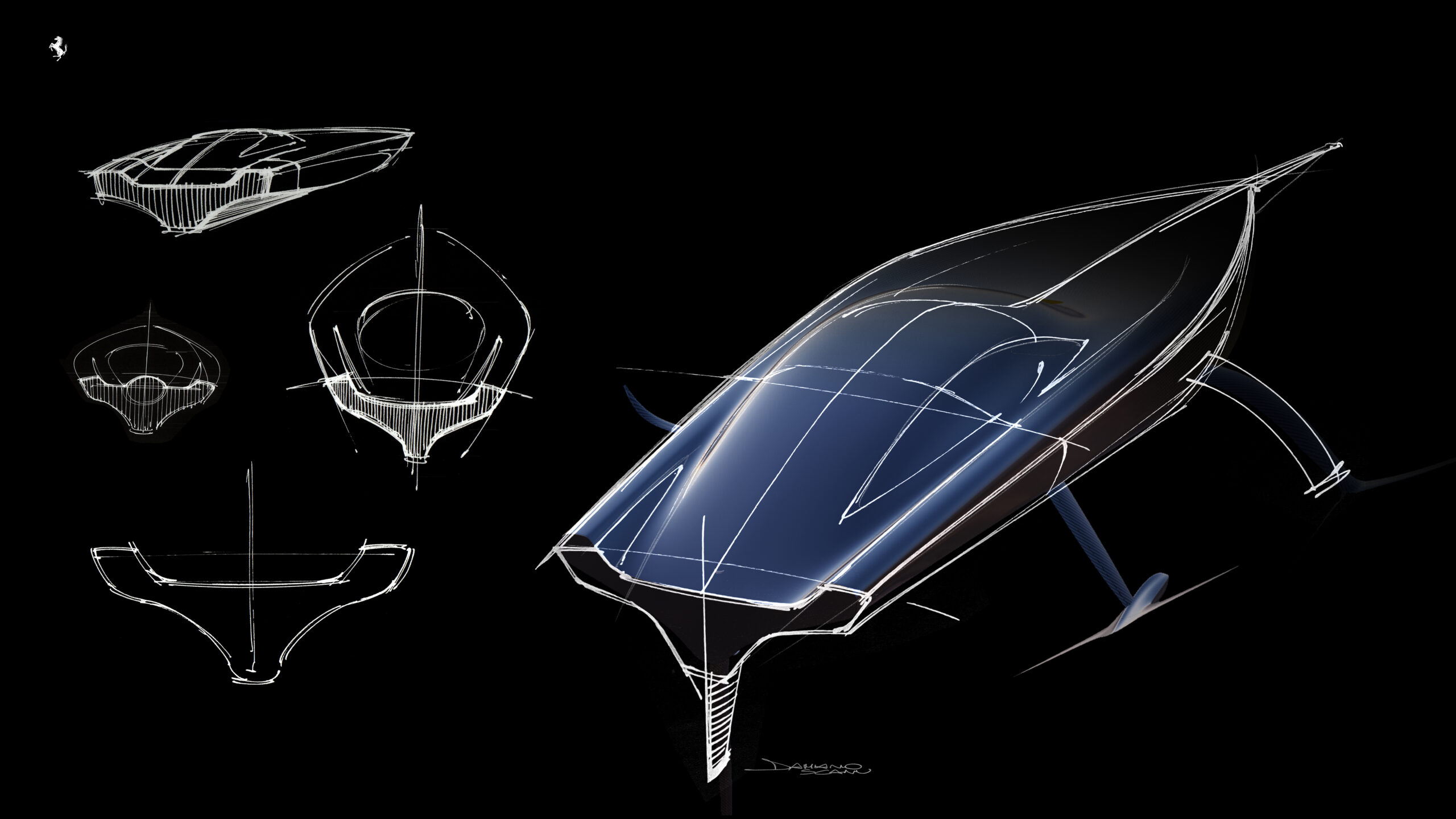
The method remains distinctly Ferrari: continuous iteration between designers and engineers, with progressive refinements turning technical constraints into design opportunities.
Surfaces, models and form generation
The presentation highlighted how surface development began with conceptual models – defined through pure volumes and intersections – before addressing the vessel’s full complexity. The so-called “speedforms” represent a key phase: not yet final objects, but capable of expressing the project’s direction. At this stage, design focuses on proportions, tensions and relationships between surfaces, anticipating what will later become structure within high performance marine engineering design. As aerodynamic, structural and energy constraints are progressively integrated, the resulting form is never arbitrary – it is the outcome of convergence.
Color as a design tool
It is in the livery definition that design’s role becomes most evident.
The choice of the new Yellow Fly, instead of the traditional Ferrari red, is not merely about identity. Yellow – Ferrari’s historic color, tied to the city of Modena – also responds to functional requirements, including thermal management of exposed surfaces. Alongside it, Hypersail Grey, a very dark grey, is conceived as an extension of the material itself: a tone developed in direct relation to exposed carbon fiber and the presence of 100 square meters of solar panels.
The contrast between yellow and grey is not only decorative – it structures the visual reading of the yacht, highlighting volumes, separations and load paths within automotive inspired yacht aesthetics. An approach that explicitly recalls the Ferrari 512 BB, the first example of an “integrated” livery in Ferrari’s design language. Surface construction thus becomes three-dimensional: color does not merely follow form – it helps define it.
References and formal continuity
The Hypersail project sits within a clear continuity of Ferrari’s design language.
Its slender proportions evoke the Ferrari Monza SP1 and SP2, while the treatment of surfaces and the coachroof recalls the Ferrari 499P, the Le Mans-winning hypercar for three consecutive editions. More subtle cues dialogue with models like LaFerrari and the latest stylistic evolution of Maranello’s sports car range. These are not direct references, but a shared vocabulary: proportions, light breaks, mass distribution. Elements that allow a radically different object to retain strong brand coherence in luxury automotive design crossover projects.
Technical integration: the solar panel challenge
Among the project’s most complex aspects, Manzoni highlighted the integration of solar panels.
Their layout – driven by energy demands and solar exposure – introduces discontinuities across the surfaces. The challenge was therefore twofold: adapting the geometry and developing a graphic language capable of absorbing this complexity. The result is a balance between technical necessity and perceptual quality, achieved through close collaboration across disciplines within sustainable marine energy integration systems.
Within this context, the contribution of Boero Yacht Coatings is also key. The company developed the coating systems for Hypersail, where finishes go beyond protection to actively participate in surface definition: uniformity, durability and color behavior are integral to the design.
A transferable approach
Hypersail ultimately stands as a case study on the role of design in high-complexity environments.
A project where the designer’s contribution is not to impose form, but to build a system of relationships between technical elements, materials and perception. An approach that, while applied here to a maxi ocean-going foiling monohull, remains fully consistent with Ferrari’s methodology: start from function, work through integration, and arrive at a result where aesthetics and performance are one.