Electrification represents one of the strategic pillars of Volvo Penta’s future development. In line with the broader Volvo Group’s industrial approach, the energy transition in the marine sector is being managed progressively, pragmatically and through immediately operational solutions.
The stated objective is not a sudden shift to full-electric propulsion, but rather the construction of a modular, scalable propulsion ecosystem, adaptable to the diverse operational profiles of both professional and leisure marine applications.
ELECTRIFICATION AS A SYSTEM
In this context, hybridisation plays a pivotal role as a bridge technology: it enables reduced fuel consumption and emissions, improved operational comfort and the introduction of new energy management capabilities – without sacrificing range, reliability or performance.
Volvo Penta emphasises that electrification is not merely a matter of propulsion, but of “system”: meaning the tight integration of the combustion engine, electric motor, energy storage system, power management software and Human-Machine Interface (HMI).
In this way, the hybrid is not presented as a disruptive solution but as the natural evolution of the IPS platform, which today boasts more than 45,000 installed units and a well-established operational credibility across the yacht, superyacht and professional marine segments.
Nautech attended the unveiling of the new IPS Hybrid propulsion system at the Volvo Penta Marine Test Centre in Krossholmen, near Gothenburg, Sweden, a unique opportunity to explore the system’s technical architecture in depth, and to see it and test it first-hand.
INTEGRATED TESTING APPROACH
There is always a sense of awe upon entering the Volvo Penta Marine Test Centre in Krossholmen, a strategic facility dedicated to the development, validation and real-world testing of the most advanced marine technologies.
The facility features equipped docking stations, data analysis laboratories and a fleet of approximately 15 experimental vessels, configurable with different propulsion architectures. Krossholmen enables both controlled and operational testing under variable environmental conditions, simulating realistic mission profiles: coastal navigation, harbour manoeuvres, stop-and-go cycles and transit at cruising speed.
A central focus of the test centre’s activities is the validation of hardware-software integration, with particular attention to energy management control systems, functional redundancy and cybersecurity of the new connected platforms.
A defining feature of the project is the integrated testing approach conducted at Krossholmen. Prior to commercialisation, the IPS Hybrid system accumulated more than 10,000 hours of bench and sea trials, including “yo-yo” endurance tests (400 hours of forward/reverse cycles per motor unit), corrosion testing, hydraulic stress testing and operational campaigns on dedicated test fleets.
The target, underscored repeatedly by Nicola Pomi, Vice President Yacht & Superyacht at Volvo Penta, is an operational reliability approaching 99%, an essential prerequisite for protecting owners, captains, shipyards and the brand’s reputation alike.
Before moving on to the technical description and sea trials, it is important to explain the application segments for which Volvo Penta designed and developed the IPS Hybrid system.
Medium and large yachts and superyachts
The IPS Hybrid system offers several design and operational advantages that captains, owners and charter operators will appreciate. From a design standpoint, the vessel benefits from a more compact engine room, directly increasing the available living space that can be utilised for additional cabins or technical areas. Beyond uncompromised cruising performance, the ability to manoeuvre the vessel in Pure Electric mode, silently and with zero local emissions, combined with the inherent manoeuvrability of the IPS system, enables seamless access to ports, marinas and Emission Control Areas (ECAs).
Commercial vessels (ferries, CTVs, pilot boats, crew boats, patrol vessels)
In addition to the space advantages described above, which equally apply to commercial platforms, trials on professional vessels and ferries recorded fuel savings of up to 20% on specific operational profiles, with direct benefits for Total Cost of Ownership (TCO), crew comfort and vessel uptime. The potential reduction in both fuel and maintenance costs should not be underestimated.
Complex refit projects
On a vessel already equipped with a conventional IPS system, the upgrade to hybrid propulsion is virtually native. The primary requirement is sufficient engine room space to accommodate the electric motor, as well as a suitable location for the battery packs, which do not need to be positioned adjacent to the drivetrain. This flexibility also enables a redistribution of onboard loads, which can be beneficial for stability and performance.
For vessels with conventional diesel inboard engines, the same space-efficiency benefits apply. From an operational standpoint, the hybrid system enables new usage modes, such as extended electric navigation in harbour or the use of the system as an auxiliary power source, replacing the generator, for onboard hotel loads. In other words: no more generator noise at night.
TECHNICAL ARCHITECTURE AND KEY ADVANTAGES
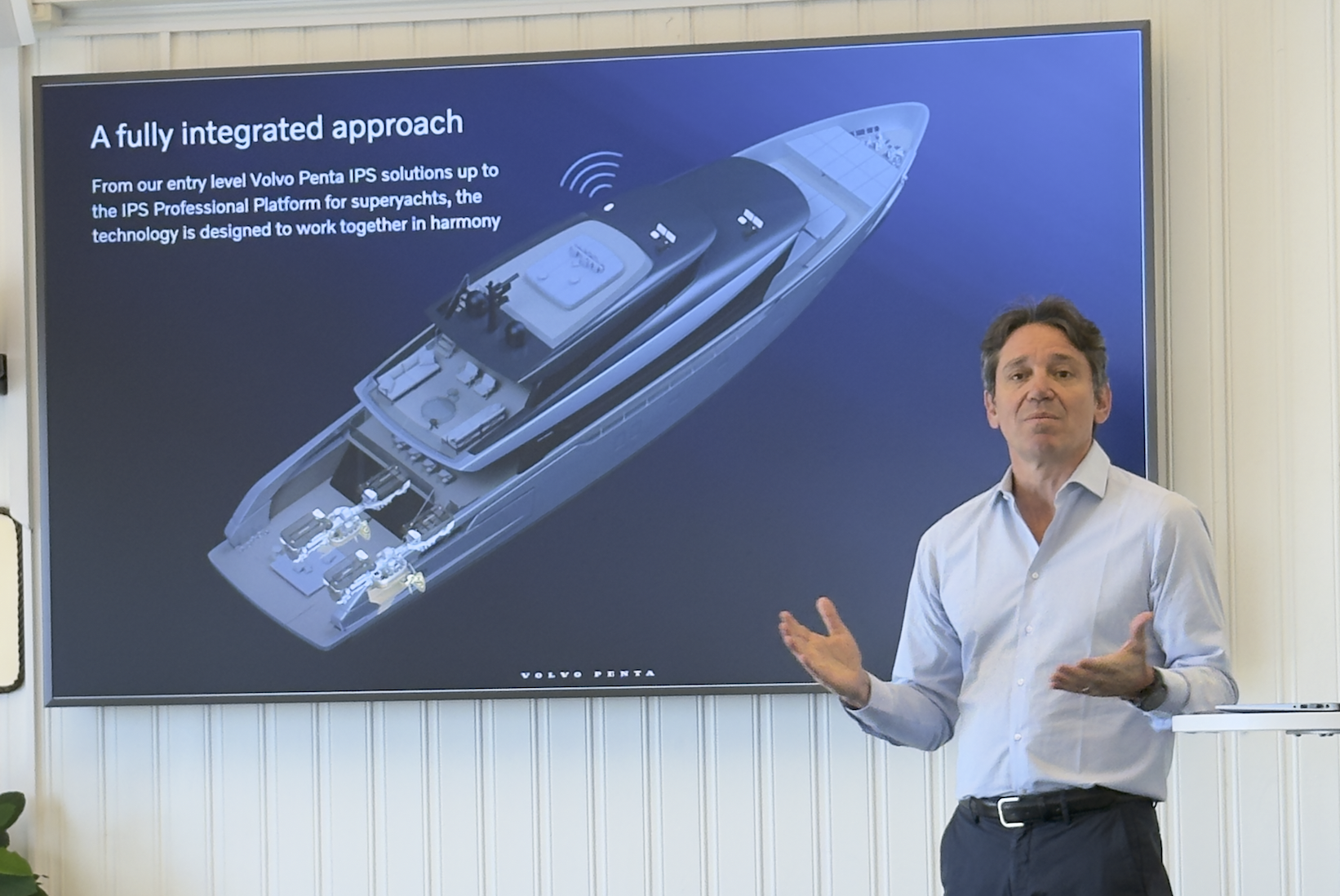
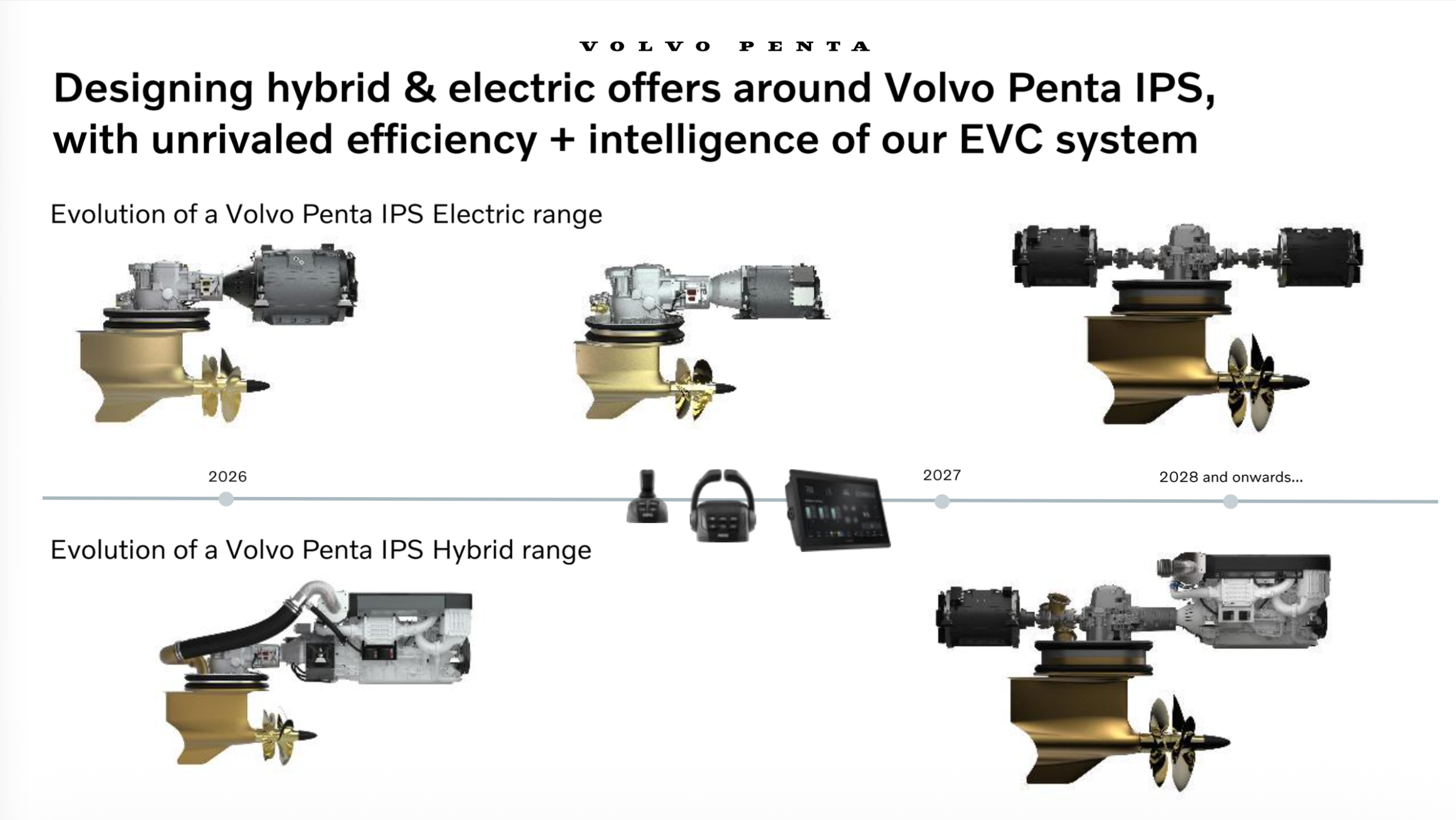
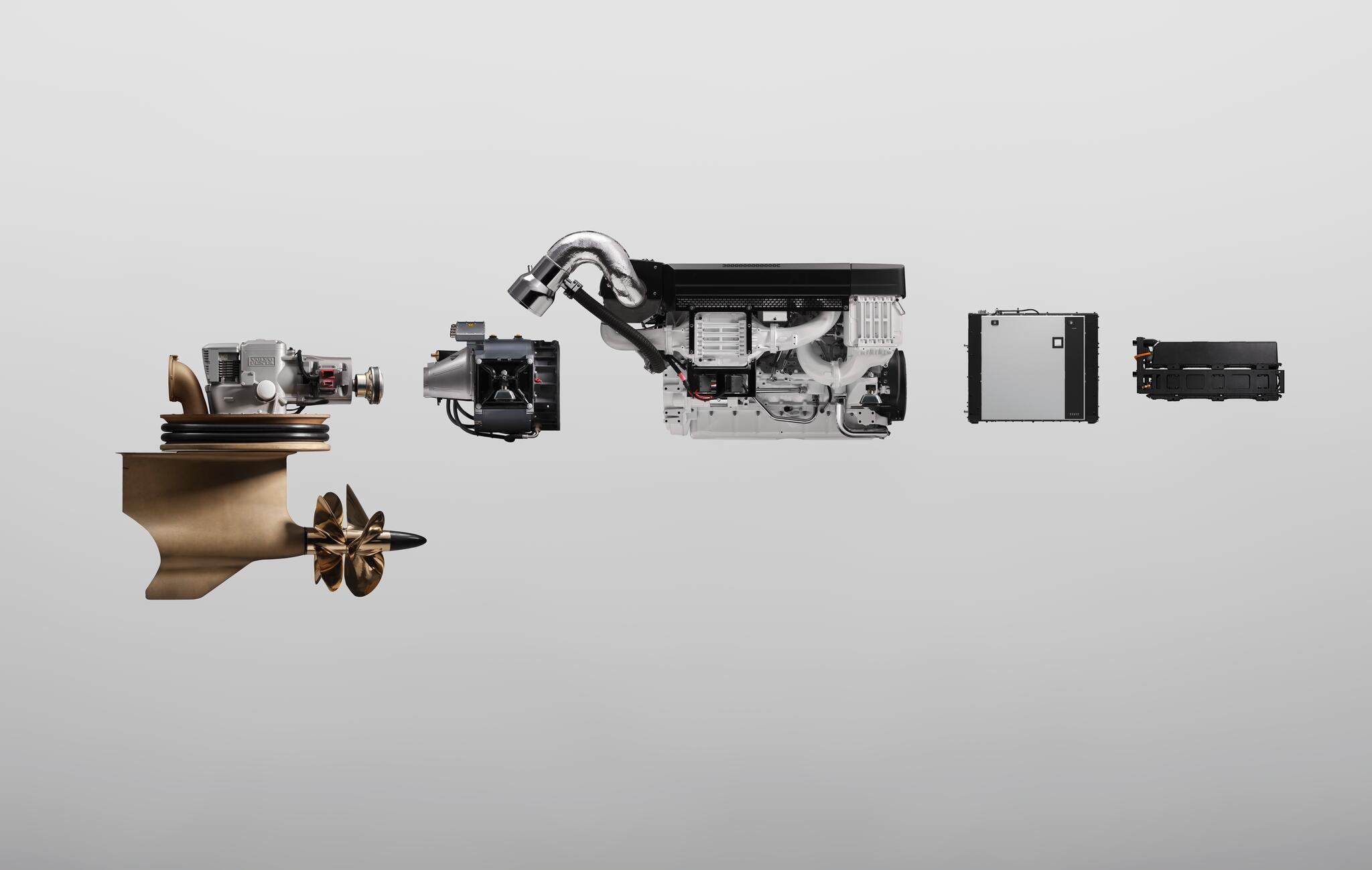
As noted at the outset of this article, the central focus of the project is not any individual component, but the integrated management of the IPS system: diesel engines, electric motors, batteries, power electronics, control software and HMI, all developed and validated as a single functional architecture, from helm-to-propeller.
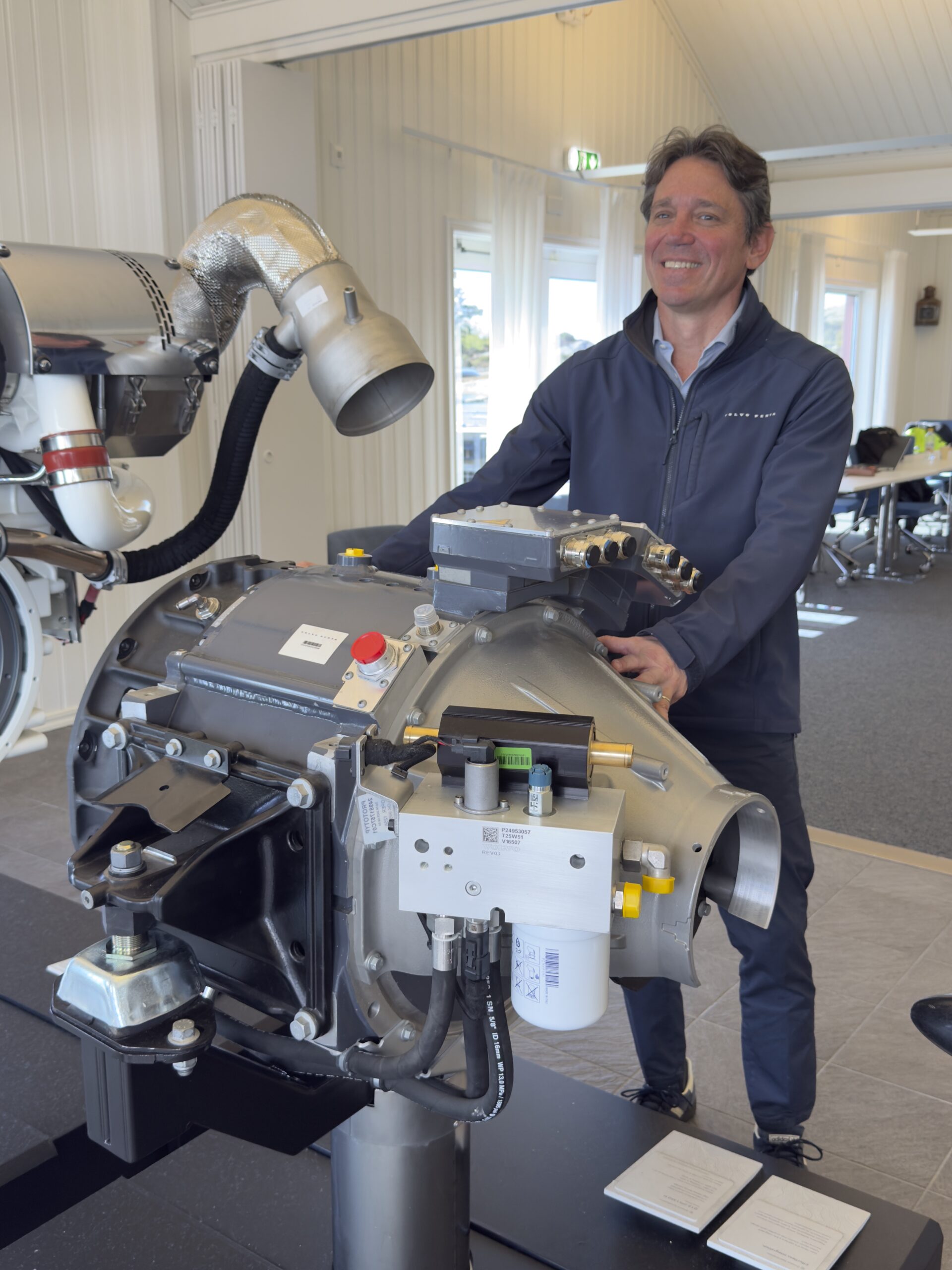
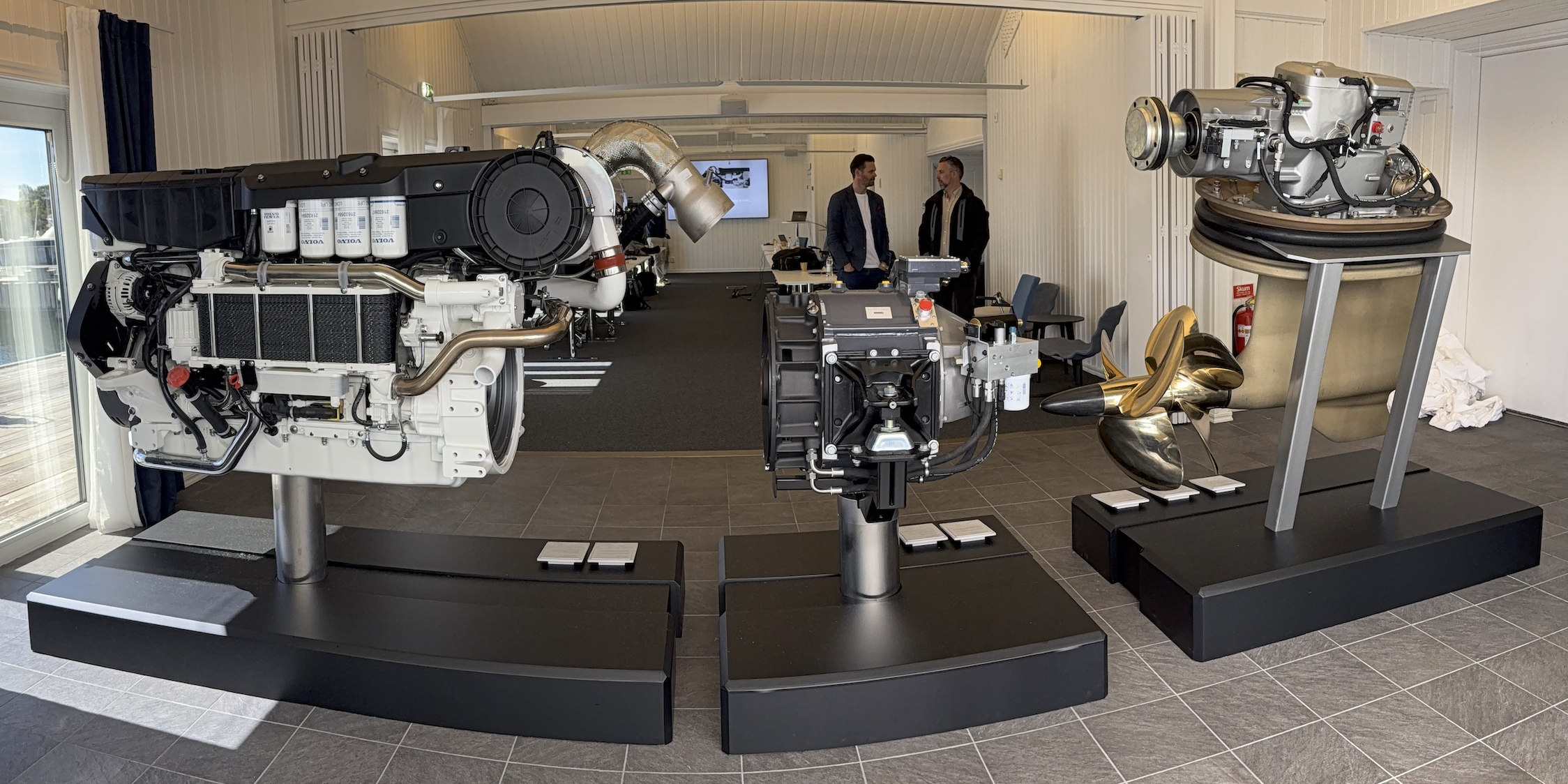
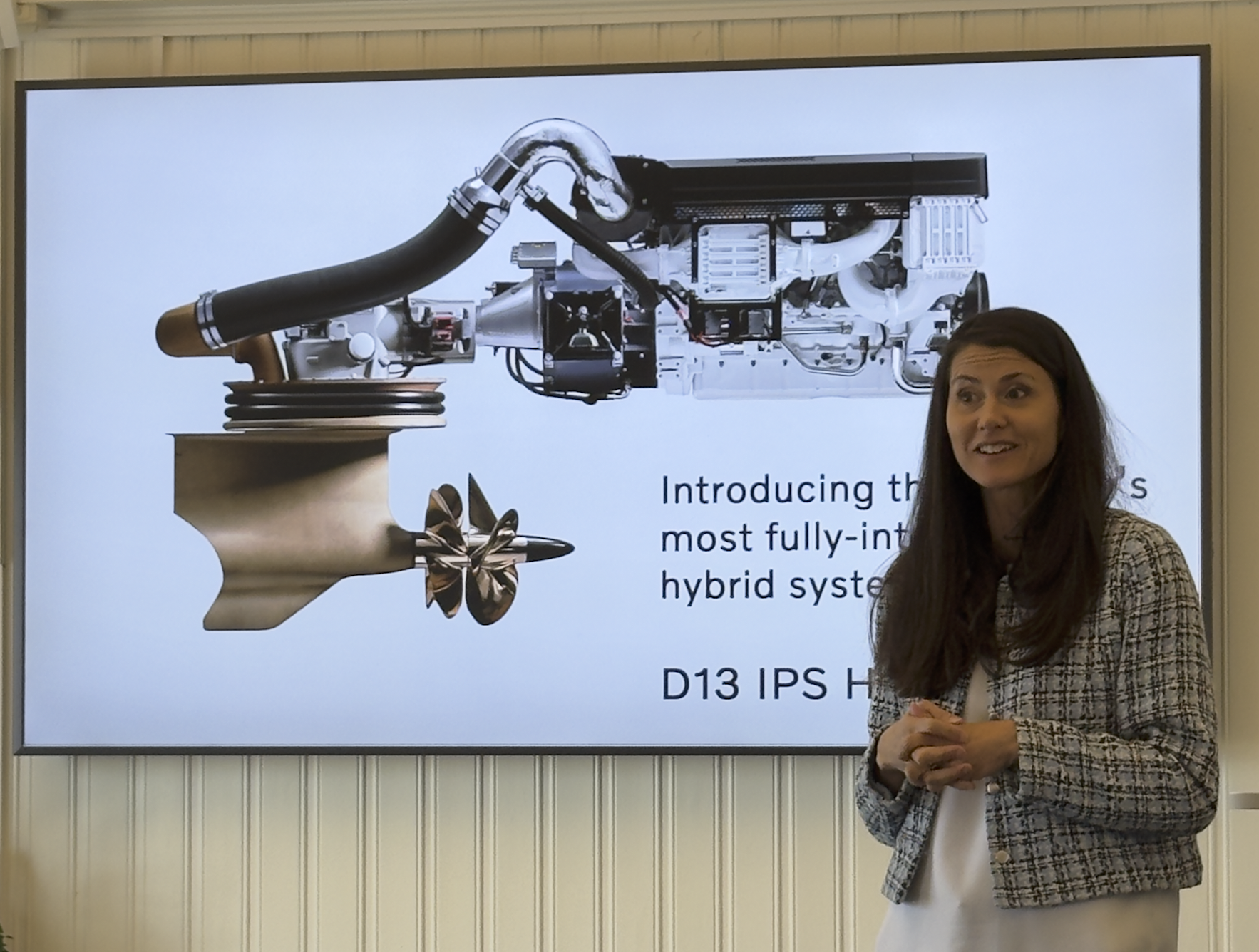
The system is a parallel hybrid, installed on the existing IPS driveline. At the heart of the configuration is the proven D13 IPS engine, to which a 160 kW electric motor is coupled via a hydraulic clutch. This solution enables functional decoupling between the combustion engine and the electric motor, allowing multiple operating modes without compromising compactness or mechanical reliability.
The IPS drivetrain remains unchanged: identical pod drives, the same steerable pod steering system, the same DuoProp architecture, and full compatibility with all legacy IPS capabilities, Joystick Docking, Assisted Docking, Dynamic Positioning System (DPS).
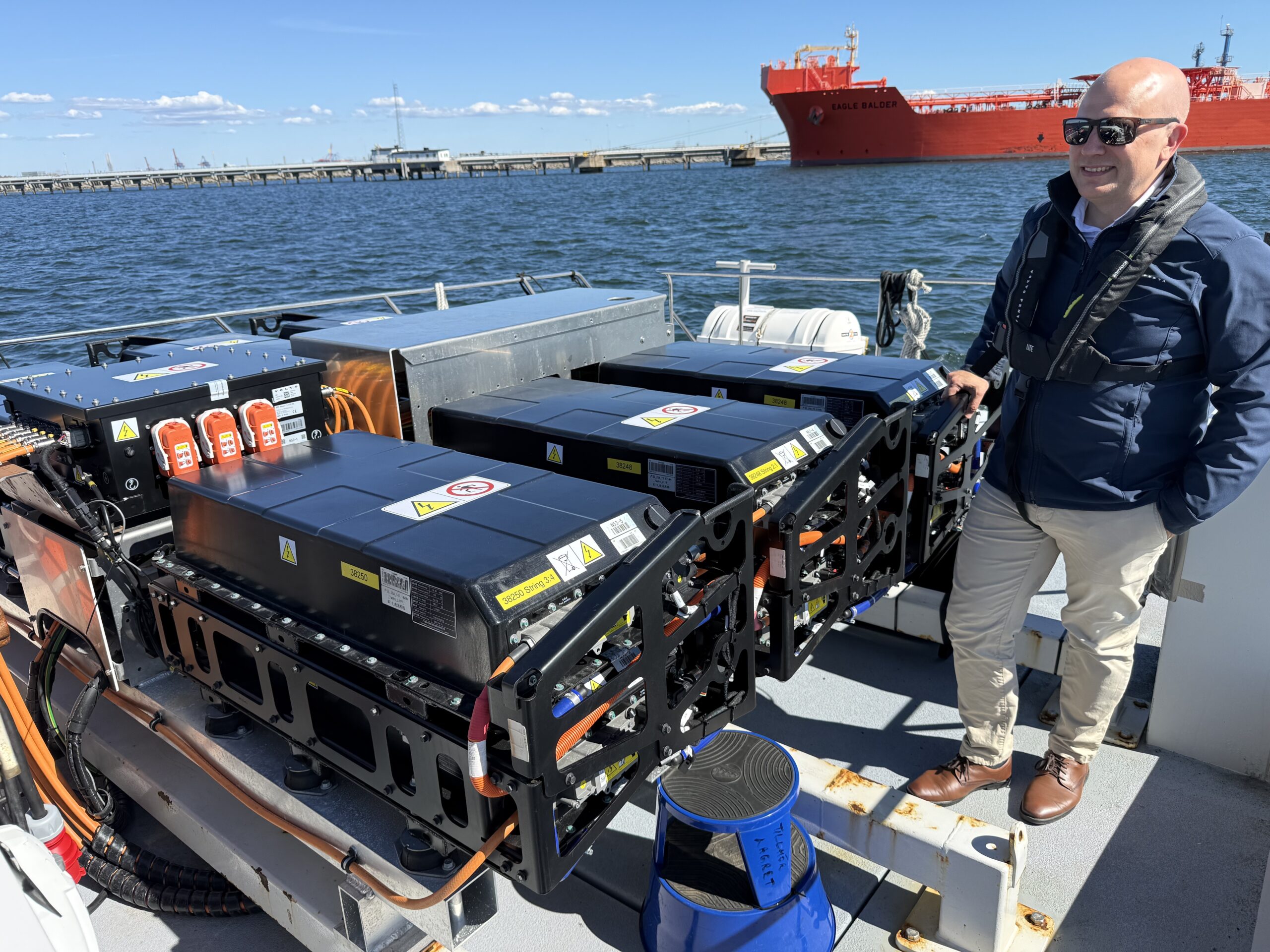
On the electrical side, the system is built around Danfoss electric motors, a proprietary Volvo Penta DC Grid, marinised LFP (Lithium Iron Phosphate) battery packs and power electronics integrated within dedicated cabinet assemblies.
ADVANTAGES OF A ONE-STOP SOLUTION
A critical point for captains and owners: the entire IPS Hybrid system is offered as a one-stop solution, eliminating the multi-supplier integration challenges that are frequently the root cause of failures and operational issues on modern complex yachts, where assigning responsibility for a malfunction can be nearly impossible.
The main advantages of the system can be summarised as follows:
- Reduced fuel consumption through optimised engine load management
- Reduced local emissions during environmentally sensitive operational phases
- Enhanced acoustic and vibration comfort
- Propulsion functional redundancy
- Access to Emission Control Areas (ECAs) and environmentally protected zones
- Native integration with IPS systems already deployed in the market
BATTERY TECHNOLOGY: SAFETY AND LONGEVITY FIRST
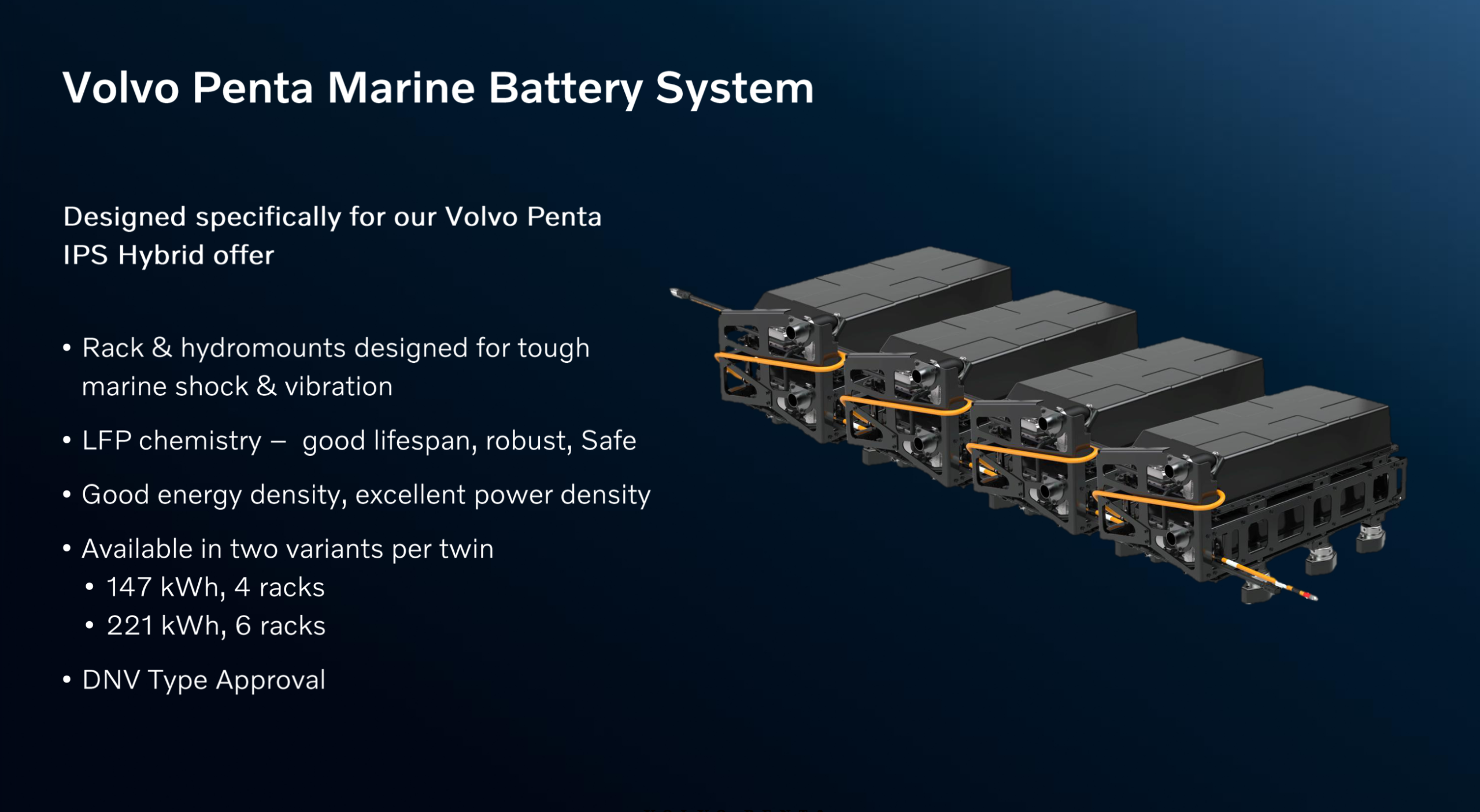
Volvo Penta selected LFP (Lithium Iron Phosphate) chemistry, prioritising safety, cycle life and usable energy window over maximum energy density.
Battery packs are available in two configurations:
- 147 kWh (small pack, four modules)
- 221 kWh (large pack, six modules)
Each pack is managed by a dedicated Battery Management System (BMS). The system is capable of delivering, for short periods, peak power outputs significantly exceeding nominal ratings, a critical characteristic for IPS manoeuvring operations, which demand high instantaneous torque.
Particularly noteworthy is the selection of flat-pack battery cells over the conventional industrial “cube” format, a decision driven by the real-world constraints of marine engine rooms, where headroom, bilge geometry, weight distribution and accessibility frequently render standard automotive or industrial solutions impractical. The battery packs can be installed in flexible positions and are mounted on shock-absorbing supports tested to withstand the vertical impact loads typical of open-water navigation in sea states.
Battery charging can be achieved:
- At berth via CCS interface (up to 250 kW DC and 43 kW AC shore charging)
- Underway, with a charging efficiency approximately 30% higher than a conventional AC generator
POWER DISTRIBUTION UNIT AND THERMAL MANAGEMENT
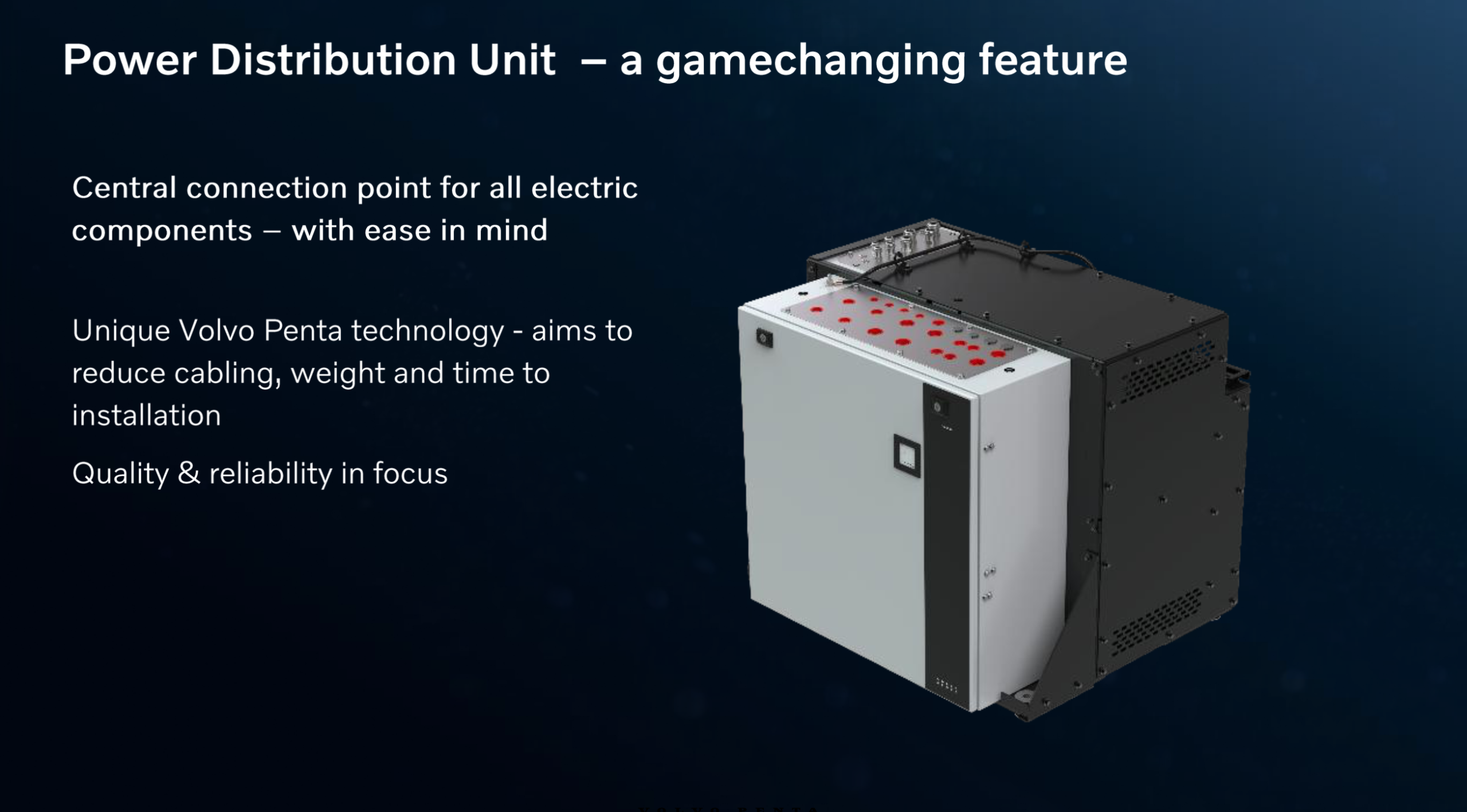
The central node of the electrical architecture is the Power Distribution Unit (PDU), which integrates:
- Inverters
- 24 V distribution with integrated fusing
- Battery chargers
- Onboard converters
- DC-DC converters
The PDU is designed to significantly reduce installation time and complexity. All cabling, including power cables, is engineered and manufactured by Volvo Penta on a vessel-specific basis, eliminating third-party supply chain risks and mismatch issues.
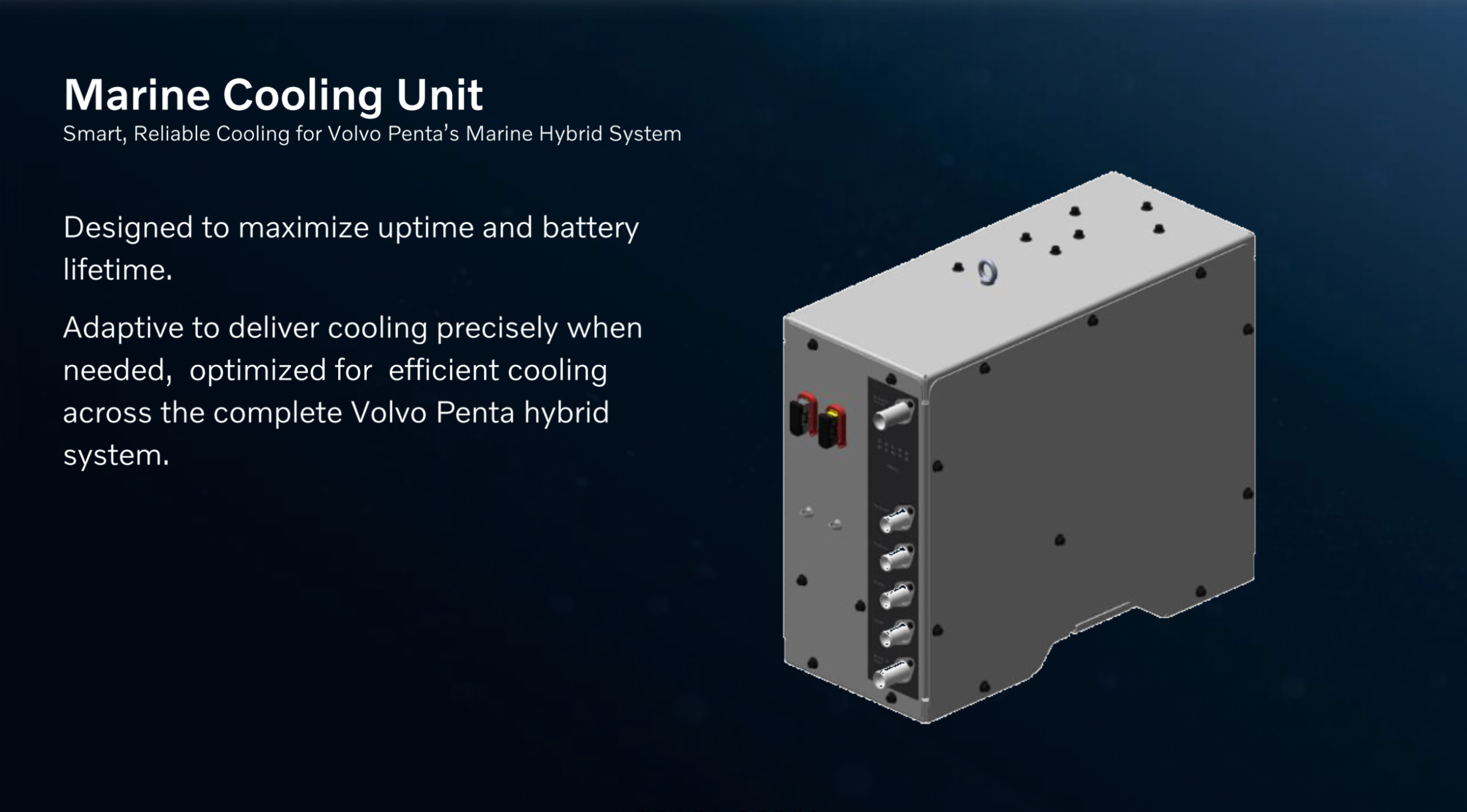
Thermal management is handled by a dedicated, actively controlled cooling system governing the electric motors, battery packs, inverters and power electronics. Regulation is fully automatic, sensor-based and integrated within the Electronic Vessel Control (EVC) system.
SEA TRIALS
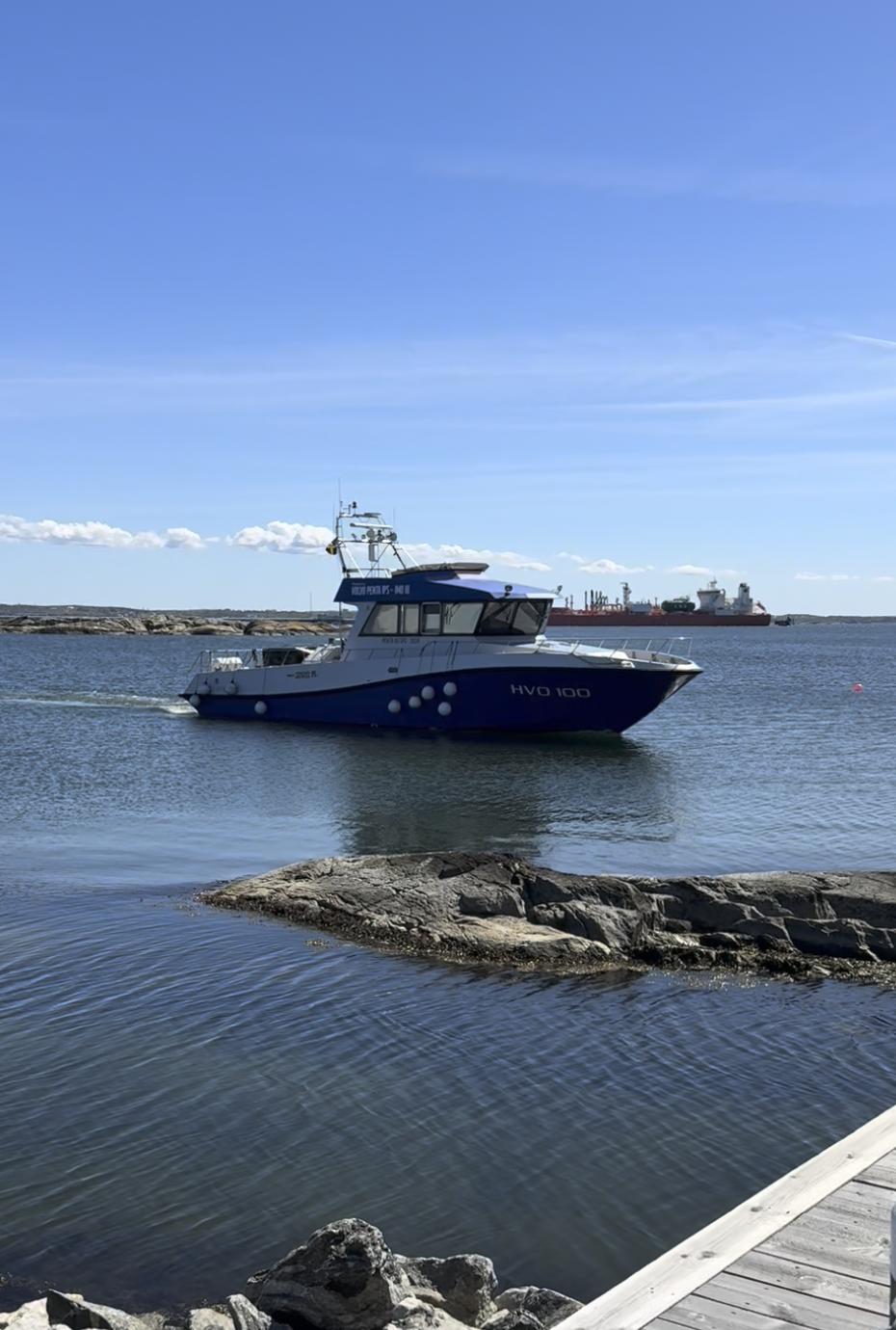
The IPS Hybrid system was installed on a 68-foot aluminium workboat, also used to validate joystick manoeuvrability. During the sea trials conducted in the waters off the Marine Test Centre at Krossholmen, the vessel and the IPS Hybrid system were put through a range of scenarios representative of real-world operational use. The sessions clearly demonstrated the benefits of hybridisation, particularly at low speed and during manoeuvring phases.
In Pure Electric mode, the vessel operated with markedly reduced noise and vibration levels, a feature of particular relevance in the following scenarios:
- Navigation in harbour areas or protected anchorages
- Approach to marinas and pontoons
- Professional operations near populated coastal areas
Transitions between Pure Electric, Hybrid and Diesel modes occur automatically and imperceptibly to the operator, managed by the integrated EVC control system. In Hybrid mode, the electric motor contribution optimises the combustion engine’s operating point, delivering measurable gains in overall system efficiency.
The trials also confirmed full compatibility of the system with Joystick Docking, Dynamic Positioning System (DPS) and vectored thrust manoeuvring capabilities.
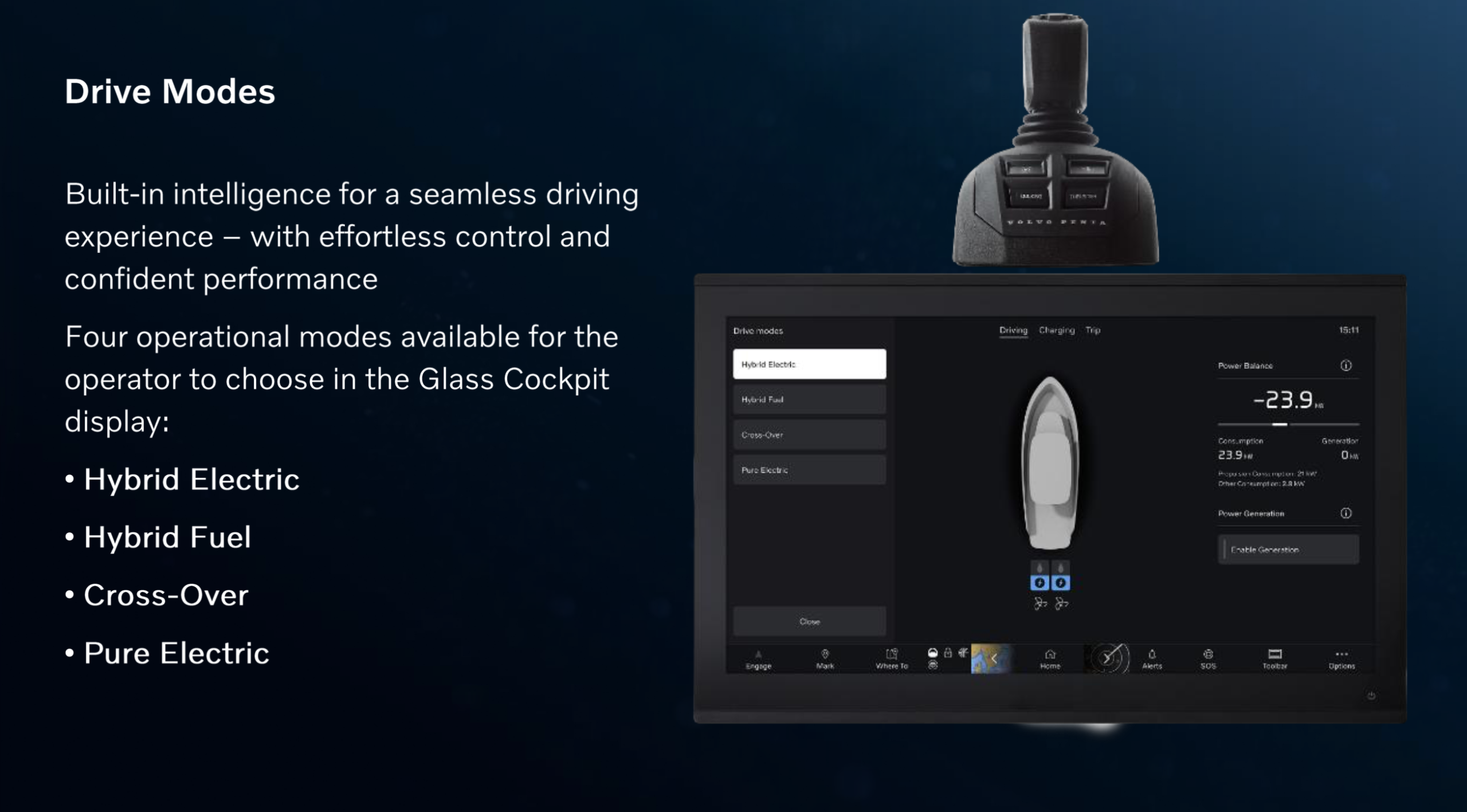
The IPS Hybrid system offers 5 operating modes, managed through the HMI:
- PURE ELECTRIC: exclusively electric propulsion. Ideal for harbour manoeuvres, environmentally sensitive areas and silent cruising.
- HYBRID ELECTRIC (DEFAULT): the electric motor operates up to approximately 10 knots (depending on vessel configuration); beyond this threshold the diesel engine engages and can simultaneously recharge the batteries in generator mode.
- HYBRID FUEL: diesel is the primary power source; the electric motor provides acceleration boost, reducing transient loads and overall fuel consumption.
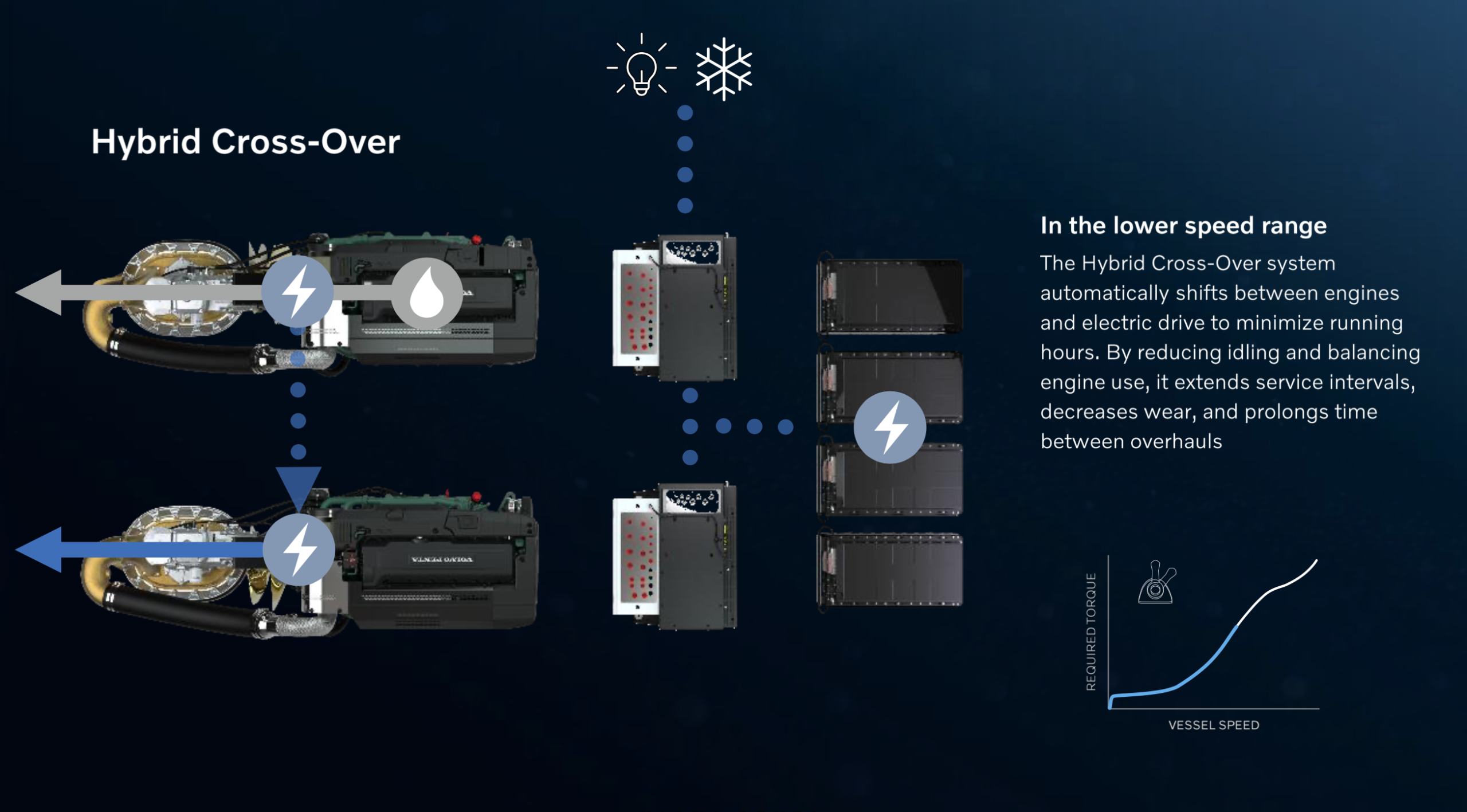
- HYBRID CROSSOVER: arguably the most operationally compelling profile. A single diesel engine provides propulsion while simultaneously generating electrical power to drive the opposite side. This mode delivers significant fuel savings and automatically balances engine hours across units.
- GENERATOR MODE: with transmissions in neutral, the diesel engines recharge the battery packs rapidly (approximately 40-45 minutes).
Mode transitions are automatic, seamless and fully integrated within the EVC control system.
ENGINEERING SUBSTANCE WITH A GREEN ETHOS
With the IPS Hybrid propulsion system, Volvo Penta is not simply launching a new product, it is setting a new integration standard. The hybrid becomes an instrument to enhance comfort, efficiency and operational control, while maintaining the reliability that has made IPS an industry benchmark.
Rather than a purely regulatory response, this is a mature engineering solution, designed to function within the real-world complexity of modern marine applications – and fully aligned with an energy transition that is now an unavoidable imperative for the entire industry.